 VIPSolutions
1. (50p) Consider the following LP. minz = 5x; + 8x, St x; +2x,2>8 x +x, 25 x 20,x,20 a) (10p) Draw the feasible region of the LP and identify all the basic feasible solutions on the graph. Does this LP have an optimal solution? b) (10p) By visually inspecting the graph, identify a direction of unboundedness. Then, numerically show that this direction satisfies all the conditions for a direction of unboundedness. Does it also satisfy the condition for LP be unbounded? ©) (30p) Apply TWO-PHASE SIMPLEX method.
Question:
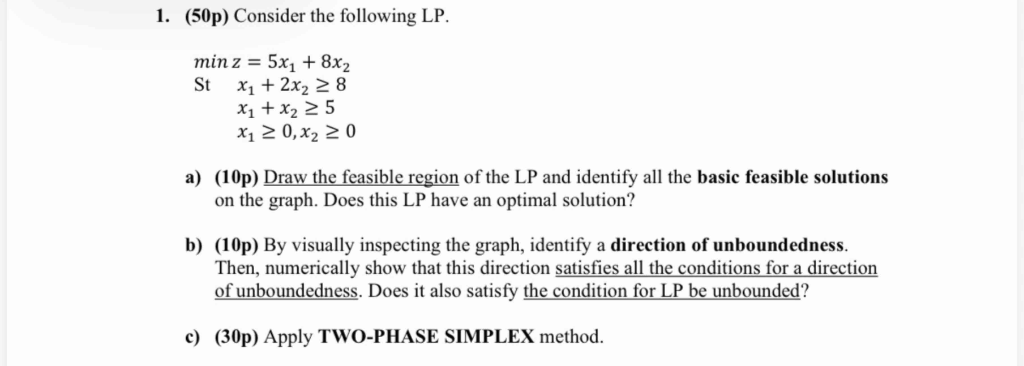 1. (50p) Consider the following LP.
minz = 5x; + 8x,
St x; +2x,2>8
x +x, 25
x 20,x,20
a) (10p) Draw the feasible region of the LP and identify all the basic feasible solutions
on the graph. Does this LP have an optimal solution?
b) (10p) By visually inspecting the graph, identify a direction of unboundedness.
Then, numerically show that this direction satisfies all the conditions for a direction
of unboundedness. Does it also satisfy the condition for LP be unbounded?
©) (30p) Apply TWO-PHASE SIMPLEX method.
1. (50p) Consider the following LP.
minz = 5x; + 8x,
St x; +2x,2>8
x +x, 25
x 20,x,20
a) (10p) Draw the feasible region of the LP and identify all the basic feasible solutions
on the graph. Does this LP have an optimal solution?
b) (10p) By visually inspecting the graph, identify a direction of unboundedness.
Then, numerically show that this direction satisfies all the conditions for a direction
of unboundedness. Does it also satisfy the condition for LP be unbounded?
©) (30p) Apply TWO-PHASE SIMPLEX method.
This is AI generated Response.
Asked by: Pradeep Rajora
Created at: 2025-10-20 01:08:57
Asked by: Pradeep Rajora
Created at: 2025-10-20 01:08:57
Final Answer:
Rendered
Raw Text
Did you like this answer?
# LP Problem and Solutions
## Given LP
Minimize \( z = 5x_1 8x_2 \)
to:
- \( x_1 + 2x_2 \geq 8 \)
- \( x_1 + x_2 \geq 5 \)
- \( x1 \geq \)
- \( x_2 \geq \)
---
## a) Draw the feasible region and identify basic feasible solutions
### Step 1: Rewrite constraints as equalities for boundary lines:
1. \( x_1 + 2x_2 = 8 \)
2. \( x_1 + x_2 = 5 \)
### Step 2: Plot the lines:
- Line 1: \( x_1 + 2x_2 = 8 \)
- Line 2: \( x_1 + x_2 = 5 \)
### Step 3: Determine the feasible region:
Since inequalities are \( \geq \), the feasible region is where the region is **above or on** the lines:
- \( x_1 + 2x_2 \geq 8 \)
- \( x_1 + x_2 \geq 5 \)
### Step 4: Find intersection points (vertices):
- Intersection of lines:
Solve:
\[
x_1 + 2x_2 = 8 \\
x_1 + x_2 = 5
\]
Subtract second from first:
\[
(x_1 + 2x_2) - (x_1 + x_2) = 8 - 5 \Rightarrow x_2 = 3
\]
Plug into \( x_1 + x_2 = 5 \):
\[
x_1 + 3 = 5 \Rightarrow x_1 = 2
\]
**Vertex 1:** \( (2, 3) \)
- Intersection of each line with axes:
Line 1: \( x_1 + 2x_2 = 8 \)
- \( x_2 = \Rightarrow x_1 = 8 \)
- \( x_1 = \Rightarrow 2x_2 = 8 \Rightarrow x_2=4 \)
Line 2: \( x_1 + x_2 = 5 \)
- \( x_2= \Rightarrow x_1=5 \)
- \( x_1= \Rightarrow x_2=5 \)
### Step 5: Identify the feasible vertices:
- **Vertex A:** \( (2, 3) \)
- **Vertex B:** Intersection of \( x_1 + 2x_2=8 \) with \( x_2= \): \( (8, ) \)
- **Vertex C:** Intersection of \( x_1 + x_2=5 \) with \( x_2= \): \( (5, ) \)
- **Vertex D:** Intersection of \( x_1 + 2x_2=8 \) with \( x_2=4 \): \( x_1 + 2(4)=8 \Rightarrow x_1= \), so \( (, 4) \)
### Step 6: Check which vertices satisfy the inequalities:
- \( (8,) \): \( x_1+2x_2=8+=8 \geq 8 \), OK; \( x_1 + x_2=8+=8 \geq 5 \), OK
- \( (5,) \): \( 5+=5 \geq 8? \) No. So NOT in feasible region.
- \( (,4) \): \( +8=8 \geq 8 \), OK; \( +4=4 \geq 5? \) No. So NOT in feasible region.
- \( (2,3) \): \( 2+6=8 \geq 8 \), OK; \( 2+3=5 \geq 5 \), OK
**Feasible vertices:**
- \( (2,3) \)
- \( (8,) \)
---
## b) Direction of Unboundedness
### Step 1: Plot the feasible region and observe:
- The feasible region is unbounded in the direction where \( x_1 \) and/or \( x_2 \) increase indefinitely, satisfying the constraints.
### Step 2: Find the direction vector:
- For LP with constraints \( \geq \), the region extends infinitely outward.
- The **direction of unboundedness** can be checked by examining the feasible region's boundary lines and the inequalities.
### Step 3: Verify the direction:
- Consider the vector \( d = (d_1, d_2) \) for which moving along \( d \) keeps us in the feasible region:
Check the constraints under movement:
\[
\text{For } x + \lambda d:
\]
- \( (x_1 + \lambda d_1) + 2(x_2 + \lambda d_2) \geq 8 \)
- \( (x_1 + \lambda d_1) + (x_2 + \lambda d_2) \geq 5 \)
which simplifies to:
\[
\text{Constraints on } d:
\]
\[
d_1 + 2d_2 \geq \\
d_1 + d_2 \geq
\]
### Step 4: Find a feasible direction:
Choose \( d \) such that:
\[
d_1 + 2d_2 \geq \\
d_1 + d_2 \geq
\]
For example, pick \( d_2=1 \):
- \( d_1 + 2(1) \geq \Rightarrow d_1 \geq -2 \)
- \( d_1 + 1 \geq \Rightarrow d_1 \geq -1 \)
Choose \( d_1 = \):
- Then, both inequalities are satisfied:
\[
+ 2(1)=2 \geq \\
+ 1=1 \geq
\]
**Thus, the direction vector**:
\[
d = (, 1)
\]
indicates the LP is **unbounded** in the direction of increasing \( x_2 \).
**Conclusion:** The LP is unbounded in the direction \( (, 1) \), which satisfies the constraints for all sufficiently large \( x_2 \).
---
## c) Applying the Two-Phase Simplex Method
### Phase 1:
- Convert inequalities to equalities by adding artificial variables.
### Step 1: Rewrite constraints with artificial variables:
Let \( s_1, s_2 \) be artificial variables:
\[
x_1 + 2x_2 - s_1 = 8 \\
x_1 + x_2 - s_2 = 5
\]
with \( s_1, s_2 \geq \).
### Step 2: Set up Phase 1 LP:
Minimize \( w = s_1 + s_2 \)
Subject to the above constraints and \( x_1, x_2, s_1, s_2 \geq \).
### Step 3: Find initial basic feasible solution:
- \( s_1=8, s_2=5 \), with \( x_1=x_2= \).
### Step 4: Optimize \( w \):
- Since \( s_1, s_2 \) are positive, the initial solution is feasible but not optimal.
- The goal is to find a basic feasible solution with \( s_1=s_2= \).
### Phase 2:
- Once \( s_1=s_2= \), the solution to the original LP can be obtained.
- Given the earlier analysis, the LP is unbounded, so Phase 2 will indicate unboundedness unless the artificial variables can be eliminated.
### **Summary:**
- The feasible region is unbounded in the direction of increasing \( x_2 \), with vertices at \( (2,3) \) and \( (8,) \).
- The LP's objective function decreases indefinitely along this unbounded direction, confirming the problem is unbounded.
---
**Note:** For detailed graphical plotting, a graph is recommended to visualize the feasible region and check the unboundedness visually.
📢 Instructions:
- Ask anything relatd to above question only.
- For new Question goto :