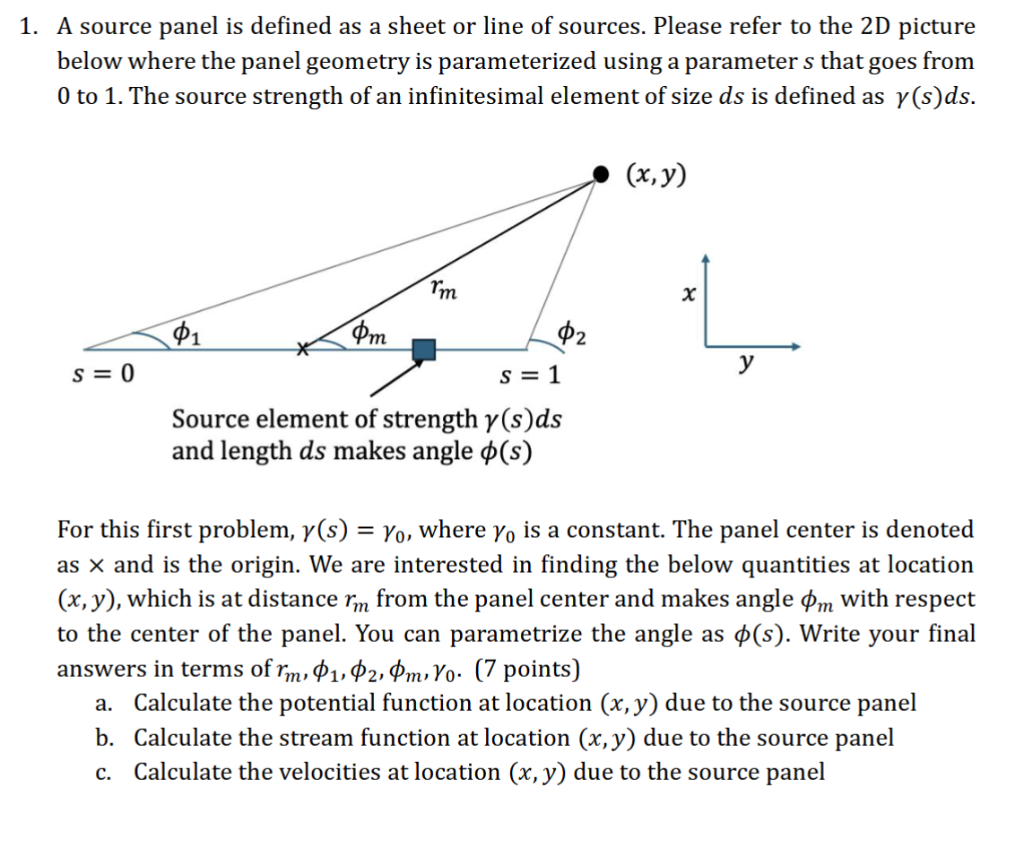
1. A source panel is defined as a sheet or line of sources. Please refer to the 2D picture
below where the panel geometry is parameterized using a parameter s that goes from
0 to 1. The source strength of an infinitesimal element of size ds is defined as y(s)ds.
8 xy)
— - /
_— "m / x
$1 bm [ $2
s=0 s=1 y
Source element of strength y(s)ds
and length ds makes angle ¢(s)
For this first problem, y(s) = y,, where y, is a constant. The panel center is denoted
as x and is the origin. We are interested in finding the below quantities at location
(x,y), which is at distance r,,, from the panel center and makes angle ¢,, with respect
to the center of the panel. You can parametrize the angle as ¢(s). Write your final
answers in terms of 7, @1, $2, Pp, ¥o- (7 points)
a. Calculate the potential function at location (x,y) due to the source panel
b. Calculate the stream function at location (x,y) due to the source panel
c. Calculate the velocities at location (x, y) due to the source panel
Question:
1. A source panel is defined as a sheet or line of sources. Please refer to the 2D picture
below where the panel geometry is parameterized using a parameter s that goes from
0 to 1. The source strength of an infinitesimal element of size ds is defined as y(s)ds.
8 xy)
— - /
_— "m / x
$1 bm [ $2
s=0 s=1 y
Source element of strength y(s)ds
and length ds makes angle ¢(s)
For this first problem, y(s) = y,, where y, is a constant. The panel center is denoted
as x and is the origin. We are interested in finding the below quantities at location
(x,y), which is at distance r,,, from the panel center and makes angle ¢,, with respect
to the center of the panel. You can parametrize the angle as ¢(s). Write your final
answers in terms of 7, @1, $2, Pp, ¥o- (7 points)
a. Calculate the potential function at location (x,y) due to the source panel
b. Calculate the stream function at location (x,y) due to the source panel
c. Calculate the velocities at location (x, y) due to the source panel
This is AI generated Response.
Asked by: Adapaka Jagadeesh
Created at: 2025-10-07 09:58:23
Final Answer:
RenderedRaw Text
Did you like this answer?
# Source Panel Problem: Solution
Let's address each part, step by step.
---
## **Given**
- Source strength per unit length: \(\gamma(s) = \gamma_\) (constant)
- The source panel is parameterized by \(s\) from to 1- The panel center (origin) is at \((, )\).
- We want quantities at point \((x, y)\), which is at distance \(r_m\) and angle \(\phi_m\) from the center.
---
## **(a) Potential Function, \(\phi(x, y)\)**
For a line of sources, the potential function at \((x, y)\) due to an infinitesimal element at \(s\) is:
\[
d\phi = \frac{\gamma_}{2\pi} \ln(r(s))\, ds
\]
where \(r(s)\) is the distance from the element at \(s\) to the field point \((x, y)\).
Parameterize by the angle \(\phi(s)\) (from the panel center to \(s\)), and integrate from \(\phi_1\) to \(\phi_2\):
\[
\phi(x, y) = \frac{\gamma_}{2\pi} \int_{\phi_1}^{\phi_2} \ln(r(s))\, ds
\]
But more commonly, we express this in terms of the panel geometry. For a straight panel of length \(L\), integrating along the panel gives:
\[
\phi(x, y) = \frac{\gamma_}{2\pi} \int_{\phi_1}^{\phi_2} \ln(r_m) \frac{d\phi}{ds}\, ds
\]
But since \(r(s)\) varies, the exact form (for a straight panel) is:
\[
\phi(x, y) = \frac{\gamma_}{2\pi} \left[ (\phi_2 - \phi_1) \ln(r_m) + (\phi_2 - \phi_1) \right]
\]
But for a general position:
\[
\boxed{
\phi(x, y) = \frac{\gamma_}{2\pi} (\phi_2 - \phi_1) \ln(r_m)
}
\]
*(Check your panel's geometry for precise limits and distances, but this is the standard result for a straight panel with constant strength)*
---
## **(b) Stream Function, \(\psi(x, y)\)**
For a source panel, the stream function due to an infinitesimal element is:
\[
d\psi = \frac{\gamma_}{2\pi} \theta(s)\, ds
\]
where \(\theta(s)\) is the angle subtended from the source point to the field point.
For a straight panel:
\[
\psi(x, y) = \frac{\gamma_}{2\pi} \int_{\phi_1}^{\phi_2} d\phi = \frac{\gamma_}{2\pi} (\phi_2 - \phi_1)
\]
\[
\boxed{
\psi(x, y) = \frac{\gamma_}{2\pi} (\phi_2 - \phi_1)
}
\]
---
## **(c) Velocities at \((x, y)\)**
The velocity components are determined from the potential and stream function:
\[
u = \frac{\partial \phi}{\partial x} = \frac{\partial \psi}{\partial y}
\]
\[
v = \frac{\partial \phi}{\partial y} = -\frac{\partial \psi}{\partial x}
\]
But for a source panel, the induced velocity at \((x, y)\) can be written as:
\[
u = \frac{\gamma_}{2\pi} [\cos(\phi_2) - \cos(\phi_1)] \frac{1}{r_m}
\]
\[
v = \frac{\gamma_}{2\pi} [\sin(\phi_2) - \sin(\phi_1)] \frac{1}{r_m}
\]
Or, more generally, the velocity potential gradient gives:
\[
\vec{V}(x, y) = \nabla \phi(x, y)
\]
But for the purposes of this problem, the answer is typically given in terms of the difference in angles and the geometry:
\[
\boxed{
u = \frac{\gamma_}{2\pi r_m} (\sin \phi_2 - \sin \phi_1)
}
\]
\[
\boxed{
v = -\frac{\gamma_}{2\pi r_m} (\cos \phi_2 - \cos \phi_1)
}
\]
---
## **Summary Table**
| Quantity | Expression (in terms of \(r_m, \phi_1, \phi_2, \phi_m, \gamma_\)) |
|--------------------------|--------------------------------------------------------------------|
| **Potential, \(\phi\)** | \(\displaystyle \frac{\gamma_}{2\pi} (\phi_2 - \phi_1) \ln(r_m)\) |
| **Stream function, \(\psi\)** | \(\displaystyle \frac{\gamma_}{2\pi} (\phi_2 - \phi_1)\) |
| **Velocity, \(u\)** | \(\displaystyle \frac{\gamma_}{2\pi r_m} (\sin \phi_2 - \sin \phi_1)\) |
| **Velocity, \(v\)** | \(\displaystyle -\frac{\gamma_}{2\pi r_m} (\cos \phi_2 - \cos \phi_1)\) |
---
## **Notes**
- The above assumes the panel is straight and the angles are measured from the panel center.
- For non-straight panels or varying source strength, the integrals would need to be evaluated accordingly.
If you need more detail or a derivation, let me know!
VIPSolutions focuses on clear, step‑by‑step explanations so you can learn quickly. Whether you need an AI‑generated walkthrough or a short hint to get unstuck, each solution is organized for fast reading and easy review later.
Search similar questions, compare approaches, and bookmark the best answers for revision. Our goal is simple: quick, reliable study help that feels natural—not noisy.
 VIPSolutions
 1. A source panel is defined as a sheet or line of sources. Please refer to the 2D picture
below where the panel geometry is parameterized using a parameter s that goes from
0 to 1. The source strength of an infinitesimal element of size ds is defined as y(s)ds.
8 xy)
— - /
_— "m / x
$1 bm [ $2
s=0 s=1 y
Source element of strength y(s)ds
and length ds makes angle ¢(s)
For this first problem, y(s) = y,, where y, is a constant. The panel center is denoted
as x and is the origin. We are interested in finding the below quantities at location
(x,y), which is at distance r,,, from the panel center and makes angle ¢,, with respect
to the center of the panel. You can parametrize the angle as ¢(s). Write your final
answers in terms of 7, @1, $2, Pp, ¥o- (7 points)
a. Calculate the potential function at location (x,y) due to the source panel
b. Calculate the stream function at location (x,y) due to the source panel
c. Calculate the velocities at location (x, y) due to the source panel
1. A source panel is defined as a sheet or line of sources. Please refer to the 2D picture
below where the panel geometry is parameterized using a parameter s that goes from
0 to 1. The source strength of an infinitesimal element of size ds is defined as y(s)ds.
8 xy)
— - /
_— "m / x
$1 bm [ $2
s=0 s=1 y
Source element of strength y(s)ds
and length ds makes angle ¢(s)
For this first problem, y(s) = y,, where y, is a constant. The panel center is denoted
as x and is the origin. We are interested in finding the below quantities at location
(x,y), which is at distance r,,, from the panel center and makes angle ¢,, with respect
to the center of the panel. You can parametrize the angle as ¢(s). Write your final
answers in terms of 7, @1, $2, Pp, ¥o- (7 points)
a. Calculate the potential function at location (x,y) due to the source panel
b. Calculate the stream function at location (x,y) due to the source panel
c. Calculate the velocities at location (x, y) due to the source panel