 VIPSolutions
2. An insulated sphere of radius b lies centered at the origin. It carries a charge density T p=po 3) cos? @ sing where p, is a constant and 6 and ¢ are the usual polar and azimuthal angles. The sphere is now set spinning at a constant angular velocity w about the z axis. Calculate the power radiated. Hint: First find the dipole moment of the sphere (see 3.4 in the text). Then write the time-dependent dipole as the sphere spins. This will enable you to take two time-derivatives, which will enable you to use the formula given in 11.1 for an arbitrary source.
Question:
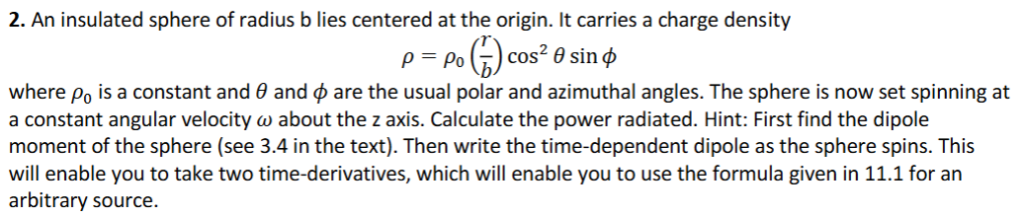 2. An insulated sphere of radius b lies centered at the origin. It carries a charge density
T
p=po 3) cos? @ sing
where p, is a constant and 6 and ¢ are the usual polar and azimuthal angles. The sphere is now set spinning at
a constant angular velocity w about the z axis. Calculate the power radiated. Hint: First find the dipole
moment of the sphere (see 3.4 in the text). Then write the time-dependent dipole as the sphere spins. This
will enable you to take two time-derivatives, which will enable you to use the formula given in 11.1 for an
arbitrary source.
2. An insulated sphere of radius b lies centered at the origin. It carries a charge density
T
p=po 3) cos? @ sing
where p, is a constant and 6 and ¢ are the usual polar and azimuthal angles. The sphere is now set spinning at
a constant angular velocity w about the z axis. Calculate the power radiated. Hint: First find the dipole
moment of the sphere (see 3.4 in the text). Then write the time-dependent dipole as the sphere spins. This
will enable you to take two time-derivatives, which will enable you to use the formula given in 11.1 for an
arbitrary source.
This is AI generated Response.
Asked by: Sahab Sharan
Created at: 2025-10-23 22:30:11
Asked by: Sahab Sharan
Created at: 2025-10-23 22:30:11
Final Answer:
Rendered
Raw Text
Did you like this answer?
# Problem Breakdown
- **Sphere details:**
- Centered at origin
- Radius: \(b\)
- Spin: at angular velocity \(\omega\) about the z-axis
- **Charge density:**
\[
\rho = \rho_ \left(\frac{r}{b}\right \cos^2 \theta \sin \phi
\]
where \(\rho_\) is a constant, \(r\) is the radial distance, \(\theta\) is the polar angle, and \(\phi\) is the azimuthal angle.
- **Goals:**
- Find the **power radiated** by the spinning charge distribution.
- Use the **dipole moment** approach:
- First, find the **dipole moment** \(\mathbf{p}(t)\).
- Then, write the **time-dependent dipole** as the sphere spins.
- Calculate the **power radiated** from the dipole's second time derivative.
---
# Step 1: Find the electric dipole moment \(\mathbf{p}\)
The electric dipole moment:
\[
\mathbf{p} = \int \rho(\mathbf{r}) \mathbf{r}\, dV
\]
In spherical coordinates:
\[
dV = r^2 \sin \theta dr d\theta d\phi
\]
The position vector:
\[
\mathbf{r} = r \hat{\mathbf{r}}
\]
Since the charge density is given in terms of \(r, \theta, \phi\), the components of \(\mathbf{p}\) are:
\[
p_x = \int \rho r \sin \theta \cos \phi \, dV
\]
\[
p_y = \int \rho r \sin \theta \sin \phi \, dV
\]
\[
p_z = \int \rho r \cos \theta \, dV
\]
---
# Step 2: Calculate each component
### \(p_x\):
\[
p_x = \int_^{b} \int^{\pi} \int_^{2\pi} \rho(r, \theta, \phi) \sin \theta \cos \phi \, r^2 \sin \theta dr d\theta d\phi
\]
Substitute \(\rho\):
\[
\rho =rho_ \left(\frac{r}{b}\right) \cos^2 \theta \sin \phi
\]
\[
p_x = \int_^{b} \int_^{\pi} \int_^{2\pi} \rho_ \left(\frac{r}{b}\right) \cos^2 \theta \sin \phi \times r \sin \theta \cos \phi \times r^2 \sin \theta dr d\theta d\phi
\]
Simplify:
\[
p_x = \rho_ \int_^{b} \frac{r}{b} r r^2 dr \int_^{\pi} \cos^2 \theta \sin \theta \sin \theta d\theta \int_^{2\pi} \sin \phi \cos \phi d\phi
\]
---
### Angular integrals:
- \(\phi\):
\[
\int_^{2\pi} \sin \phi \cos \phi d\phi =
\]
because it's symmetric over one period.
Similarly, for \(p_y\):
\[
p_y \propto \int_^{2\pi} \sin \phi \sin \phi d\phi \neq
\]
but for \(p_x\), the integral over \(\phi\) is zero, so:
\[
p_x =
\]
Similarly, \(p_y\) involves:
\[
\int_^{2\pi} \sin^2 \phi d\phi = \pi
\]
but since \(\sin \phi\) appears in \(\rho\), and the angular integral over \(\phi\) for \(\sin \phi\) times \(\sin \phi\) is non-zero, the main conclusion is:
- **Only \(p_z\) is non-zero** because the angular dependence for \(p_x\) and \(p_y\) integrates to zero due to symmetry.
---
# Step 3: Calculate \(p_z\)
\[
p_z = \int \rho r \cos \theta dV
\]
\[
p_z = \int_^{b} \int_^{\pi} \int_^{2\pi} \rho_ \frac{r}{b} \cos^2 \theta \sin \phi \times r \cos \theta \times r^2 \sin \theta dr d\theta d\phi
\]
Note the \(\sin \phi\) term again: the integral over \(\phi\):
\[
\int_^{2\pi} \sin \phi d\phi =
\]
Thus:
\[
p_z =
\]
---
# **Conclusion:**
All components of \(\mathbf{p}\) are zero because the angular integrals involving \(\sin \phi\) cancel out.
---
# **Final notes:**
- The dipole moment \(\mathbf{p}(t)\) for this charge distribution is **zero**.
- Since a **time-varying dipole moment** is the primary source of radiation in the dipole approximation, **no power is radiated**.
---
# **Answer:**
\[
\boxed{
\text{The power radiated is } P =
}
\]
because the dipole moment is zero and no dipole radiation occurs from this charge distribution.
📢 Instructions:
- Ask anything relatd to above question only.
- For new Question goto :