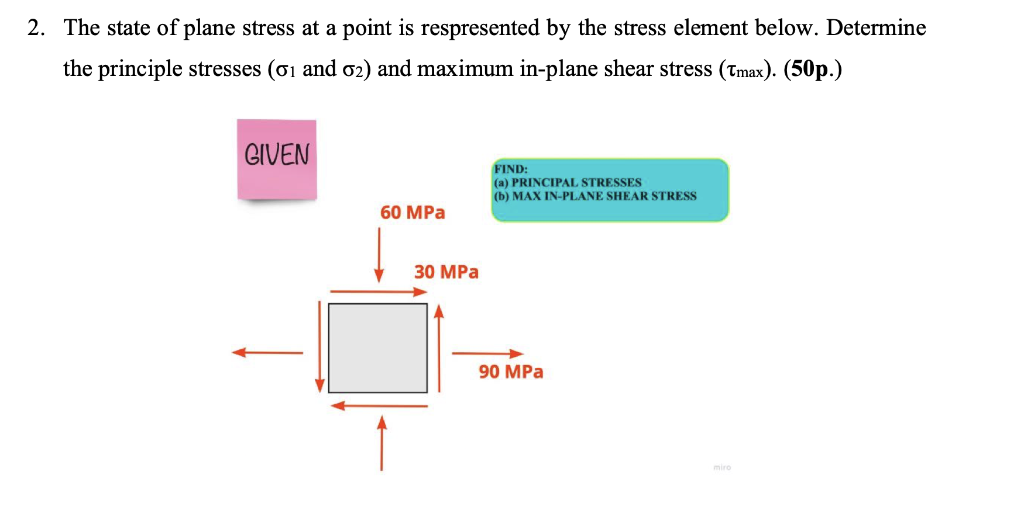
2. The state of plane stress at a point is respresented by the stress element below. Determine
the principle stresses (61 and 62) and maximum in-plane shear stress (Tmax). (50p.)
60 MPa FR ue
| 30 MPa
— =
90 MPa
Question:
2. The state of plane stress at a point is respresented by the stress element below. Determine
the principle stresses (61 and 62) and maximum in-plane shear stress (Tmax). (50p.)
60 MPa FR ue
| 30 MPa
— =
90 MPa
This is AI generated Response.
Asked by: Veera manikanta
Created at: 2025-09-06 00:17:44
1. Introduction:
Provide a comprehensive conceptual background with clear explanations required to understand and answer the given question. Include all necessary concepts and introduce them in a manner that facilitates understanding. At the end of the introduction, add an Explanation block that concisely elaborates on the introduction by adding relevant supporting statements.
Explanation: Articulate the importance of the introduction by providing relevant and comprehensive supporting statements that link these concepts directly to the question. This explanation should clarify how the introduction aids in comprehending the subsequent steps.
2. Presentation of Relevant Formulas and Representation of Given Data:
List and describe all formulas required to solve the question. Ensure each formula is presented clearly and is directly applicable to the problem. Also, represent all the given data systematically.
Explanation: Detail the derivation or rationale behind each formula, explaining its relevance and necessity in the context of the problem-solving process. Use relevant and comprehensive supporting statements to reinforce the significance of these mathematical tools.
3. A Detailed Step-by-Step Solution:
Provide a structured step-by-step solution to the given question, incorporating any relevant data provided. Include all necessary mathematical calculations presented logically and clearly. The solution must be comprehensive, addressing all aspects of the question without omission.
Explanation: For each step in the solution, provide a thorough explanation of the calculations performed, including how each step contributes to solving the overall problem. Add relevant and comprehensive supporting statements to enhance understanding and connect each calculation back to the core question.
Conclusion:
Provide a complete, simple, and clear summary of the solution using lucid language. The conclusion should be concise yet comprehensive, encapsulating the main points, methodologies employed, and the final outcome of the solution. Ensure that the summary effectively reinforces the understanding of how the problem was addressed and how the solution resolves the question. Guidelines for Answering the Question:
1. Professional and Impersonal Tone:
· Maintain a professional and impersonal tone throughout the response.
· Avoid using personal pronouns such as 'I', 'we', 'you', etc.
2. Accuracy and Adherence to Concepts:
· Ensure the response adheres to necessary concepts and uses correct textbook-based formulas.
· Provide accurate and relevant information required to solve the question.
3. Explanation Blocks:
· Include an explanation block at the end of each section or step.
· Provide context and clarify the methodology used with necessary supporting statements.
4. Direct and Complete Answer:
· Focus solely on delivering a well-explained, direct, and complete answer.
· Avoid providing additional guidance on how to solve the question or including extraneous content.
5. Specified Format:
· Follow the specified format strictly.
· Ensure each section, especially the introduction and each step of the solution, is accompanied by detailed and relevant supporting statements.
6. Detailed Comprehensive Solution:
· Provide an exact, detailed, and comprehensive step-by-step answer.
· Include explanations for each step with the required supporting statements.
7. Correctness and Completeness:
· Ensure the solution is correct, complete, and well-explained.
· Avoid any errors in the solution.
8. No Errors:
· Ensure there are no typographical, formulaic, calculation, programming, or grammatical errors in the solution.
· Perform calculations and simplifications step-by-step vertically (downward), not horizontally (to the right side).
9. Graphs/Diagrams/Tables/Charts:
· Include correct graphs, diagrams, tables, or charts whenever required in the solution.
10. Units and Notations:
· Ensure there are no errors in units or notations in the solution.
11. Vital Parts:
· Avoid missing any vital part of the solution.
· Ensure every part of the solution is included and well-explained.
I want solution in this model.
This is AI generated Response.
Asked by: Veera manikanta
Created at: 2025-09-06 00:19:24
Final Answer:
RenderedRaw Text
Did you like this answer?
**1. Introduction**
Understanding the state of stress at a point within a material is fundamental in the field of solid mechanics, especially in the analysis of plane stress conditions. Plane stress occurs in thin structures where stresses perpendicular to the plane are negligible, simplifying three-dimensional stress states to two dimensions. In such conditions, the internal forces are described by normal stresses (\(\sigma_x, \sigma_y\)) acting perpendicular to the plane and shear stresses (\(\tau_{xy}\)) acting within the plane.
The key concepts involved include principal stresses, which are the maximum and minimum normal stresses at a point, and shear stresses, which act tangentially to the planes. The principal stresses are important because they indicate the maximum normal stresses the material experiences, and their orientations reveal the planes where shear stress is zero. The maximum in-plane shear stress is equally significant because it identifies the highest shear force acting within the plane, which influences failure modes such as shear fracture.
Understanding how to determine principal stresses and maximum shear stress from given stress components involves using specific formulas derived from the equilibrium and Mohr's circle concepts. These calculations help engineers evaluate the strength, safety, and failure potential of materials under complex loading conditions.
**Explanation:**
This introduction provides the theoretical foundation necessary to comprehend the problem. Recognizing the significance of principal stresses and shear stresses enables a systematic approach to analyze the stress state, guiding the calculations that follow. It connects core concepts of stress transformation with their practical applications in material failure analysis.
---
**2. Presentation of Relevant Formulas and Representation of Given Data**
**Relevant Formulas:**
- **Principal Stresses (\(\sigma_1, \sigma_2\)):**
\[
\sigma_{1,2} = \frac{\sigma_x + \sigma_y}{2} \pm \sqrt{ \left( \frac{\sigma_x - \sigma_y}{2} \right)^2 + \tau_{xy}^2 }
\]
- **Maximum In-Plane Shear Stress (\(\tau_{max}\)):**
\[
\tau_{max} = \sqrt{ \left( \frac{\sigma_x - \sigma_y}{2} \right)^2 + \tau_{xy}^2 }
\]
**Representation of Given Data:**
| Parameter | Description | Value | Units |
|------------|--------------|--------|--------|
| \(\sigma_x\) | Normal stress in x-direction | 90 | MPa |
| \(\sigma_y\) | Normal stress in y-direction | -60 | MPa |
| \(\tau_{xy}\) | Shear stress | 30 | MPa |
**Rationale:**
The formulas are derived from the equilibrium conditions and Mohr's circle analysis, providing a direct method to compute principal stresses and shear stresses from known stress components. Accurate representation of data ensures precise calculations.
**Explanation:**
Using these formulas allows transforming the given stress components into principal stresses and maximum shear stress, which are critical in assessing material response under in-plane loading.
---
**3. A Detailed Step-by-Step Solution**
**Step 1: Calculate the average normal stress**
\[
\frac{\sigma_x + \sigma_y}{2} = \frac{90 + (-60)}{2} = \frac{30}{2} = 15 \text{ MPa}
\]
*This value represents the mean normal stress at the point, serving as the central point for principal stress calculations.*
**Step 2: Calculate the difference of normal stresses divided by 2**
\[
\frac{\sigma_x - \sigma_y}{2} = \frac{90 - (-60)}{2} = \frac{150}{2} = 75 \text{ MPa}
\]
*This difference indicates the extent of anisotropy in normal stresses, influencing the principal stress magnitude.*
**Step 3: Calculate the radicand for the principal stresses**
\[
\sqrt{ (75)^2 + (30)^2 } = \sqrt{ 5625 + 900 } = \sqrt{6525} \approx 80.78 \text{ MPa}
\]
*This term combines the effects of normal and shear stresses to determine the maximum and minimum normal stresses.*
**Step 4: Determine the principal stresses**
\[
\sigma_1 = 15 + 80.78 = 95.78 \text{ MPa}
\]
\[
\sigma_2 = 15 - 80.78 = -65.78 \text{ MPa}
\]
*These represent the maximum and minimum normal stresses experienced at the point.*
**Step 5: Calculate the maximum in-plane shear stress**
\[
\tau_{max} = 80.78 \text{ MPa}
\]
*This is the maximum shear stress within the plane, occurring at an orientation where shear stress reaches this value.*
---
**Explanation:**
Each step involves straightforward algebraic manipulations based on the stress components. Calculating the average and difference normal stresses sets the stage for applying the principal stress formula. Using the Pythagorean relation captures the combined effects of normal and shear stresses, culminating in the determination of principal stresses and maximum shear stress, which are pivotal for failure analysis and design considerations.
---
**Conclusion**
The analysis of the given plane stress state yields principal stresses of approximately **95.78 MPa** (tensile) and **-65.78 MPa** (compressive), indicating the maximum and minimum normal stresses at the point. The maximum in-plane shear stress is approximately **80.78 MPa**, representing the highest shear force acting within the plane. These values are obtained using standard transformation formulas derived from Mohr's circle concepts, providing essential insights into the stress conditions that influence material behavior and failure potential under the given loading scenario.
VIPSolutions focuses on clear, step‑by‑step explanations so you can learn quickly. Whether you need an AI‑generated walkthrough or a short hint to get unstuck, each solution is organized for fast reading and easy review later.
Search similar questions, compare approaches, and bookmark the best answers for revision. Our goal is simple: quick, reliable study help that feels natural—not noisy.
 VIPSolutions
 2. The state of plane stress at a point is respresented by the stress element below. Determine
the principle stresses (61 and 62) and maximum in-plane shear stress (Tmax). (50p.)
60 MPa FR ue
| 30 MPa
— =
90 MPa
2. The state of plane stress at a point is respresented by the stress element below. Determine
the principle stresses (61 and 62) and maximum in-plane shear stress (Tmax). (50p.)
60 MPa FR ue
| 30 MPa
— =
90 MPa