 VIPSolutions
3.10 Consider the partially filled parallel plate waveguide shown in the accompanying figure. Derive the solution (fields and cutoff frequency) for the lowest order TE mode of this structure. Assume the metal plates are infinitely wide. Can a TEM wave propagate on this structure? J, ] ° Be © —— —_—— ~~ x
Question:
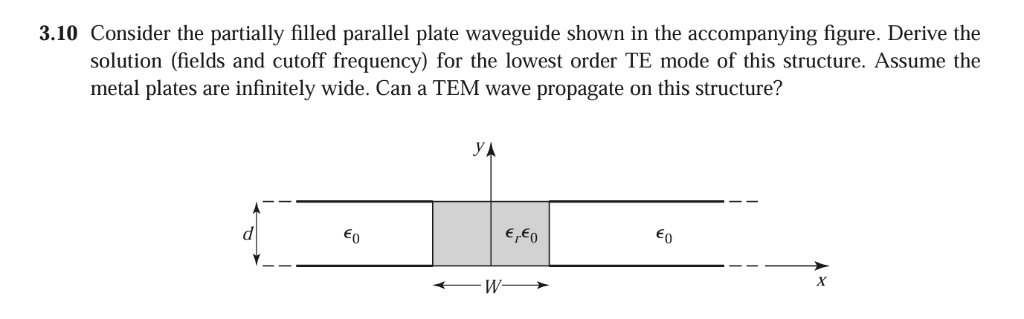 3.10 Consider the partially filled parallel plate waveguide shown in the accompanying figure. Derive the
solution (fields and cutoff frequency) for the lowest order TE mode of this structure. Assume the
metal plates are infinitely wide. Can a TEM wave propagate on this structure?
J,
] ° Be ©
—— —_——
~~ x
3.10 Consider the partially filled parallel plate waveguide shown in the accompanying figure. Derive the
solution (fields and cutoff frequency) for the lowest order TE mode of this structure. Assume the
metal plates are infinitely wide. Can a TEM wave propagate on this structure?
J,
] ° Be ©
—— —_——
~~ x
This is AI generated Response.
Asked by: Adapaka Jagadeesh
Created at: 2025-10-16 23:18:16
Asked by: Adapaka Jagadeesh
Created at: 2025-10-16 23:18:16
Final Answer:
Rendered
Raw Text
Did you like this answer?
# Solution to Problem 3.10: Partially Filled Parallel Plate Waveguide
Let's analyze the partially filled parallel plate waveguide as shown in the figure.
---
## **Step 1: Structure Description**
- **Plate separation:** \( d \)
- **Width of dielectric slab:** \( W \)
- **Relative permittivity in slab:** \( \epsilon_r \)
- **Permittivity elsewhere:** \( \epsilon_ \)
The dielectric slab of width \( W \) and permittivity \( \epsilon_r \epsilon_ \) is sandwiched symmetrically between two regions of air (\( \epsilon_ \)).
---
## **Step 2: TE Mode Fields**
For the **TE mode** (Transverse Electric), \( E_z = \), and the nonzero field component is \( H_z \).
Let the propagation be along the \( x \)-direction, and the plates are at \( y = \) and \( y = d \).
Assume \( H_z(x, y, t) = H_z(x, y)e^{j\omega t} \).
We solve for the **lowest order (TE\(_1\))** mode.
---
### **Wave Equation for \( H_z \)**
The general wave equation for \( H_z \) is:
\[
\left( \frac{\partial^2}{\partial y^2} + \frac{\partial^2}{\partial x^2} + k^2 \right) H_z(x, y) =
\]
where \( k^2 = \omega^2 \mu_ \epsilon \) (depends on region).
Assume propagation: \( H_z(x, y) = \psi(x) \sin\left(\frac{\pi y}{d}\right) \) (lowest order TE mode).
---
### **Separation of Regions**
- **Region 1:** \( x < -W/2 \), \( \epsilon = \epsilon_ \)
- **Region 2:** \( |x| < W/2 \), \( \epsilon = \epsilon_r \epsilon_ \)
- **Region 3:** \( x > W/2 \), \( \epsilon = \epsilon_ \)
---
### **Field Solutions**
#### **General Form**
For each region, the equation for \( \psi(x) \) is:
\[
\frac{d^2 \psi}{dx^2} + (k^2 - (\pi/d)^2) \psi = \beta^2 \psi
\]
where \( \beta \) is the propagation constant.
Define:
- \( k_^2 = \omega^2 \mu_ \epsilon_ \)
- \( k_2^2 = \omega^2 \mu_ \epsilon_r \epsilon_ \)
Let \( \gamma_1^2 = (\pi/d)^2 - k_^2 + \beta^2 \) in Region 1 and 3
Let \( \gamma_2^2 = (\pi/d)^2 - k_2^2 + \beta^2 \) in Region 2
But for propagating modes, \( \beta^2 < (\pi/d)^2 \), so usually \( \gamma \) is real (evanescent in x).
So,
- **Region 1/3 (air):**
\[
\psi_1(x) = A e^{\alpha(x+W/2)} \quad (x < -W/2)
\]
\[
\psi_3(x) = B e^{-\alpha(x-W/2)} \quad (x > W/2)
\]
where \( \alpha = \sqrt{\left(\frac{\pi}{d}\right)^2 - k_^2 + \beta^2} \)
- **Region 2 (dielectric):**
\[
\psi_2(x) = C \cos(q x) + D \sin(q x) \quad (|x| < W/2)
\]
where \( q = \sqrt{k_2^2 - \left(\frac{\pi}{d}\right)^2 - \beta^2} \)
---
### **Boundary Conditions**
At \( x = \pm W/2 \):
- Continuity of \( H_z \)
- Continuity of \( \frac{1}{\epsilon} \frac{\partial H_z}{\partial x} \)
Assume **even symmetry** (lowest mode), so \( D = \):
\[
\psi_2(x) = C \cos(q x)
\]
At \( x = W/2 \):
\[
\begin{align*}
\psi_2(W/2) &= \psi_3(W/2) \\
C \cos(q W/2) &= B\\
\end{align*}
\]
\[
\frac{1}{\epsilon_r \epsilon_} \left. \frac{d\psi_2}{dx} \right|_{x=W/2} = \frac{1}{\epsilon_} \left. \frac{d\psi_3}{dx} \right|_{x=W/2}
\]
\[
-\frac{q}{\epsilon_r \epsilon_} C \sin(q W/2) = -\frac{\alpha}{\epsilon_} B
\]
Substitute \( B = C \cos(q W/2) \):
\[
-\frac{q}{\epsilon_r} \sin(q W/2) = -\alpha \cos(q W/2)
\]
\[
\frac{q}{\epsilon_r \alpha} \tan(q W/2) = 1
\]
---
## **Step 3: Cutoff Frequency**
At **cutoff**, \( \beta = \):
- \( \alpha = \sqrt{(\pi/d)^2 - k_^2} \)
- \( q = \sqrt{k_2^2 - (\pi/d)^2} \)
Plug into the transcendental equation:
\[
\frac{q}{\epsilon_r \alpha} \tan(q W/2) = 1
\]
**Solve this equation for the cutoff frequency \( f_c \).**
---
## **Step 4: TEM Wave Possibility**
A **TEM mode** requires both electric and magnetic fields to be entirely transverse, meaning there can be no longitudinal (in \( x \), the direction of propagation) electric or magnetic field. For a parallel plate waveguide **with a single dielectric interface**, TEM is possible. However, for **multiple dielectrics** (as here), boundary conditions at the interface (discontinuity of \( E_x \)) *prevent* a pure TEM mode.
**Conclusion:**
**A TEM wave cannot propagate in this structure** because the dielectric interface violates the necessary conditions for the existence of a TEM mode.
---
## **Summary**
### **Lowest Order TE Mode:**
- Field: \( H_z(x, y) = \psi(x) \sin(\pi y/d) \)
- \( \psi(x) \) as above in each region
- **Cutoff frequency** is determined by:
\[
\frac{q}{\epsilon_r \alpha} \tan(q W/2) = 1
\]
where
- \( q = \sqrt{k_2^2 - (\pi/d)^2} \)
- \( \alpha = \sqrt{(\pi/d)^2 - k_^2} \)
### **TEM Mode:**
- **Cannot propagate** in this structure.
---
Let me know if you need the explicit expressions for the **electric and magnetic field components**!
📢 Instructions:
- Ask anything relatd to above question only.
- For new Question goto :