 VIPSolutions
4. Let's look at an FTIR instrument. a. If it has a mirror that can move 5 cm from ZPD, what can you tell me about the spectrum you could collect from this instrument? b. If it uses interference from a 632.8 nm laser (a nice helium-neon laser line) to determine mirror position, what can you tell me about the spectrum you could collect from this instrument? c. Now suppose we are using this instrument to measure a material's properties around a wavelength of 1550 nm. What is the wavenumber associated with this wavelength? d. What is the wavelength resolution of our spectrometer at 1550 nm?
Question:
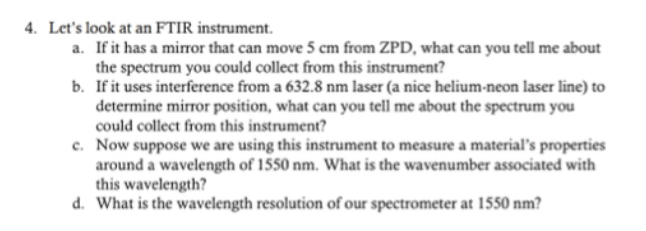 4. Let's look at an FTIR instrument.
a. If it has a mirror that can move 5 cm from ZPD, what can you tell me about
the spectrum you could collect from this instrument?
b. If it uses interference from a 632.8 nm laser (a nice helium-neon laser line) to
determine mirror position, what can you tell me about the spectrum you
could collect from this instrument?
c. Now suppose we are using this instrument to measure a material's properties
around a wavelength of 1550 nm. What is the wavenumber associated with
this wavelength?
d. What is the wavelength resolution of our spectrometer at 1550 nm?
4. Let's look at an FTIR instrument.
a. If it has a mirror that can move 5 cm from ZPD, what can you tell me about
the spectrum you could collect from this instrument?
b. If it uses interference from a 632.8 nm laser (a nice helium-neon laser line) to
determine mirror position, what can you tell me about the spectrum you
could collect from this instrument?
c. Now suppose we are using this instrument to measure a material's properties
around a wavelength of 1550 nm. What is the wavenumber associated with
this wavelength?
d. What is the wavelength resolution of our spectrometer at 1550 nm?
This is AI generated Response.
Asked by: Sam
Created at: 2025-11-23 00:14:52
Asked by: Sam
Created at: 2025-11-23 00:14:52
Final Answer:
Rendered
Raw Text
Did you like this answer?
## 4. Let's look at an FTIR instrument
### a Mirror Can Move 5 from ZPDIf the FT has a mirror can move up **5 cm from the Zero Path Difference (ZPD)**, the **maximum optical path difference (OPD)** is **10 cm** (since the light goes to the mirror and back). The **spectral resolution (Δν)** is given by:
\[
\Delta \nu = \frac{1}{\text{OPD}_{\text{max}}}
\]
So,
\[
\Delta \nu = \frac{1}{10\ \text{cm}} = .1\ \text{cm}^{-1}
\]
- **You could collect spectra with a resolution of .1 cm⁻¹.**
- **The minimum resolvable difference in wavenumber is .1 cm⁻¹.**
- **The spectral range depends on the source, detector, and beamsplitter, not just the mirror travel.**
---
### b. Uses 632.8 nm Laser for Mirror Position
- The **laser wavelength (632.8 nm)** is used for precise position calibration, not as a limit on measurement.
- The laser provides an **accurate reference for path difference**, allowing high-precision interferogram sampling.
- **The spectrum collected is not limited to the laser wavelength—** the system can still measure a broad spectrum, as determined by the source and detector. The **laser only improves accuracy and reproducibility**.
---
### c. Wavenumber at 155 nm
Wavenumber (\(\tilde{\nu}\)) is:
\[
\tilde{\nu} = \frac{1}{\lambda}
\]
But with \(\lambda\) in cm:
\[
155\ \text{nm} = 1.55 \times 10^{-4}\ \text{cm}
\]
\[
\tilde{\nu} = \frac{1}{1.55 \times 10^{-4}\ \text{cm}} \approx 6451.6\ \text{cm}^{-1}
\]
---
### d. Wavelength Resolution at 155 nm
Wavenumber resolution found above: \(\Delta \nu = .1\ \text{cm}^{-1}\)
Wavelength resolution (\(\Delta \lambda\)) at a given wavelength:
\[
\Delta \lambda = \lambda^2 \Delta \tilde{\nu}
\]
Substitute \(\lambda = 1.55 \times 10^{-4}\) cm and \(\Delta \tilde{\nu} = .1\ \text{cm}^{-1}\):
\[
\Delta \lambda = (1.55 \times 10^{-4})^2 \times .1 = 2.4025 \times 10^{-8}\ \text{cm}
\]
Convert to nm:
\[
2.4025 \times 10^{-8}\ \text{cm} \times 10^7\ \text{nm/cm} = .240\ \text{nm}
\]
**So, the wavelength resolution at 155 nm is approximately .24 nm.**
---
## **Summary Table**
| Part | Answer |
|------|--------|
| a | Spectral resolution is .1 cm⁻¹ with 5 cm mirror travel. |
| b | Laser is for calibration; spectrum range is not limited by 632.8 nm. |
| c | Wavenumber at 155 nm is ~6452 cm⁻¹. |
| d | Wavelength resolution at 155 nm is ~.24 nm. |
📢 Instructions:
- Ask anything relatd to above question only.
- For new Question goto :