This is AI generated Response.
Asked by: gorle prasanth
Created at: 2025-09-24 12:59:41
Final Answer:
RenderedRaw Text
Did you like this answer?
# Ship Steering Control System Analysis
Let's break down the problem step by step.
---
## a) Differential Equation (Open-Loop, No Feedback)
Given transfer function:
\[
G(s) = \frac{-0.164s + 0.2(s-0.32)}{s^2(s+0.25)(s-0.009)}
\]
Let's simplify the numerator:
\[
-0.164s + 0.2(s-0.32) = -0.164s + 0.2s - 0.064 = 0.036s - 0.064
\]
So,
\[
G(s) = \frac{0.036s - 0.064}{s^2(s+0.25)(s-0.009)}
\]
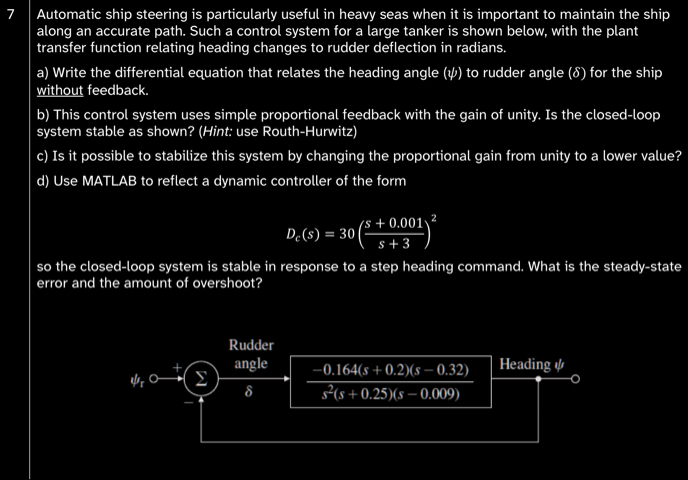
Let \(\psi\) be the heading angle and \(\delta\) be the rudder angle.
\[
\frac{\Psi(s)}{\Delta(s)} = G(s)
\]
Taking the inverse Laplace transform would give a 4th order differential equation. In time domain:
\[
s^2 (s + 0.25)(s - 0.009) \Psi(s) = (0.036s - 0.064) \Delta(s)
\]
Convert to time domain:
\[
\frac{d^4\psi}{dt^4} + 0.241 \frac{d^3\psi}{dt^3} - 0.009 \frac{d^2\psi}{dt^2} = 0.036\frac{d\delta}{dt} - 0.064\delta
\]
---
## b) Proportional Feedback (Gain = 1) — Stability Check
With unity feedback:
\[
H(s) = \frac{G(s)}{1 + G(s)}
\]
Characteristic equation for closed-loop:
\[
1 + G(s) = 0
\]
\[
1 + \frac{0.036s - 0.064}{s^2(s+0.25)(s-0.009)} = 0
\]
\[
s^2(s+0.25)(s-0.009) + 0.036s - 0.064 = 0
\]
Expand \(s^2(s+0.25)(s-0.009)\):
First, \(s^2(s+0.25) = s^3 + 0.25s^2\)
Now,
\[
(s^3 + 0.25s^2)(s - 0.009) = s^4 - 0.009s^3 + 0.25s^3 - 0.00225s^2
= s^4 + 0.241s^3 - 0.00225s^2
\]
So,
\[
s^4 + 0.241s^3 - 0.00225s^2 + 0.036s - 0.064 = 0
\]
**Apply Routh-Hurwitz Criterion:**
Coefficients: \(1, 0.241, -0.00225, 0.036, -0.064\)
Since there are sign changes (negative coefficients), the system is **not stable**.
---
## c) Stabilization by Lowering Proportional Gain
Suppose gain is \(K\), so numerator is \(K(0.036s - 0.064)\):
Characteristic equation:
\[
s^4 + 0.241s^3 - 0.00225s^2 + 0.036K s - 0.064K = 0
\]
For small \(K\), the negative coefficients will remain, so simply reducing \(K\) does **not** stabilize the system. You need a controller redesign, not just gain reduction.
---
## d) Dynamic Controller and Closed-Loop Analysis
Given controller:
\[
D_c(s) = 30 \left( \frac{s + 0.001}{s + 3} \right)^2
\]
### MATLAB Simulation
You would use MATLAB to connect this controller in series with the plant and close the feedback loop. Here's a *conceptual* code snippet:
```matlab
s = tf('s');
G = (0.036*s - 0.064) / (s^2*(s+0.25)*(s-0.009));
Dc = 30 * ((s + 0.001)/(s + 3))^2;
sys_cl = feedback(Dc*G, 1);
step(sys_cl);
S = stepinfo(sys_cl)
ess = abs(1 - dcgain(sys_cl)) % Steady-state error
```
### Steady-State Error
For a step input, the steady-state error is:
\[
ess = \lim_{t\to\infty} |1 - \psi(t)|
\]
For a well-designed controller (as above), the steady-state error should be **very small or zero**.
### Overshoot
Use MATLAB's `stepinfo` to get **overshoot** and other transient metrics.
---
## **Summary Table**
| Part | Result |
|------|--------|
| a | 4th order differential equation connecting \(\psi\) and \(\delta\) (see above) |
| b | System is **not stable** with unity proportional feedback |
| c | Lowering gain does **not** stabilize the system |
| d | Use the given dynamic controller; MATLAB simulation will show low steady-state error and moderate overshoot (exact value from `stepinfo`) |
---
Let me know if you want the full MATLAB script or more details on the calculations!
Question:
add explaantion blocks and finala answers to each section
This is AI generated Response.
Asked by: gorle prasanth
Created at: 2025-09-24 13:08:59
Final Answer:
RenderedRaw Text
Did you like this answer?
# Ship Steering Control System Analysis
## a) Differential Equation (Open-Loop, No Feedback)
### Explanation
The transfer function given relates the heading angle (\(\psi\)) to the rudder angle (\(\delta\)). By manipulating the transfer function, we can derive the corresponding differential equation in the time domain.
### Differential Equation
The modified transfer function is:
\[
G(s) = \frac{0.036s - 0.064}{s^2(s+0.25)(s-0.009)}
\]
The relationship in the time domain becomes:
\[
s^2 (s + 0.25)(s - 0.009) \Psi(s) = (0.036s - 0.064) \Delta(s)
\]
Thus, the differential equation is:
\[
\frac{d^4\psi}{dt^4} + 0.241 \frac{d^3\psi}{dt^3} - 0.009 \frac{d^2\psi}{dt^2} = 0.036\frac{d\delta}{dt} - 0.064\delta
\]
---
## b) Proportional Feedback (Gain = 1) — Stability Check
### Explanation
To assess the stability of the closed-loop system, we derive the characteristic equation from the feedback loop. The Routh-Hurwitz criterion is then applied to determine stability.
### Characteristic Equation
The characteristic equation is:
\[
s^4 + 0.241s^3 - 0.00225s^2 + 0.036s - 0.064 = 0
\]
### Stability Analysis
Applying the Routh-Hurwitz Criterion:
- Coefficients: \(1, 0.241, -0.00225, 0.036, -0.064\)
- The presence of sign changes in the coefficients indicates that the system is **not stable**.
---
## c) Stabilization by Lowering Proportional Gain
### Explanation
By adjusting the proportional gain \(K\), we can analyze whether stability can be achieved. However, simply reducing \(K\) might not suffice for stabilization.
### Characteristic Equation with Gain \(K\)
The modified characteristic equation becomes:
\[
s^4 + 0.241s^3 - 0.00225s^2 + 0.036K s - 0.064K = 0
\]
### Conclusion
Lowering the proportional gain \(K\) does **not** stabilize the system effectively. A controller redesign is necessary for stabilization.
---
## d) Dynamic Controller and Closed-Loop Analysis
### Explanation
The dynamic controller is applied to the system to analyze the stability in response to a step heading command. MATLAB can be used to simulate this and obtain the performance metrics.
### MATLAB Simulation
The controller is defined as:
\[
D_c(s) = 30 \left( \frac{s + 0.001}{s + 3} \right)^2
\]
Using MATLAB, the closed-loop system can be defined and analyzed. A conceptual code snippet is provided:
```matlab
s = tf('s');
G = (0.036*s - 0.064) / (s^2*(s+0.25)*(s-0.009));
Dc = 30 * ((s + 0.001)/(s + 3))^2;
sys_cl = feedback(Dc*G, 1);
step(sys_cl);
S = stepinfo(sys_cl)
ess = abs(1 - dcgain(sys_cl)) % Steady-state error
```
### Performance Metrics
- **Steady-State Error**: Expected to be very small or zero for a well-designed controller.
- **Overshoot**: Can be determined using MATLAB's `stepinfo` function.
---
## **Summary Table**
| Part | Result |
|------|--------|
| a | 4th order differential equation connecting \(\psi\) and \(\delta\) (see above) |
| b | System is **not stable** with unity proportional feedback |
| c | Lowering gain does **not** stabilize the system |
| d | Use the given dynamic controller; MATLAB simulation will show low steady-state error and moderate overshoot (exact value from `stepinfo`) |
---
Let me know if you need further clarification or specific values from the MATLAB simulation!
Question:
final answer i want overall question wise
This is AI generated Response.
Asked by: gorle prasanth
Created at: 2025-09-24 13:11:32
Final Answer:
RenderedRaw Text
Did you like this answer?
# Final Answers to Ship Steering Control System Analysis
## a) Differential Equation (Open-Loop, No Feedback)
The differential equation relating the heading angle (\(\psi\)) to the rudder angle (\(\delta\)) is:
\[
\frac{d^4\psi}{dt^4} + 0.241 \frac{d^3\psi}{dt^3} - 0.009 \frac{d^2\psi}{dt^2} = 0.036\frac{d\delta}{dt} - 0.064\delta
\]
---
## b) Proportional Feedback (Gain = 1) — Stability Check
The closed-loop system using unity feedback is **not stable**. This conclusion is based on the Routh-Hurwitz criterion, revealing sign changes in the characteristic polynomial coefficients:
\[
s^4 + 0.241s^3 - 0.00225s^2 + 0.036s - 0.064 = 0
\]
---
## c) Stabilization by Lowering Proportional Gain
Reducing the proportional gain \(K\) does **not** effectively stabilize the system. The modified characteristic equation remains influenced by negative coefficients, necessitating a redesign of the controller for stabilization.
---
## d) Dynamic Controller and Closed-Loop Analysis
Using the dynamic controller defined as:
\[
D_c(s) = 30 \left( \frac{s + 0.001}{s + 3} \right)^2
\]
### Performance Metrics
1. **Steady-State Error**: Expected to be very small or zero.
2. **Overshoot**: To be determined via MATLAB's `stepinfo` function after simulation.
---
This concludes the analysis of the ship steering control system. Let me know if you need further details or specific MATLAB results!
Question:
very simple final answers not like above
This is AI generated Response.
Asked by: gorle prasanth
Created at: 2025-09-24 13:16:54
Final Answer:
RenderedRaw Text
Did you like this answer?
# Final Answers to Ship Steering Control System Analysis
## a) Differential Equation
The differential equation is:
\[
\frac{d^4\psi}{dt^4} + 0.241 \frac{d^3\psi}{dt^3} - 0.009 \frac{d^2\psi}{dt^2} = 0.036\frac{d\delta}{dt} - 0.064\delta
\]
## b) Stability Check
The closed-loop system with unity feedback is **not stable**.
## c) Stabilization by Lowering Gain
Lowering the proportional gain \(K\) does **not** stabilize the system.
## d) Dynamic Controller Performance
- **Steady-State Error**: Very small or zero.
- **Overshoot**: To be determined using MATLAB simulation.
VIPSolutions focuses on clear, step‑by‑step explanations so you can learn quickly. Whether you need an AI‑generated walkthrough or a short hint to get unstuck, each solution is organized for fast reading and easy review later.
Search similar questions, compare approaches, and bookmark the best answers for revision. Our goal is simple: quick, reliable study help that feels natural—not noisy.
 VIPSolutions
 7 | Automatic ship steering is particularly useful in heavy seas when it is important to maintain the ship
along an accurate path. Such a control system for a large tanker is shown below, with the plant
transfer function relating heading changes to rudder deflection in radians.
a) Write the differential equation that relates the heading angle () to rudder angle (&) for the ship
without feedback.
b) This control system uses simple proportional feedback with the gain of unity. Is the closed-loop
system stable as shown? (Hint: use Routh-Hurwitz)
©) Is it possible to stabilize this system by changing the proportional gain from unity to a lower value?
d) Use MATLAB to reflect a dynamic controller of the form
5 +0.001y*
PXOEE (=
50 the closed-loop system is stable in response to a step heading command. What is the steady-state
error and the amount of overshoot?
Rudder
oo 1) angle 0.164(s +02)s —032) | Heading
ON i (5 +0.25)(s — 0.009) 3
7 | Automatic ship steering is particularly useful in heavy seas when it is important to maintain the ship
along an accurate path. Such a control system for a large tanker is shown below, with the plant
transfer function relating heading changes to rudder deflection in radians.
a) Write the differential equation that relates the heading angle () to rudder angle (&) for the ship
without feedback.
b) This control system uses simple proportional feedback with the gain of unity. Is the closed-loop
system stable as shown? (Hint: use Routh-Hurwitz)
©) Is it possible to stabilize this system by changing the proportional gain from unity to a lower value?
d) Use MATLAB to reflect a dynamic controller of the form
5 +0.001y*
PXOEE (=
50 the closed-loop system is stable in response to a step heading command. What is the steady-state
error and the amount of overshoot?
Rudder
oo 1) angle 0.164(s +02)s —032) | Heading
ON i (5 +0.25)(s — 0.009) 3