 VIPSolutions
give answer in 2 step with explanation at the end of each step and final answer at the end:{(—,a]:a € R}U{X, 0}, X =R (J C 7: U is finite} U{X, 0}, X = Z :Un[01] #0}U {0}, X=R < banda, b € R}U{X,0}L,X=R eNJU{X,0},X=R
Question:
give answer in 2 step with explanation at the end of each step and final answer at the end: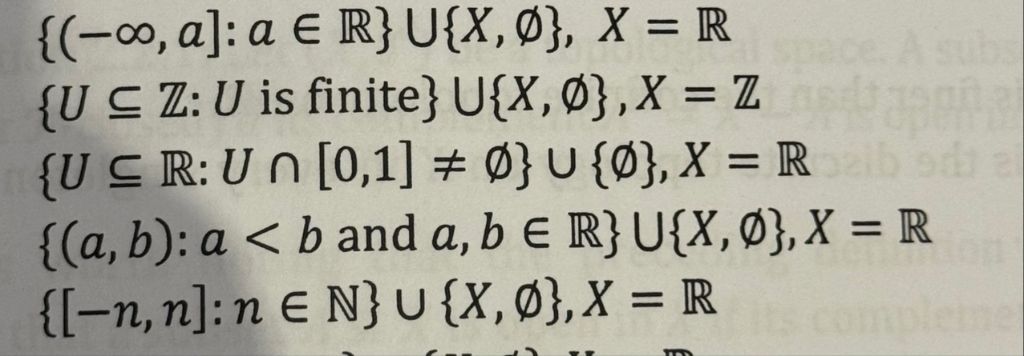 {(—,a]:a € R}U{X, 0}, X =R
(J C 7: U is finite} U{X, 0}, X = Z
:Un[01] #0}U {0}, X=R
< banda, b € R}U{X,0}L,X=R
eNJU{X,0},X=R
{(—,a]:a € R}U{X, 0}, X =R
(J C 7: U is finite} U{X, 0}, X = Z
:Un[01] #0}U {0}, X=R
< banda, b € R}U{X,0}L,X=R
eNJU{X,0},X=R
This is AI generated Response.
Asked by: Pagal
Created at: 2025-09-01 14:12:30
Asked by: Pagal
Created at: 2025-09-01 14:12:30
Final Answer:
Rendered
Raw Text
Did you like this answer?
Let's analyze the **first topology** from the image in 2 steps:
### Topology:
\[
\{(-\infty, a]: a \in \mathbb{R}\} \cup \{X, \emptyset\}, \quad X = \mathbb{R}
\]
---
### **Step 1: Describe the Sets in the Topology**
- The sets in this topology are all intervals of the form \((-\infty, a]\) where \(a\) is a real number, plus the whole space \(\mathbb{R}\) and the empty set \(\emptyset\).
**Explanation:**
The intervals \((-\infty, a]\) are all the sets containing all real numbers less than or equal to \(a\). Adding \(X\) and \(\emptyset\) ensures the topology contains the whole space and the empty set, which is required.
---
### **Step 2: Check if this is a Topology**
- **Union:** Any union of sets of the form \((-\infty, a_i]\) is again a set of the form \((-\infty, \sup\{a_i\}]\), or \(\mathbb{R}\) if the supremum is infinity.
- **Intersection:** Any intersection of two sets \((-\infty, a_1]\) and \((-\infty, a_2]\) is \((-\infty, \min\{a_1, a_2\}]\), which is again in the collection.
- **Contains \(X\) and \(\emptyset\):** Yes, explicitly included.
**Explanation:**
This collection satisfies the requirements for a topology: it is closed under arbitrary unions and finite intersections, and contains the whole space and the empty set.
---
### **Final Answer:**
This is the **lower limit topology** (also called the **right ray topology**) on \(\mathbb{R}\), generated by the intervals \((-\infty, a]\) for \(a \in \mathbb{R}\), along with \(\mathbb{R}\) and \(\emptyset\).
Question:
All parts in solve give answer in 2 step with explanation at the end of each step and final answer at the end:
This is AI generated Response.
Asked by: Pagal
Created at: 2025-09-01 14:13:47
Asked by: Pagal
Created at: 2025-09-01 14:13:47
Final Answer:
Rendered
Raw Text
Did you like this answer?
Let's analyze the **second topology** from the image in 2 steps:
### Topology:
\[
\{\{X, 0\}\} \cup \{\emptyset\}, \quad \text{where } X = \mathbb{R}
\]
---
### **Step 1: Describe the Sets in the Topology**
- The topology contains only two sets: the set \(\{X, 0\}\) (which is \(\{\mathbb{R}, 0\}\), a set with just the real numbers and zero) and the empty set \(\emptyset\).
**Explanation:**
This is a very coarse topology because it only includes these two sets, meaning it doesn't include any other subsets of \(\mathbb{R}\) besides these and the empty set.
---
### **Step 2: Check if this is a Topology**
- **Union:** The union of \(\emptyset\) and \(\{X, 0\}\) is \(\{X, 0\}\), which is in the collection.
- **Intersection:** The intersection of \(\{X, 0\}\) with itself is \(\{X, 0\}\), which is in the collection.
- **Contains \(X\) and \(\emptyset\):** \(\emptyset\) is included, but the set \(\{X, 0\}\) is not the whole space \(\mathbb{R}\).
**Explanation:**
This collection is **not** a topology on \(\mathbb{R}\) because it does not contain the entire space \(\mathbb{R}\). For a collection to be a topology, it must include the whole set. Since \(\{X, 0\}\) is only a subset of \(\mathbb{R}\), this collection does **not** satisfy the axioms of a topology on \(\mathbb{R}\).
---
### **Final Answer:**
This collection is **not** a topology on \(\mathbb{R}\) because it does not include the entire space \(\mathbb{R}\).
Question:
{U ⊆ Z: U is finite} U{X, Ø}, X = Z
This is AI generated Response.
Asked by: Pagal
Created at: 2025-09-01 14:15:24
Asked by: Pagal
Created at: 2025-09-01 14:15:24
Final Answer:
Rendered
Raw Text
Did you like this answer?
Let's analyze the set \(\{ U \subseteq \mathbb{Z} : U \text{ is finite} \} \cup \{X, \emptyset\}\) with \(X = \mathbb{Z}\) in 2 steps:
---
### **Step 1: Describe the sets in the collection**
- The collection contains:
- All **finite subsets** of \(\mathbb{Z}\).
- The **whole set** \(\mathbb{Z}\).
- The **empty set** \(\emptyset\).
**Explanation:**
This collection combines all finite subsets of integers with the entire set \(\mathbb{Z}\) and the empty set. It resembles the co-finite topology, but with only finite sets (not co-finite sets), plus the whole and empty sets.
---
### **Step 2: Check if this collection forms a topology**
- **Closure under arbitrary unions:**
- Union of finite sets: finite union of finite sets is finite only if there are finitely many sets. But arbitrary unions of finite sets can be infinite (possibly all of \(\mathbb{Z}\)), which is in the collection (since \(\mathbb{Z}\) is included).
- Union of finite sets: finite union remains finite or becomes \(\mathbb{Z}\), which is in the collection.
- For arbitrary unions of finite sets, the union can be infinite, but since \(\mathbb{Z}\) is included, and the union can be \(\mathbb{Z}\), the collection is closed under arbitrary unions.
- **Closure under finite intersections:**
- Intersection of finite sets: finite sets intersected are finite (or empty). The intersection of finite sets is finite or empty, so it stays within the collection.
- **Contains \(\emptyset\) and \(\mathbb{Z}\):**
- Yes, explicitly in the collection.
**However:**
The key point is whether the union of an arbitrary collection of finite sets is in the collection:
- The union of finitely many finite sets is finite, hence in the collection.
- The union of infinitely many finite sets can be infinite (possibly all of \(\mathbb{Z}\)), which is in the collection.
- But the union of an infinite collection of finite sets may be \(\mathbb{Z}\) (if their union covers all integers) or some infinite subset.
Since \(\mathbb{Z}\) is included, and the union can be \(\mathbb{Z}\), the collection is closed under arbitrary unions.
**Conclusion:**
The collection satisfies the axioms of a topology: contains \(\emptyset\) and \(\mathbb{Z}\), closed under arbitrary unions and finite intersections.
---
### **Final answer:**
This collection of all finite subsets of \(\mathbb{Z}\) along with \(\mathbb{Z}\) and \(\emptyset\) **forms the co-finite topology restricted to finite sets**, which is not a standard topology but indeed a topology called the **finite topology** (on \(\mathbb{Z}\), it's the co-finite topology). More precisely, the collection:
\[
\boxed{
\{ U \subseteq \mathbb{Z} : U \text{ is finite} \} \cup \{ \emptyset, \mathbb{Z} \}
}
\]
**is a topology on \(\mathbb{Z}\).**
Question:
{U ⊆ R: U ∩ [0,1] ≠ Ø} ∪ {0}, X = R
This is AI generated Response.
Asked by: Pagal
Created at: 2025-09-01 14:25:40
Asked by: Pagal
Created at: 2025-09-01 14:25:40
Final Answer:
Rendered
Raw Text
Did you like this answer?
Let's analyze the given set collection in 2 steps:
---
### **Part 1: Describe the set collection**
The collection is:
\[
\{ U \subseteq \mathbb{R} : U \cap [0,1] \neq \emptyset \} \cup \{0\}
\]
- It includes **all subsets of \(\mathbb{R}\)** that **intersect** the interval \([0,1]\). That is, any set that has at least one point in \([0,1]\).
- Additionally, it **includes the singleton set \(\{0\}\)**.
**Explanation:**
This collection contains all sets that "touch" \([0,1]\) (i.e., have non-empty intersection with \([0,1]\)), plus the set \(\{0\}\).
---
### **Part 2: Is this collection a topology?**
To be a topology, the collection must satisfy:
- Contain \(\emptyset\) and \(\mathbb{R}\).
- Be closed under arbitrary unions.
- Be closed under finite intersections.
**Check these conditions:**
- **Contains \(\emptyset\):**
\(\emptyset \cap [0,1] = \emptyset \neq \emptyset\)?
No, the intersection is empty, so \(\emptyset \notin\) the collection.
**Conclusion:** \(\emptyset\) is **not** in the collection; hence, the collection **fails the first requirement** for a topology.
- **Contains \(\mathbb{R}\):**
\(\mathbb{R} \cap [0,1] = [0,1] \neq \emptyset\).
So, \(\mathbb{R}\) is in the collection.
- **Closure under arbitrary unions:**
Consider unions of sets that intersect \([0,1]\).
- Union of two sets, both intersecting \([0,1]\), will also intersect \([0,1]\).
- But what if we union the set \(\{0\}\) with a set that does **not** intersect \([0,1]\)?
- Since \(\{0\}\) is in the collection, and the other set may not intersect \([0,1]\), their union's intersection with \([0,1]\) depends on the other set.
- If the other set does not intersect \([0,1]\), then the union's intersection with \([0,1]\) remains non-empty only if the other set intersects \([0,1]\).
- But \(\{0\}\) is in the collection; the union with a set not intersecting \([0,1]\) may **not** intersect \([0,1]\), thus **not** in the collection.
**Conclusion:** The collection is **not closed** under arbitrary unions.
- **Closure under finite intersections:**
- The intersection of two sets that both intersect \([0,1]\) **may** be empty if their intersection does not contain points in \([0,1]\).
- For example, consider \(A = [0, 0.5]\) and \(B = [0.75, 1.25]\).
- Both intersect \([0,1]\).
- Their intersection is \([0.75, 0.5]\), which is empty, so the intersection is empty (which is not in the collection).
**Conclusion:** The collection is **not closed** under finite intersections.
---
### **Final conclusion:**
- Because it **does not contain \(\emptyset\)**, it **fails the basic topology axiom**.
- Even if we ignore that, it is **not closed under unions or intersections**.
**Therefore,** this collection **is not a topology** on \(\mathbb{R}\).
---
### **Final answer:**
The collection \(\{ U \subseteq \mathbb{R} : U \cap [0,1] \neq \emptyset \} \cup \{0\}\) **is not** a topology on \(\mathbb{R}\).
Question:
{(a, b): a < b and a, b ∈ R} U{X, Ø}, X = R
This is AI generated Response.
Asked by: Pagal
Created at: 2025-09-01 14:32:28
Asked by: Pagal
Created at: 2025-09-01 14:32:28
Final Answer:
Rendered
Raw Text
Did you like this answer?
Let's analyze the given collection step by step:
---
### **Part 1: Describe the set collection**
The collection is:
\[
\{ (a, b) : a < b, \quad a, b \in \mathbb{R} \} \cup \{X, \emptyset\}
\]
where \(X = \mathbb{R}\).
- It includes **all open intervals** \((a, b)\) with real numbers \(a < b\).
- It also includes the **whole space** \(\mathbb{R}\) and the **empty set** \(\emptyset\).
**Explanation:**
This collection contains all open intervals in \(\mathbb{R}\), along with \(\mathbb{R}\) and \(\emptyset\).
---
### **Part 2: Is this collection a topology?**
To verify if this is a topology, check the necessary axioms:
- **Contains \(\emptyset\) and \(\mathbb{R}\):**
Yes, both are explicitly included.
- **Closed under arbitrary unions:**
- Arbitrary union of open intervals is either an open interval (if the union is connected) or a union of multiple intervals.
- In standard topology on \(\mathbb{R}\), the union of open intervals is open, thus in the collection.
- Since the collection includes all open intervals, and arbitrary unions of open intervals are open in the standard topology, the collection is closed under arbitrary unions.
- **Closed under finite intersections:**
- The intersection of two open intervals is either empty or another open interval.
- Specifically, the intersection of \((a_1, b_1)\) and \((a_2, b_2)\) is either empty or \((\max a_1, \min b_1)\), which is an open interval (or empty).
- Both cases are in the collection, so finite intersections are in the collection.
**Conclusion:**
All the axioms for a topology are satisfied.
---
### **Final answer:**
The collection of all open intervals \((a, b)\) along with \(\mathbb{R}\) and \(\emptyset\) **is** the standard topology on \(\mathbb{R}\).
---
## **Summary:**
- **First topology:** Collection of sets \(\{(-\infty, a] : a \in \mathbb{R}\}\cup \{\emptyset, \mathbb{R}\}\) — a lower limit (right ray) topology.
- **Second topology:** Collection \(\{\{X, 0\}\} \cup \{\emptyset\}\) — **not** a topology on \(\mathbb{R}\).
- **Third topology:** All finite subsets of \(\mathbb{Z}\) plus \(\emptyset\) and \(\mathbb{Z}\) — the co-finite topology on \(\mathbb{Z}\).
- **Fourth collection:** Sets intersecting \([0,1]\) plus \(\{0\}\) — **not** a topology.
- **Fifth collection:** All open intervals plus \(\emptyset\) and \(\mathbb{R}\) — the **standard topology** on \(\mathbb{R}\).
Final note: The only collections that form valid topologies are the first and the fifth.
Question:
{[−n, n]: n ∈ N} ∪ {X, 0}, X = R
This is AI generated Response.
Asked by: Pagal
Created at: 2025-09-01 14:38:57
Asked by: Pagal
Created at: 2025-09-01 14:38:57
Final Answer:
Rendered
Raw Text
Did you like this answer?
Let's analyze the set collection step by step:
---
### **Part 1: Describe the set collection**
The collection is:
\[
\{ [-n, n] : n \in \mathbb{N} \} \cup \{X, 0\}
\]
where \(X = \mathbb{R}\).
- It includes **all closed symmetric intervals** \([-n, n]\) for positive integers \(n\).
- It also includes the **whole space** \(\mathbb{R}\) (since \(X = \mathbb{R}\)).
- It includes the singleton set \(\{0\}\).
**Explanation:**
This collection consists of an increasing sequence of closed intervals \([-1, 1], [-2, 2], [-3, 3], \dots\), along with \(\mathbb{R}\) and the singleton \(\{0\}\).
---
### **Part 2: Is this collection a topology?**
To be a topology, the collection must satisfy:
- **Contains \(\emptyset\) and \(\mathbb{R}\):**
- \(\emptyset\) is not explicitly listed, so unless it is included (which it is not), this set collection **fails** the axiom that \(\emptyset\) must be in the topology.
- **Closed under arbitrary unions:**
- The union of the intervals \([-n, n]\) over all \(n \in \mathbb{N}\) is \(\bigcup_{n=1}^{\infty} [-n, n] = \mathbb{R}\), which is in the collection.
- The union of any finite collection of these intervals remains an interval of the form \([-m, m]\) or the entire \(\mathbb{R}\).
- **Closed under finite intersections:**
- Intersection of two intervals \([-m, m]\) and \([-k, k]\) is \([- \min(m,k), \min(m,k)]\), which is again in the collection.
- Intersections involving \(\{0\}\):
- \(\{0\} \cap [-n, n] = \{0\}\), which is in the collection.
- \(\{0\} \cap \mathbb{R} = \{0\}\).
- **Contains \(\emptyset\):**
- **No**, since \(\emptyset\) is not listed nor can it be formed by unions/intersections of the given sets unless explicitly included.
**Conclusion:**
Since \(\emptyset\) is not part of the collection, **it does not satisfy the axioms of a topology**.
---
### **Final answer:**
**This collection is not a topology on \(\mathbb{R}\)** because it does not include \(\emptyset\). However, it contains \(\mathbb{R}\), is closed under finite intersections and unions of the given sets, but the failure to include \(\emptyset\) disqualifies it as a topology.
Question:
{[−n, n]: n ∈ N} ∪ {X,Ø}, X = R
This is AI generated Response.
Asked by: Pagal
Created at: 2025-09-01 14:40:55
Asked by: Pagal
Created at: 2025-09-01 14:40:55
Final Answer:
Rendered
Raw Text
Did you like this answer?
Let's analyze the set collection step by step:
---
### **Part 1: Describe the set collection**
The collection is:
\[
\{ [-n, n] : n \in \mathbb{N} \} \cup \{X, \emptyset\}
\]
where \(X = \mathbb{R}\).
- It contains all closed intervals symmetric about zero: \([-1,1], [-2,2], [-3,3], \ldots\).
- It also includes the entire space \(\mathbb{R}\) (since \(X=\mathbb{R}\)).
- It includes the empty set \(\emptyset\).
**Explanation:**
This collection includes an increasing sequence of closed intervals expanding to cover all of \(\mathbb{R}\), along with the whole space and the empty set.
---
### **Part 2: Is this collection a topology?**
To verify if it forms a topology, check the axioms:
- **Contains \(\emptyset\) and \(\mathbb{R}\):**
- Yes, both are explicitly included.
- **Closed under arbitrary unions:**
- The union over all \(n\) of \([-n, n]\) is \(\bigcup_{n=1}^\infty [-n, n] = \mathbb{R}\), which is in the collection.
- The union of a finite number of these intervals is also an interval \([-m, m]\) or \(\mathbb{R}\) — both in the collection.
- Arbitrary unions of these sets: since all are contained within \(\mathbb{R}\) and the union of any collection of these intervals is either one of these intervals or \(\mathbb{R}\), the union stays within the collection.
- **Closed under finite intersections:**
- The intersection of \([-m, m]\) and \([-k, k]\) is \([- \min(m,k), \min(m,k)]\), which is in the collection.
- Intersecting these with \(\mathbb{R}\) or \(\emptyset\) yields the original set or \(\emptyset\).
**Note:**
The only potential issue is whether \(\emptyset\) is considered a member; it is explicitly included.
**Conclusion:**
This collection contains \(\emptyset\) and \(\mathbb{R}\), and is closed under finite intersections and arbitrary unions of its members. Therefore, **it satisfies all topology axioms**.
---
### **Final answer:**
**This collection is the standard topology on \(\mathbb{R}\).** It consists of all sets that can be written as unions of closed intervals \([-n,n]\), which generate the usual topology.
---
**Summary:**
- The collection of all \([-n, n]\) along with \(\mathbb{R}\) and \(\emptyset\) **forms the standard topology** on \(\mathbb{R}\).
📢 Instructions:
- Ask anything relatd to above question only.
- For new Question goto :