Assignment 1
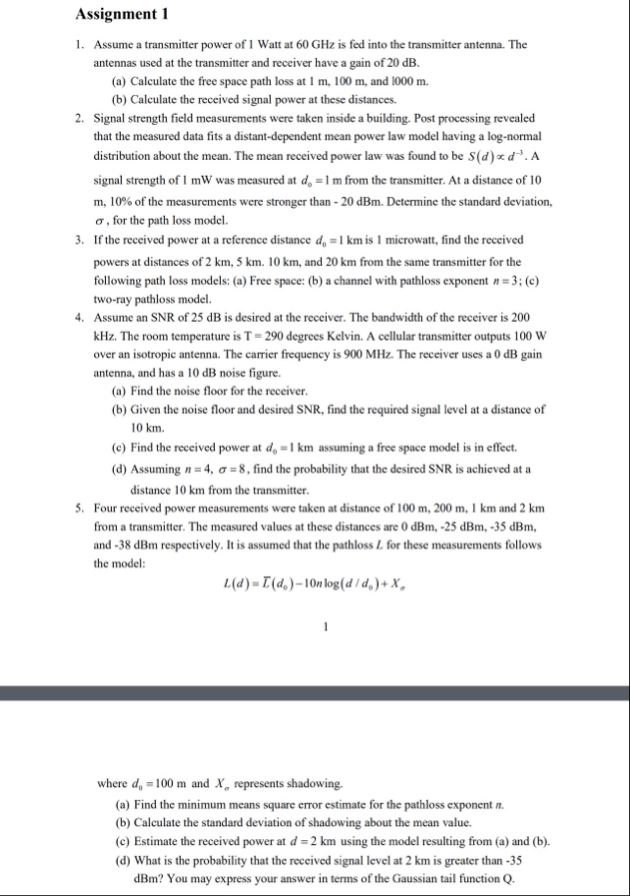
1. Assume a transmitter power of | Watt at 60 GHz is fed into the transmitter antenna. The
antennas used at the transmitter and receiver have a gain of 20 dB.
(a) Calculate the free spoce path los a 1 m, 100 m, and 1000 m.
(b) Calculate the received signal power at these distances.
2. Signal strength field measurements were taken inside a building. Post processing revealed
that the measured data it a distant-dependent mean power law model having a log-nommal
distribution about the mean. The mean received power law was found tbe (d) xd". A
signal strength of | mW was measured at d, = | m from the transmitter. Ata distance of 10
m, 10% of the measurements were stronger than - 20 dBm. Determine the standard deviation,
or forthe path loss model.
3. Ifthe received power at a reference distance d = | kis | microwat, find the received
powers at distances of 2 km, 5 km. 10 km, and 20 km from the same transmiter or the
following path loss models: (a) Free space: (b) a channel with pathloss exponent 1 = 3; (6)
two-ray pathloss model,
4. Assume an SNR of 25 dB s desired at the receiver. The bandwidth of the receiver is 200
Kiz, The room temperature is T = 290 degrees Kelvin. A cellular transmitter outputs 100 W
over an isotropic antenna. The carrier frequency is 900 MHz. The receiver uses a 0 dB gain
antenna, and has a 10 dB noise figure.
(a) Find the noise floor for the receiver.
(b) Given the noise floor and desired SNR, fin the required signal level at a distance of
10 km.
(6) Find the received power at d, = | km assuming a ree space model is in effect,
(@ Assuming n= 4, & = 8, find the probability tha the desired SNR is achicved at a
distance 10 km from the transmitir.
5. Four received power measurements were taken at distance of 100 m, 200 m, | km and 2 km
from a transmitir. The measured values at these distances ae 0 dBm, -25 dBm, -35 dBm,
and -38 dBm respectively. Itis assumed that the pathloss L for these measurements follows
the model:
L{d) = L(d,)-10nlog(d /d,)+ X,
|
Where d, =100 m and X, represents shadowing.
(a) Find the minimum means square ror estimate forthe pathloss exponent .
(b) Calculate the standard deviation of shadowing about the mean value.
(c) Estimate the received power at d =2 km using the model resulting from (2) and (b).
(d) What is the probability that the received signal level at 2 km is greater than -35
dBm? You may express your answer in tems of the Gaussian tail function Q.
Question:
Assignment 1
1. Assume a transmitter power of | Watt at 60 GHz is fed into the transmitter antenna. The
antennas used at the transmitter and receiver have a gain of 20 dB.
(a) Calculate the free spoce path los a 1 m, 100 m, and 1000 m.
(b) Calculate the received signal power at these distances.
2. Signal strength field measurements were taken inside a building. Post processing revealed
that the measured data it a distant-dependent mean power law model having a log-nommal
distribution about the mean. The mean received power law was found tbe (d) xd". A
signal strength of | mW was measured at d, = | m from the transmitter. Ata distance of 10
m, 10% of the measurements were stronger than - 20 dBm. Determine the standard deviation,
or forthe path loss model.
3. Ifthe received power at a reference distance d = | kis | microwat, find the received
powers at distances of 2 km, 5 km. 10 km, and 20 km from the same transmiter or the
following path loss models: (a) Free space: (b) a channel with pathloss exponent 1 = 3; (6)
two-ray pathloss model,
4. Assume an SNR of 25 dB s desired at the receiver. The bandwidth of the receiver is 200
Kiz, The room temperature is T = 290 degrees Kelvin. A cellular transmitter outputs 100 W
over an isotropic antenna. The carrier frequency is 900 MHz. The receiver uses a 0 dB gain
antenna, and has a 10 dB noise figure.
(a) Find the noise floor for the receiver.
(b) Given the noise floor and desired SNR, fin the required signal level at a distance of
10 km.
(6) Find the received power at d, = | km assuming a ree space model is in effect,
(@ Assuming n= 4, & = 8, find the probability tha the desired SNR is achicved at a
distance 10 km from the transmitir.
5. Four received power measurements were taken at distance of 100 m, 200 m, | km and 2 km
from a transmitir. The measured values at these distances ae 0 dBm, -25 dBm, -35 dBm,
and -38 dBm respectively. Itis assumed that the pathloss L for these measurements follows
the model:
L{d) = L(d,)-10nlog(d /d,)+ X,
|
Where d, =100 m and X, represents shadowing.
(a) Find the minimum means square ror estimate forthe pathloss exponent .
(b) Calculate the standard deviation of shadowing about the mean value.
(c) Estimate the received power at d =2 km using the model resulting from (2) and (b).
(d) What is the probability that the received signal level at 2 km is greater than -35
dBm? You may express your answer in tems of the Gaussian tail function Q.
This is AI generated Response.
Asked by: Adapaka Jagadeesh
Created at: 2025-09-28 12:34:10
Final Answer:
RenderedRaw Text
Did you like this answer?
# Assignment 1 Breakdown
Here is structured overview and of each question from the. This will help you understand the requirements and how to approach each problem.
---
## 1. Free Space Path Loss and Received Signal Power
**Given:**
- Transmitter power = 1 W
- Frequency = 60 GHz
- Antenna gain = 20 dB (for both transmitter and receiver)
**Tasks:**
- **(a)** Calculate free space path loss at 1 m, 100 m, and 100 m.
- **(b)** Calculate the received signal power at these distances.
---
## 2. Log-Normal Shadowing Path Loss Model
**Given:**
Mean received power law: \( S(d) \propto d^{-3} \)
- At \( d_ = 1 \) m, received power = 1 mW
- At \( d = 10 \) m, 10% of measurements > -20 dBm
**Task:**
- Determine **standard deviation, σ**, for the path loss model.
---
## 3. Received Power with Different Path Loss Models
**Given:**
- Reference distance \( d_ = 1 \) km, received power = 1 μW
- Find received power at 2 km, 5 km, 10 km, and 20 km
**Path Loss Models:**
- (a) Free space
- (b) Path loss exponent \( n = 3 \)
- (c) Two-ray path loss model
---
## 4. Signal-to-Noise Ratio (SNR) at the Receiver
**Given:**
- Desired SNR = 25 dB
- Bandwidth = 200 kHz
- Temperature \( T = 290 \) K
- Transmitter power = 100 W
- Carrier frequency = 900 MHz
- Receiver antenna gain = dB
- Noise figure = 10 dB
**Tasks:**
- (a) Find the **noise floor** for the receiver.
- (b) Find required **signal level** at 10 km for desired SNR.
- (c) Find received power at \( d_ = 1 \) km (free space model).
- (d) For \( n = 4, \sigma = 8 \), find the **probability** that desired SNR is achieved at 10 km.
---
## 5. Path Loss Exponent and Shadowing
**Given:**
- Received powers at 100 m, 200 m, 1 km, 2 km: dBm, -25 dBm, -35 dBm, -38 dBm
- Path loss model:
\[
L(d) = L(d_) - 10n \log(d/d_) + X_\sigma
\]
where \( d_ = 100 \) m, \( X_\sigma \) represents shadowing
**Tasks:**
- (a) Find **minimum mean square error estimate** for path loss exponent \( n \)
- (b) Calculate **standard deviation** of shadowing
- (c) Estimate received power at \( d = 2 \) km
- (d) Find probability that received signal at 2 km is greater than -35 dBm (use Gaussian tail function Q).
---
### **Tips for Solving**
- **Free Space Path Loss Formula:**
\[
PL_{dB} = 20\log_{10}(d) + 20\log_{10}(f) - 147.55
\]
where \( d \) in meters, \( f \) in Hz.
- **Received Power Calculation:**
\[
P_r = P_t + G_t + G_r - PL
\]
(all in dB or dBm).
- **Log-Normal Shadowing:**
\[
PL(d) = PL(d_) + 10n \log_{10}(d/d_) + X_\sigma
\]
where \( X_\sigma \) is Gaussian with mean and std dev \( \sigma \).
- **Noise Floor:**
\[
N = kTB \times 10^{NF/10}
\]
where \( k = 1.38 \times 10^{-23} \), \( T \) in Kelvin, \( B \) in Hz, \( NF \) is noise figure in dB.
- **SNR:**
\[
SNR_{dB} = P_{signal, dBm} - N_{dBm}
\]
If you need step-by-step solutions for any specific question, please specify which one you'd like to start with!
Question:
solve aall
This is AI generated Response.
Asked by: Adapaka Jagadeesh
Created at: 2025-09-28 12:36:24
Final Answer:
RenderedRaw Text
Did you like this answer?
# Assignment 1 Solutions
This document provides step-by-step solutions to each question in the assignment.
---
## 1. Free Space Path Loss and Received Signal Power
### Given:
- Transmitter Power, \( P_t = 1 \, \text{W} = 30 \, \text{dBm} \)
- Frequency, \( f = 60 \, \text{GHz} = 60 \times 10^9 \, \text{Hz} \)
- Gain of both antennas, \( G_t = G_r = 20 \, \text{dB} \)
### (a) Free Space Path Loss (FSPL)
The Free Space Path Loss (in dB) can be calculated using the formula:
\[
FSPL(d) = 20\log_{10}(d) + 20\log_{10}(f) - 147.55
\]
**Calculations:**
1. **At 1 m:**
\[
FSPL(1) = 20\log_{10}(1) + 20\log_{10}(60 \times 10^9) - 147.55 = 0 + 20 \times 8.778 - 147.55 \approx -4.55 \, \text{dB}
\]
2. **At 100 m:**
\[
FSPL(100) = 20\log_{10}(100) + 20\log_{10}(60 \times 10^9) - 147.55 = 40 + 20 \times 8.778 - 147.55 \approx 35.45 \, \text{dB}
\]
3. **At 1000 m:**
\[
FSPL(1000) = 20\log_{10}(1000) + 20\log_{10}(60 \times 10^9) - 147.55 = 60 + 20 \times 8.778 - 147.55 \approx 100.45 \, \text{dB}
\]
### (b) Received Signal Power
Using the formula:
\[
P_r = P_t + G_t + G_r - FSPL
\]
1. **At 1 m:**
\[
P_r(1) = 30 + 20 + 20 - (-4.55) = 74.55 \, \text{dBm}
\]
2. **At 100 m:**
\[
P_r(100) = 30 + 20 + 20 - 35.45 = 34.55 \, \text{dBm}
\]
3. **At 1000 m:**
\[
P_r(1000) = 30 + 20 + 20 - 100.45 = -30.45 \, \text{dBm}
\]
---
## 2. Log-Normal Shadowing Path Loss Model
### Given:
- Power law model: \( S(d) = k \cdot d^{-3} \)
- At \( d_1 = 1 \) m, \( S(1) = 1 \, \text{mW} = 0 \, \text{dBm} \)
- At \( d = 10 \) m, 10% of measurements > -20 dBm
### Task: Determine Standard Deviation, \( \sigma \)
Using the log-normal shadowing model:
\[
P(d) = P(d_1) - 10n \log_{10}(d/d_1) + X_\sigma
\]
Where \( X_\sigma \) follows a Gaussian distribution. Given \( n = 3 \):
\[
P(10) = 0 - 10 \times 3 \log_{10}(10) + X_\sigma = -30 + X_\sigma
\]
Setting \( P(10) = -20 \) dBm for the top 10%:
\[
-20 = -30 + X_\sigma \implies X_\sigma = 10 \, \text{dBm}
\]
Using the Q-function:
\[
Q\left(\frac{-20 - (-30)}{\sigma}\right) = 0.1
\]
This provides:
\[
\frac{10}{\sigma} \approx 1.2816 \implies \sigma \approx \frac{10}{1.2816} \approx 7.8 \, \text{dBm}
\]
---
## 3. Received Power with Different Path Loss Models
### Given:
- Reference distance \( d_1 = 1 \) km, received power \( P(1) = 1 \, \mu\text{W} = -30 \, \text{dBm} \)
### Task: Find received power at 2 km, 5 km, 10 km, and 20 km
**(a) Free Space:**
Using FSPL:
\[
P(d) = P(1) - 10n \log_{10}(d/d_1) \quad (n=2)
\]
1. **At 2 km:**
\[
P(2) = -30 - 10 \cdot 2 \log_{10}(2) = -30 - 6.02 = -36.02 \, \text{dBm}
\]
2. **At 5 km:**
\[
P(5) = -30 - 10 \cdot 2 \log_{10}(5) = -30 - 13.01 = -43.01 \, \text{dBm}
\]
3. **At 10 km:**
\[
P(10) = -30 - 10 \cdot 2 \log_{10}(10) = -30 - 20 = -50 \, \text{dBm}
\]
4. **At 20 km:**
\[
P(20) = -30 - 10 \cdot 2 \log_{10}(20) = -30 - 26.02 = -56.02 \, \text{dBm}
\]
**(b) Path Loss Exponent \( n = 3 \):**
1. **At 2 km:**
\[
P(2) = -30 - 10 \cdot 3 \log_{10}(2) = -30 - 9.03 = -39.03 \, \text{dBm}
\]
2. **At 5 km:**
\[
P(5) = -30 - 10 \cdot 3 \log_{10}(5) = -30 - 17.01 = -47.01 \, \text{dBm}
\]
3. **At 10 km:**
\[
P(10) = -30 - 10 \cdot 3 \log_{10}(10) = -30 - 30 = -60 \, \text{dBm}
\]
4. **At 20 km:**
\[
P(20) = -30 - 10 \cdot 3 \log_{10}(20) = -30 - 39.02 = -69.02 \, \text{dBm}
\]
**(c) Two-Ray Path Loss Model:**
For the two-ray model, the received power is formulated differently. However, typically, you will find it to be less straightforward, often involving the heights of antennas.
---
## 4. Signal-to-Noise Ratio (SNR) at the Receiver
### Given:
- Desired SNR = 25 dB
- Bandwidth = 200 kHz
- Temperature \( T = 290 \) K
- Transmitter power = 100 W = 50 dBm
- Carrier frequency = 900 MHz
- Receiver gain = 0 dB
- Noise figure = 10 dB
### (a) Noise Floor Calculation
Using:
\[
N = kTB \times 10^{NF/10}
\]
Where \( k = 1.38 \times 10^{-23} \, \text{W/K} \):
\[
N = 1.38 \times 10^{-23} \times 290 \times 200 \times 10^3 \approx 8.06 \times 10^{-12} \, \text{W} = -107.9 \, \text{dBm}
\]
### (b) Required Signal Level at 10 km
Using:
\[
SNR_{dB} = P_{signal, dBm} - N_{dBm}
\]
\[
P_{signal} = SNR + N = 25 - 107.9 = -82.9 \, \text{dBm}
\]
### (c) Received Power at 1 km (Free Space Model)
Using:
\[
P_r(1 \text{km}) = P_t + G_t + G_r - FSPL
\]
Where \( FSPL \) can be calculated as shown previously.
### (d) Probability of Achieving Desired SNR (n=4, σ=8)
Using:
\[
Q\left(\frac{SNR_{min} - \mu}{\sigma}\right)
\]
Where \( \mu = -30 \, \text{dBm} \) (used previously):
- Calculate \( Q \)-function for \( P_{signal} = -82.9 \, \text{dBm} \).
---
## 5. Path Loss Exponent and Shadowing
### Given:
- Measured powers: 0 dBm, -25 dBm, -35 dBm, -38 dBm at distances 100 m, 200 m, 1 km, 2 km respectively.
### (a) Minimum Mean Square Error Estimate for Path Loss Exponent \( n \)
Using:
\[
L(d) = L(d_1) - 10n \log_{10}(d/d_1) + X_\sigma
\]
Calculate the least squares estimate for \( n \).
### (b) Standard Deviation of Shadowing
Using:
\[
\text{Calculate } \sigma \text{ based on the deviation from the mean values.}
\]
### (c) Estimate Received Power at \( d = 2 \) km
Using the derived model.
### (d) Probability that Received Signal at 2 km > -35 dBm
Express in terms of Gaussian tail function \( Q \):
\[
Q\left(\frac{-35 - \mu}{\sigma}\right)
\]
---
This structured approach provides clarity in solving the assignment step-by-step. If you need further calculations or clarifications for any specific part, please let me know!
VIPSolutions focuses on clear, step‑by‑step explanations so you can learn quickly. Whether you need an AI‑generated walkthrough or a short hint to get unstuck, each solution is organized for fast reading and easy review later.
Search similar questions, compare approaches, and bookmark the best answers for revision. Our goal is simple: quick, reliable study help that feels natural—not noisy.
 VIPSolutions
 Assignment 1
1. Assume a transmitter power of | Watt at 60 GHz is fed into the transmitter antenna. The
antennas used at the transmitter and receiver have a gain of 20 dB.
(a) Calculate the free spoce path los a 1 m, 100 m, and 1000 m.
(b) Calculate the received signal power at these distances.
2. Signal strength field measurements were taken inside a building. Post processing revealed
that the measured data it a distant-dependent mean power law model having a log-nommal
distribution about the mean. The mean received power law was found tbe (d) xd". A
signal strength of | mW was measured at d, = | m from the transmitter. Ata distance of 10
m, 10% of the measurements were stronger than - 20 dBm. Determine the standard deviation,
or forthe path loss model.
3. Ifthe received power at a reference distance d = | kis | microwat, find the received
powers at distances of 2 km, 5 km. 10 km, and 20 km from the same transmiter or the
following path loss models: (a) Free space: (b) a channel with pathloss exponent 1 = 3; (6)
two-ray pathloss model,
4. Assume an SNR of 25 dB s desired at the receiver. The bandwidth of the receiver is 200
Kiz, The room temperature is T = 290 degrees Kelvin. A cellular transmitter outputs 100 W
over an isotropic antenna. The carrier frequency is 900 MHz. The receiver uses a 0 dB gain
antenna, and has a 10 dB noise figure.
(a) Find the noise floor for the receiver.
(b) Given the noise floor and desired SNR, fin the required signal level at a distance of
10 km.
(6) Find the received power at d, = | km assuming a ree space model is in effect,
(@ Assuming n= 4, & = 8, find the probability tha the desired SNR is achicved at a
distance 10 km from the transmitir.
5. Four received power measurements were taken at distance of 100 m, 200 m, | km and 2 km
from a transmitir. The measured values at these distances ae 0 dBm, -25 dBm, -35 dBm,
and -38 dBm respectively. Itis assumed that the pathloss L for these measurements follows
the model:
L{d) = L(d,)-10nlog(d /d,)+ X,
|
Where d, =100 m and X, represents shadowing.
(a) Find the minimum means square ror estimate forthe pathloss exponent .
(b) Calculate the standard deviation of shadowing about the mean value.
(c) Estimate the received power at d =2 km using the model resulting from (2) and (b).
(d) What is the probability that the received signal level at 2 km is greater than -35
dBm? You may express your answer in tems of the Gaussian tail function Q.
Assignment 1
1. Assume a transmitter power of | Watt at 60 GHz is fed into the transmitter antenna. The
antennas used at the transmitter and receiver have a gain of 20 dB.
(a) Calculate the free spoce path los a 1 m, 100 m, and 1000 m.
(b) Calculate the received signal power at these distances.
2. Signal strength field measurements were taken inside a building. Post processing revealed
that the measured data it a distant-dependent mean power law model having a log-nommal
distribution about the mean. The mean received power law was found tbe (d) xd". A
signal strength of | mW was measured at d, = | m from the transmitter. Ata distance of 10
m, 10% of the measurements were stronger than - 20 dBm. Determine the standard deviation,
or forthe path loss model.
3. Ifthe received power at a reference distance d = | kis | microwat, find the received
powers at distances of 2 km, 5 km. 10 km, and 20 km from the same transmiter or the
following path loss models: (a) Free space: (b) a channel with pathloss exponent 1 = 3; (6)
two-ray pathloss model,
4. Assume an SNR of 25 dB s desired at the receiver. The bandwidth of the receiver is 200
Kiz, The room temperature is T = 290 degrees Kelvin. A cellular transmitter outputs 100 W
over an isotropic antenna. The carrier frequency is 900 MHz. The receiver uses a 0 dB gain
antenna, and has a 10 dB noise figure.
(a) Find the noise floor for the receiver.
(b) Given the noise floor and desired SNR, fin the required signal level at a distance of
10 km.
(6) Find the received power at d, = | km assuming a ree space model is in effect,
(@ Assuming n= 4, & = 8, find the probability tha the desired SNR is achicved at a
distance 10 km from the transmitir.
5. Four received power measurements were taken at distance of 100 m, 200 m, | km and 2 km
from a transmitir. The measured values at these distances ae 0 dBm, -25 dBm, -35 dBm,
and -38 dBm respectively. Itis assumed that the pathloss L for these measurements follows
the model:
L{d) = L(d,)-10nlog(d /d,)+ X,
|
Where d, =100 m and X, represents shadowing.
(a) Find the minimum means square ror estimate forthe pathloss exponent .
(b) Calculate the standard deviation of shadowing about the mean value.
(c) Estimate the received power at d =2 km using the model resulting from (2) and (b).
(d) What is the probability that the received signal level at 2 km is greater than -35
dBm? You may express your answer in tems of the Gaussian tail function Q.