Give step-by-step solution with explanation and final answer:
What is thr correct answer and why was I wrongWhich of the following is true?
A monopolist produces on the inelastic portion of
its demand.
In the short run, a monopoly will shut down if P<
AVC.
(0)
The more inelastic the demand, the closer marginal
revenue is to price.
7 A monopolist always earns an economic profit.
Question:
Give step-by-step solution with explanation and final answer:
What is thr correct answer and why was I wrongWhich of the following is true?
A monopolist produces on the inelastic portion of
its demand.
In the short run, a monopoly will shut down if P<
AVC.
(0)
The more inelastic the demand, the closer marginal
revenue is to price.
7 A monopolist always earns an economic profit.
This is AI generated Response.
Asked by: Vikram Kumar
Created at: 2025-11-15 01:13:44
Final Answer:
RenderedRaw Text
Did you like this answer?
Let's analyze each statement step by step:
---
## 1. "A monopolist produces on the **inelastic** portion of its demand."
- **FALSE**.
- A monopolist **never** produces on the inelastic portion of its demand curve because marginal revenue (MR) is **negative** there.
- Producing in the inelastic range would mean that lowering output increases total revenue and reduces total cost, so profit would increase by reducing output.
- **Monopolists always produce where demand is elastic** (where MR > ).
---
## 2. "In the short run, a monopoly will shut down if P < AVC."
- **TRUE**.
- This is a general rule for all firms, including monopolies.
- If the price (P) is less than average variable cost (AVC), the firm cannot cover its variable costs and will shut down in the short run.
---
## 3. "The more inelastic the demand, the closer marginal revenue is to price."
- **FALSE**.
- Actually, the more **elastic** the demand, the closer MR is to price.
- With inelastic demand, MR is much **less** than price (can even be negative).
- With perfectly elastic demand, MR equals price.
---
## 4. "A monopolist always earns an economic profit."
- **FALSE**.
- A monopolist **can** make losses or break even, depending on costs and demand.
- Monopoly is no guarantee of profit; it depends on market conditions.
---
## **Correct Answer and Explanation**
### The correct answer is:
> **In the short run, a monopoly will shut down if P < AVC.**
---
### **Why was your answer wrong?**
You selected:
> "The more inelastic the demand, the closer marginal revenue is to price."
**Why it is wrong:**
- As demand becomes more inelastic, marginal revenue falls further below price.
- The correct relationship is: **the more elastic the demand, the closer MR is to price.**
- When demand is perfectly inelastic, MR is negative infinity.
---
## **Summary Table**
| Statement | True or False | Explanation |
|-----------|---------------|-------------|
| Monopolist produces on inelastic demand | **False** | Always produces on elastic portion |
| Monopoly shuts down if P < AVC | **True** | General shutdown rule, applies to all firms |
| More inelastic demand, MR closer to P | **False** | It's the opposite: more elastic, MR closer to P |
| Monopolist always earns economic profit | **False** | Not always; depends on costs and demand |
---
**Let me know if you want a mathematical explanation or graph!**
Question:
1. "A monopolist produces on the inelastic portion of its demand."
FALSE.
A monopolist never produces on the inelastic portion of its demand curve because marginal revenue (MR) is negative there.
Producing in the inelastic range would mean that lowering output increases total revenue and reduces total cost, so profit would increase by reducing output.
Monopolists always produce where demand is elastic (where MR > ). explantion in 30 words and this quetion micro economic or macro economic
This is AI generated Response.
Asked by: Vikram Kumar
Created at: 2025-11-15 01:21:39
Final Answer:
RenderedRaw Text
Did you like this answer?
# Explanation of Monopolist Production
A monopolist never operates in the inelastic portion of its demand curve because marginal revenue (MR) becomes negative, leading to increasing profits by reducing output. They always produce where demand is elastic (MR > 0).
## Economic Classification
This question falls under **microeconomics**, as it deals with individual firm behavior and market structures.
Question:
"In the short run, a monopoly will shut down if P < AVC."
TRUE.
This is a general rule for all firms, including monopolies.
If the price (P) is less than average variable cost (AVC), the firm cannot cover its variable costs and will shut down in the short run. expanation in 20 words and "The more inelastic the demand, the closer marginal revenue is to price."
FALSE.
Actually, the more elastic the demand, the closer MR is to price.
With inelastic demand, MR is much less than price (can even be negative).
With perfectly elastic demand, MR equals price. explantion in 20 words ok
This is AI generated Response.
Asked by: Vikram Kumar
Created at: 2025-11-15 01:26:45
Final Answer:
RenderedRaw Text
Did you like this answer?
# Explanation of Monopoly Shutdown
A monopoly will shut down in the short run if price (P) is less than average variable cost (AVC), as it cannot cover variable costs.
## Explanation of Marginal Revenue and Demand Elasticity
The statement is false; more elastic demand results in marginal revenue (MR) being closer to price. Inelastic demand causes MR to be significantly lower than price, sometimes negative.
Question:
"A monopolist always earns an economic profit."
FALSE.
A monopolist can make losses or break even, depending on costs and demand.
Monopoly is no guarantee of profit; it depends on market conditions. explanation in 20 words.
This is AI generated Response.
Asked by: Vikram Kumar
Created at: 2025-11-15 01:32:34
Final Answer:
RenderedRaw Text
Did you like this answer?
# Explanation of Monopoly Economic Profit
A monopolist does not always earn economic profit; losses or break-even situations can occur depending on market conditions and cost structures.
Question:
You tell me the mathematical explanation!
This is AI generated Response.
Asked by: Vikram Kumar
Created at: 2025-11-15 01:37:38
Final Answer:
RenderedRaw Text
Did you like this answer?
# Mathematical Explanation of Monopoly Concepts
## 1. Marginal Revenue (MR) and Demand Elasticity
The relationship between price (P), quantity (Q), and marginal revenue (MR) can be described mathematically:
### Demand Function
Assume a linear demand function:
\[
P = a - bQ
\]
where \(a\) is the intercept, and \(b\) is the slope.
### Total Revenue (TR)
Total revenue is given by:
\[
TR = P \times Q = (a - bQ) \times Q = aQ - bQ^2
\]
### Marginal Revenue (MR)
Marginal revenue is the derivative of total revenue with respect to quantity:
\[
MR = \frac{d(TR)}{dQ} = a - 2bQ
\]
### Relationship with Price
1. When demand is elastic (|E| > 1):
- MR is positive: \(MR > 0\).
- Demand decrease leads to an increase in total revenue.
2. When demand is inelastic (|E| < 1):
- MR is negative: \(MR < 0\).
- Decreasing output leads to an increase in total revenue.
### Conclusion
Thus, a monopolist operates in the elastic range where \(MR \geq 0\).
---
## 2. Shutdown Condition
The shutdown condition for a firm occurs when:
\[
P < AVC
\]
where AVC is average variable cost.
### Average Variable Cost (AVC)
AVC is defined as:
\[
AVC = \frac{VC}{Q}
\]
where \(VC\) is variable costs.
### Short-run Decision
If price falls below AVC:
- The firm cannot cover its variable costs.
- It minimizes losses by shutting down.
---
## 3. Economic Profit
Economic profit (π) can be calculated as:
\[
\pi = TR - TC
\]
where \(TC\) is total cost.
### Conditions for Profit
1. **Positive Economic Profit**: When \(TR > TC\).
2. **Zero Economic Profit**: When \(TR = TC\).
3. **Negative Economic Profit**: When \(TR < TC\).
### Conclusion
A monopolist does not always earn economic profits; it depends on the relationship between total revenue and total costs.
---
Feel free to ask further questions or for additional clarifications!
VIPSolutions focuses on clear, step‑by‑step explanations so you can learn quickly. Whether you need an AI‑generated walkthrough or a short hint to get unstuck, each solution is organized for fast reading and easy review later.
Search similar questions, compare approaches, and bookmark the best answers for revision. Our goal is simple: quick, reliable study help that feels natural—not noisy.
 VIPSolutions
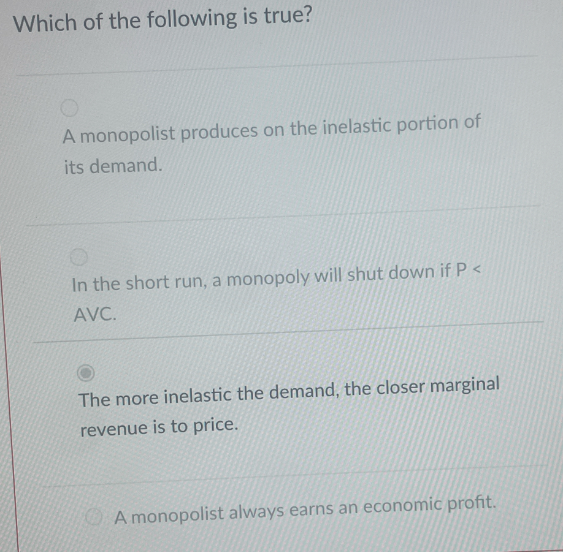 Which of the following is true?
A monopolist produces on the inelastic portion of
its demand.
In the short run, a monopoly will shut down if P<
AVC.
(0)
The more inelastic the demand, the closer marginal
revenue is to price.
7 A monopolist always earns an economic profit.
Which of the following is true?
A monopolist produces on the inelastic portion of
its demand.
In the short run, a monopoly will shut down if P<
AVC.
(0)
The more inelastic the demand, the closer marginal
revenue is to price.
7 A monopolist always earns an economic profit.