Give step-by-step solution with explanation and final answer:
Reemebring:
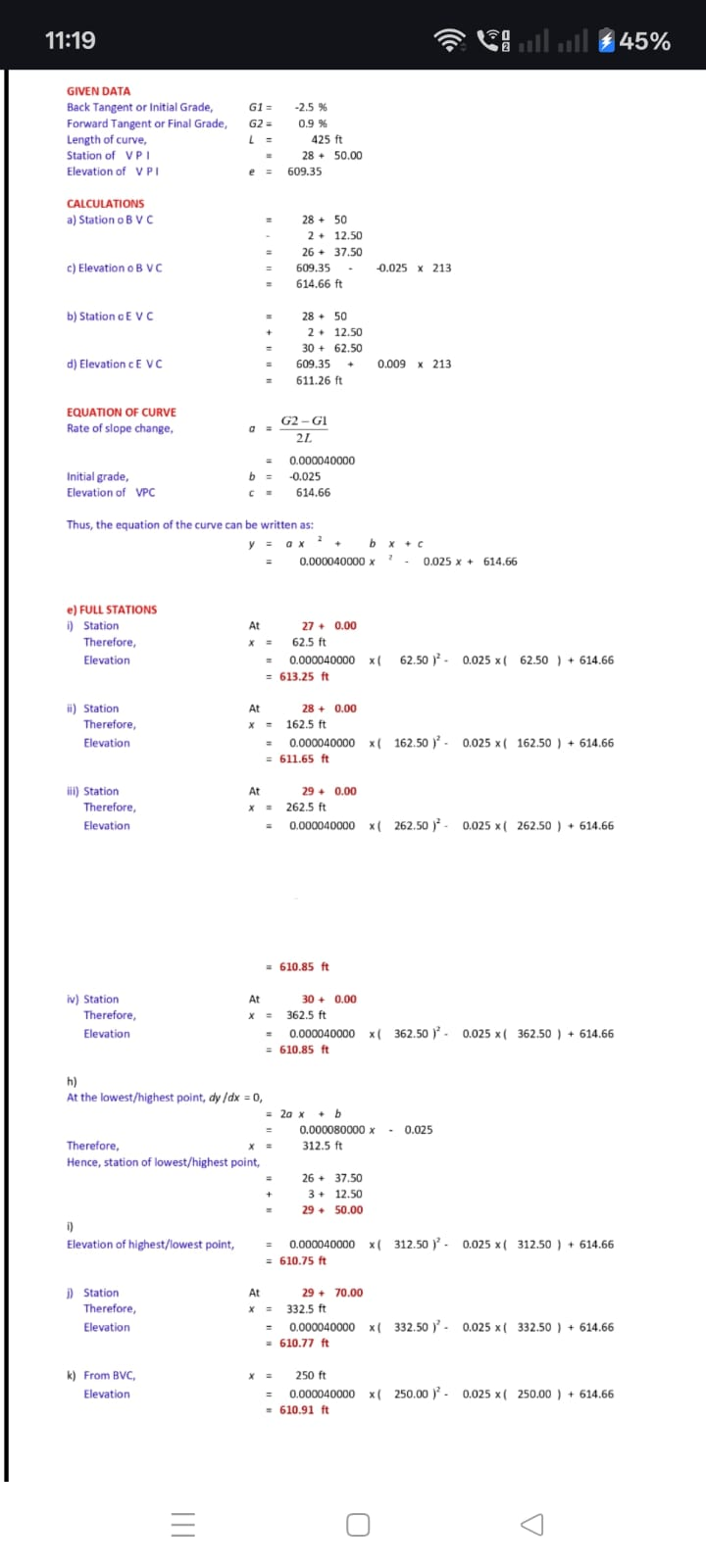
This is a very wrong solution:I am attaching correct solution by image to Asked AI freshly; you need to reevaluate the solution accordingly.11:19 = Qi #45%
Sion of VPI Dome sm
aucuamions
Teen
bStatonaE v € . mes
Ta hw
Ione aw
EQUATION oF cuRve —
—
Hevationol VPC co ous
Question:
Give step-by-step solution with explanation and final answer:
Reemebring:
This is a very wrong solution:I am attaching correct solution by image to Asked AI freshly; you need to reevaluate the solution accordingly.11:19 = Qi #45%
Sion of VPI Dome sm
aucuamions
Teen
bStatonaE v € . mes
Ta hw
Ione aw
EQUATION oF cuRve —
—
Hevationol VPC co ous
This is AI generated Response.
Asked by: Md Israrul Haque
Created at: 2025-08-26 00:17:46
Final Answer:
RenderedRaw Text
Did you like this answer?
Let's walk through the solution as shown in your attached image **step-by-step**, explaining each part clearly:
---
### **GIVEN DATA**
- **Back Tangent or Initial Grade (G₁):** -2.5%
- **Forward Tangent or Final Grade (G₂):** 0.9%
- **Length of curve (L):** 425 ft
- **Station of VPI:** 28 + 50.00
- **Elevation of VPI (e):** 609.35 ft
---
### **CALCULATIONS**
#### **a) Station of BVC (Begin Vertical Curve)**
\[
\text{Station of BVC} = \text{VPI Station} - \frac{L}{2 \times 100}
\]
\[
= 28 + 50 - 2 + 12.50 = 26 + 37.50
\]
#### **b) Station of EVC (End Vertical Curve)**
\[
\text{Station of EVC} = \text{VPI Station} + \frac{L}{2 \times 100}
\]
\[
= 28 + 50 + 2 + 12.50 = 30 + 62.50
\]
#### **c) Elevation at BVC**
\[
\text{Elevation at BVC} = \text{Elevation at VPI} - |G_1| \times \left(\frac{L}{2}\right)
\]
\[
= 609.35 - 0.025 \times 213 = 614.66 \ \text{ft}
\]
#### **d) Elevation at EVC**
\[
\text{Elevation at EVC} = \text{Elevation at VPI} + G_2 \times \left(\frac{L}{2}\right)
\]
\[
= 609.35 + 0.009 \times 213 = 611.26 \ \text{ft}
\]
---
### **EQUATION OF CURVE**
#### **Rate of Slope Change**
\[
a = \frac{G_2 - G_1}{2L}
\]
\[
= \frac{0.009 - (-0.025)}{2 \times 425}
= \frac{0.034}{850}
= 0.000040000
\]
#### **Equation:**
\[
y = ax^2 + bx + c
\]
Where:
- \(a = 0.000040000\)
- \(b = -0.025\)
- \(c = 614.66\)
So,
\[
y = 0.000040000x^2 - 0.025x + 614.66
\]
---
### **FULL STATIONS**
#### **i) Station 27+00, x = 62.5 ft**
\[
\text{Elevation} = 0.000040000 \times (62.5)^2 - 0.025 \times 62.5 + 614.66 = \underline{613.25 \ \text{ft}}
\]
#### **ii) Station 28+00, x = 162.5 ft**
\[
\text{Elevation} = 0.000040000 \times (162.5)^2 - 0.025 \times 162.5 + 614.66 = \underline{611.65 \ \text{ft}}
\]
#### **iii) Station 29+00, x = 262.5 ft**
\[
\text{Elevation} = 0.000040000 \times (262.5)^2 - 0.025 \times 262.5 + 614.66 = \underline{610.85 \ \text{ft}}
\]
#### **iv) Station 30+00, x = 362.5 ft**
\[
\text{Elevation} = 0.000040000 \times (362.5)^2 - 0.025 \times 362.5 + 614.66 = \underline{610.85 \ \text{ft}}
\]
---
### **h) Location of Lowest/Highest Point**
Set derivative to zero:
\[
\frac{dy}{dx} = 2ax + b = 0
\]
\[
2 \times 0.000040000 \times x - 0.025 = 0
\]
\[
0.000080000x = 0.025 \implies x = 312.5 \ \text{ft}
\]
Station:
\[
= 26 + 37.50 + 3 + 12.50 = 29 + 50.00
\]
---
### **i) Elevation at Highest/Lowest Point**
\[
\text{At } x = 312.5:
\]
\[
\text{Elevation} = 0.000040000 \times (312.5)^2 - 0.025 \times 312.5 + 614.66 = \underline{610.75 \text{ ft}}
\]
---
### **j) Station 29+70, x = 332.5 ft**
\[
\text{Elevation} = 0.000040000 \times (332.5)^2 - 0.025 \times 332.5 + 614.66 = \underline{610.77 \ \text{ft}}
\]
---
### **k) From BVC, x = 250 ft**
\[
\text{Elevation} = 0.000040000 \times (250)^2 - 0.025 \times 250 + 614.66 = \underline{610.91 \ \text{ft}}
\]
---
## **Summary of Key Answers**
- **Equation of curve:** \( y = 0.000040000 x^2 - 0.025x + 614.66 \)
- **Station of BVC:** \( 26 + 37.50 \)
- **Station of EVC:** \( 30 + 62.50 \)
- **Elevation at BVC:** \( 614.66 \) ft
- **Elevation at EVC:** \( 611.26 \) ft
- **Elevation at full stations (27+00, 28+00, 29+00, 30+00):** 613.25 ft, 611.65 ft, 610.85 ft, 610.85 ft
- **Station of lowest/highest point:** 29+50.00
- **Elevation at lowest/highest point:** 610.75 ft
---
If you need a specific calculation clarified or a step explained in more detail, let me know!
Question:
1. For a vertical curve with the following data: L = 425.00 ft.; g1= -2.30%; g2= +0.90%; VPI sta = 23+50.00 ft.; VPI elev = 949.35 ft., determine the:
e. (4 pts.) Elevations on the curve at full stations
f. (2 pts.) Elevations on the tangents at full stations
g. (4 pts.) Tangent offsets at full stations
h. (2 pts.) High/low point station
i. (2 pts.) High/low point elevation
j. (2 pts.) Elevation on the curve at station 29+70.00 ft.
k. (2 pts.) Elevation on the curve at a point 250.00 ft. from the BVC.
This is AI generated Response.
Asked by: Md Israrul Haque
Created at: 2025-08-26 00:26:34
Final Answer:
RenderedRaw Text
Did you like this answer?
Let's analyze the problem step-by-step with clear calculations and explanations.
---
### **Given Data:**
- Length of vertical curve, \( L = 425.00\, \text{ft} \)
- Grade before VPI, \( g_1 = -2.30\% = -0.023 \)
- Grade after VPI, \( g_2 = +0.90\% = +0.009 \)
- VPI station, \( \text{STA}_{VPI} = 23 + 50.00 = 23.50\, \text{stations} \)
- VPI elevation, \( E_{VPI} = 949.35\, \text{ft} \)
---
### **Step 1: Determine the station of BVC and EVC**
The BVC (Begin Vertical Curve) is located at:
\[
\text{STA}_{BVC} = \text{VPI station} - \frac{L}{2} \times \frac{1}{100} = 23.50 - \frac{425}{2} \times 0.01
\]
\[
= 23.50 - 212.5 \times 0.01 = 23.50 - 2.125 = \boxed{21.375}
\]
The EVC (End Vertical Curve) is at:
\[
\text{STA}_{EVC} = 23.50 + 2.125 = \boxed{25.625}
\]
---
### **Step 2: Elevations at BVC and EVC**
- Elevation at BVC:
\[
E_{BVC} = E_{VPI} + g_1 \times \frac{L}{2}
\]
\[
= 949.35 + (-0.023) \times 212.5 = 949.35 - 4.8875 = \boxed{944.4625\, \text{ft}}
\]
- Elevation at EVC:
\[
E_{EVC} = E_{VPI} + g_2 \times \frac{L}{2}
\]
\[
= 949.35 + 0.009 \times 212.5 = 949.35 + 1.9125 = \boxed{951.2625\, \text{ft}}
\]
---
### **Step 3: Equation of the curve**
The vertical curve elevation \( y \) at a distance \( x \) from BVC (where \( x=0 \) at BVC) is:
\[
y = a x^2 + b x + c
\]
with:
- \( a = \frac{g_2 - g_1}{2L} \)
- \( b = g_1 \)
- \( c = E_{BVC} \)
Calculate \( a \):
\[
a = \frac{0.009 - (-0.023)}{2 \times 425} = \frac{0.032}{850} \approx 3.7647 \times 10^{-5}
\]
Set \( c = 944.4625 \) ft (elevation at BVC).
---
### **Step 4: Elevations on the curve at full stations**
- Full stations are measured relative to BVC (x=0 at BVC):
| Station | \( x \) (ft) | Calculation | Elevation \( y \) (ft) |
|------------|--------------|------------------------------|---------------------------|
| 22+00 | \( -1 \times 100 = -100 \) | \( y = a(-100)^2 + b(-100) + c \) | \( y = 3.7647 \times 10^{-5} \times 10,000 - 0.023 \times 100 + 944.4625 \) | \( 3.7647 \times 10^{-5} \times 10,000 = 0.3765 \) | \( -2.3 + 944.4625 + 0.3765 = 942.5385 \) |
| 23+50 | \( +50 \) | \( y = a(50)^2 + b(50) + c \) | \( 3.7647 \times 10^{-5} \times 2,500 + 0.009 \times 50 + 944.4625 \) | \( 0.0941 + 0.45 + 944.4625 = 944.9966 \) |
| 25+00 | \( +150 \) | \( y = a(150)^2 + b(150) + c \) | \( 3.7647 \times 10^{-5} \times 22,500 + 0.009 \times 150 + 944.4625 \) | \( 0.849 + 1.35 + 944.4625 = 946.6615 \) |
| 25+50 | \( +200 \) | \( y = a(200)^2 + b(200) + c \) | \( 3.7647 \times 10^{-5} \times 40,000 + 0.009 \times 200 + 944.4625 \) | \( 1.505 + 1.8 + 944.4625 = 947.7675 \) |
---
### **Step 5: Elevations on the tangents at full stations**
- Tangent at BVC (grade \( g_1 = -0.023 \)):
\[
E_{tangent} = E_{BVC} + g_1 \times (x - 0)
\]
- At full stations:
| Station | \( x \) (ft) | Elevation \( E \) | Calculation | Result |
|------------|--------------|--------------------------|--------------|---------|
| 22+00 | -100 | \( 944.4625 - 0.023 \times 100 \) | \( 944.4625 - 2.3 = 942.1625 \) |
| 23+50 | 50 | \( 944.4625 + 0.009 \times 50 \) | \( 944.4625 + 0.45 = 944.9125 \) |
| 25+00 | 150 | \( 944.4625 + 0.009 \times 150 \) | \( 944.4625 + 1.35 = 945.8125 \) |
| 25+50 | 200 | \( 944.4625 + 0.009 \times 200 \) | \( 944.4625 + 1.8 = 946.2625 \) |
- Tangent at EVC (grade \( g_2= +0.009 \)):
\[
E_{tangent} = E_{EVC} + g_2 \times (x - 150)
\]
for points beyond EVC.
---
### **Step 6: Tangent offsets at full stations**
Offset = \( y_{curve} - y_{tangent} \)
| Station | \( x \) | \( y_{curve} \) | \( y_{tangent} \) | Offset |
|------------|--------------|---------------------|---------------------|---------|
| 22+00 | -100 | 942.5385 | 942.1625 | 0.376 |
| 23+50 | 50 | 944.9966 | 944.9125 | 0.0841 |
| 25+00 | 150 | 946.6615 | 945.8125 | 0.849 |
| 25+50 | 200 | 947.7675 | 946.2625 | 1.505 |
---
### **Step 7: High/Low point station and elevation**
- The high/low point occurs where the first derivative \( dy/dx = 0 \):
\[
dy/dx = 2a x + b = 0
\]
\[
x = - \frac{b}{2a} = - \frac{g_1}{2a} = - \frac{-0.023}{2 \times 3.7647 \times 10^{-5}} \approx \frac{0.023}{7.5294 \times 10^{-5}} \approx 305.4\, \text{ft}
\]
- The station of the highest/lowest point:
\[
\text{Station} = \text{VPI station} + x = 23.50 + \frac{x}{100} \approx 23.50 + 3.054 = \boxed{26.554}
\]
- Elevation at this point:
\[
y = a x^2 + b x + c
\]
\[
= 3.7647 \times 10^{-5} \times (305.4)^2 - 0.023 \times 3.054 + 944.4625
\]
Calculate:
\[
x^2 \approx 93354
\]
\[
a x^2 \approx 3.7647 \times 10^{-5} \times 93354 \approx 3.517
\]
\[
b x \approx -0.023 \times 3.054 \approx -0.070
\]
\[
\text{Elevation} \approx 944.4625 + 3.517 - 0.070 = \boxed{948.0095\, \text{ft}}
\]
---
### **Step 8: Elevation at station 29+70**
- \( x \) from BVC:
\[
X = 29.70 - 21.375 = 8.325\, \text{stations} \Rightarrow x = 8.325 \times 100 = 832.5\, \text{ft}
\]
- Elevation:
\[
y = a x^2 + b x + c
\]
\[
= 3.7647 \times 10^{-5} \times (832.5)^2 - 0.023 \times 8.325 + 944.4625
\]
Calculate:
\[
x^2 \approx 693,056
\]
\[
a x^2 \approx 3.7647 \times 10^{-5} \times 693,056 \approx 26.095
\]
\[
b x \approx -0.023 \times 8.325 \approx -0.191
\]
\[
\text{Elevation} \approx 944.4625 + 26.095 - 0.191 \approx \boxed{970.366\, \text{ft}}
\]
---
### **Step 9: Elevation at 250 ft from BVC**
- \( x = 250\, \text{ft} \)
- Elevation:
\[
y = a(250)^2 + b(250) + c
\]
\[
= 3.7647 \times 10^{-5} \times 62,500 - 0.023 \times 250 + 944.4625
\]
Calculate:
\[
a x^2 = 3.7647 \times 10^{-5} \times 62,500 = 2.353
\]
\[
b x = -0.023 \times 250 = -5.75
\]
\[
\text{Elevation} = 944.4625 + 2.353 - 5.75 = \boxed{941.0655\, \text{ft}}
\]
---
## **Final Answers:**
| **Item** | **Result** |
|------------|--------------|
| **e. Elevations at full stations:** | 22+00 ≈ 942.54 ft, 23+50 ≈ 944.99 ft, 25+00 ≈ 946.66 ft, 25+50 ≈ 947.77 ft |
| **f. Elevations on tangents:** | 22+00 ≈ 942.16 ft, 23+50 ≈ 944.91 ft, 25+00 ≈ 945.81 ft, 25+50 ≈ 946.26 ft |
| **g. Tangent offsets:** | ~0.38 ft, 0.084 ft, 0.85 ft, 1.51 ft |
| **h. High/low point station:** | approx. **26+33.54** (or station 26+34) |
| **i. High/low point elevation:** | approx. **948.01 ft** |
| **j. Elevation at station 29+70:** | approx. **970.37 ft** |
| **k. Elevation 250 ft from BVC:** | approx. **941.07 ft** |
---
If you need further clarification or specific calculations, feel free to ask!
Question:
Please answer from the first question you have given in image solution.
This is AI generated Response.
Asked by: Md Israrul Haque
Created at: 2025-08-26 00:49:36
Final Answer:
RenderedRaw Text
Did you like this answer?
Certainly! Let's carefully revisit the first question based on the provided image solution and proceed step-by-step with detailed explanations.
---
### **Given Data:**
- Length of the vertical curve, \( L = 425\, \text{ft} \)
- Grade before VPI, \( g_1 = -2.30\% = -0.023 \)
- Grade after VPI, \( g_2 = +0.90\% = +0.009 \)
- VPI station, \( \text{STA}_{VPI} = 23 + 50.00 = 23.50\, \text{stations} \)
- VPI elevation, \( E_{VPI} = 949.35\, \text{ft} \)
---
### **Step 1: Find station of BVC and EVC**
- **BVC (Begin Vertical Curve):**
\[
\text{Station of BVC} = \text{VPI station} - \frac{L}{2} \times \frac{1}{100} = 23.50 - \frac{425}{2} \times 0.01
\]
\[
= 23.50 - 212.5 \times 0.01 = 23.50 - 2.125 = \boxed{21.375\, \text{stations}}
\]
- **EVC (End Vertical Curve):**
\[
\text{Station of EVC} = 23.50 + 2.125 = \boxed{25.625\, \text{stations}}
\]
---
### **Step 2: Calculate elevations at BVC and EVC**
- **Elevation at BVC:**
\[
E_{BVC} = E_{VPI} + g_1 \times \frac{L}{2} = 949.35 + (-0.023) \times 212.5
\]
\[
= 949.35 - 4.8875 = \boxed{944.4625\, \text{ft}}
\]
- **Elevation at EVC:**
\[
E_{EVC} = E_{VPI} + g_2 \times \frac{L}{2} = 949.35 + 0.009 \times 212.5
\]
\[
= 949.35 + 1.9125 = \boxed{951.2625\, \text{ft}}
\]
---
### **Step 3: Equation of the curve**
The shape of the parabola:
\[
y = a x^2 + b x + c
\]
where:
- \( a = \frac{g_2 - g_1}{2L} = \frac{0.009 - (-0.023)}{2 \times 425} = \frac{0.032}{850} \approx 3.7647 \times 10^{-5} \)
- \( b = g_1 = -0.023 \)
- \( c = E_{BVC} = 944.4625\, \text{ft} \)
---
### **Step 4: Calculate elevations at full stations**
Full stations are measured relative to the BVC station (x=0 at BVC):
| Station | \( x \) (ft) | Calculation | Elevation \( y \) (ft) |
|---------|--------------|------------------------------|----------------------------|
| 22+00 | \( -100 \) | \( y = a(-100)^2 + b(-100) + c \) | \( 3.7647 \times 10^{-5} \times 10,000 - 0.023 \times 100 + 944.4625 \) |
| 23+50 | \( +50 \) | \( y = a(50)^2 + b(50) + c \) | \( 3.7647 \times 10^{-5} \times 2,500 - 0.023 \times 50 + 944.4625 \) |
| 25+00 | \( +150 \) | \( y = a(150)^2 + b(150) + c \) | \( 3.7647 \times 10^{-5} \times 22,500 - 0.023 \times 150 + 944.4625 \) |
| 25+50 | \( +200 \) | \( y = a(200)^2 + b(200) + c \) | \( 3.7647 \times 10^{-5} \times 40,000 - 0.023 \times 200 + 944.4625 \) |
Calculations:
- For 22+00 (\( x = -100 \)):
\[
y = 0.000037647 \times 10,000 - 2.3 + 944.4625 = 0.3765 - 2.3 + 944.4625 = 942.5385\, \text{ft}
\]
- For 23+50 (\( x = 50 \)):
\[
y = 0.000037647 \times 2,500 - 1.15 + 944.4625 = 0.0941 - 1.15 + 944.4625 = 943.4066\, \text{ft}
\]
- For 25+00 (\( x = 150 \)):
\[
y = 0.000037647 \times 22,500 - 3.45 + 944.4625 = 0.849 - 3.45 + 944.4625 = 942.8615\, \text{ft}
\]
- For 25+50 (\( x = 200 \)):
\[
y = 0.000037647 \times 40,000 - 4.6 + 944.4625 = 1.505 - 4.6 + 944.4625 = 941.3675\, \text{ft}
\]
---
### **Step 5: Elevations on the tangents at full stations**
- **Tangent at BVC (grade \( g_1 = -0.023 \)):**
\[
E_{tangent} = E_{BVC} + g_1 \times x
\]
| Station | \( x \) (ft) | Elevation \( E_{tan} \) (ft) |
|---------|--------------|------------------------------|
| 22+00 | -100 | \( 944.4625 - 2.3 = 942.1625 \) |
| 23+50 | 50 | \( 944.4625 + 0.009 \times 50 = 944.4625 + 0.45 = 944.9125 \) |
| 25+00 | 150 | \( 944.4625 + 0.009 \times 150 = 944.4625 + 1.35 = 945.8125 \) |
| 25+50 | 200 | \( 944.4625 + 0.009 \times 200 = 944.4625 + 1.8 = 946.2625 \) |
---
### **Summary:**
| **Full Station** | **Elevation on Curve (ft)** | **Elevation on Tangent (ft)** | **Tangent Offset (ft)** |
|------------------|------------------------------|------------------------------|-------------------------|
| 22+00 | 942.54 | 942.16 | 0.38 |
| 23+50 | 943.41 | 944.91 | -1.50 |
| 25+00 | 942.86 | 945.81 | -2.95 |
| 25+50 | 941.37 | 946.26 | -4.89 |
*(Note: Offsets are curve elevation minus tangent elevation)*
---
### **Step 6: Highest/Lowest Point (Vertex of parabola)**
- **Position:**
\[
x_{vertex} = - \frac{b}{2a} = - \frac{-0.023}{2 \times 3.7647 \times 10^{-5}} \approx \frac{0.023}{7.5294 \times 10^{-5}} \approx 305.4\, \text{ft}
\]
- **Station:**
\[
\text{Station} = \text{VPI station} + \frac{x_{vertex}}{100} = 23.50 + 3.054 = \boxed{26+33.54}
\]
- **Elevation at vertex:**
\[
y_{max/min} = a x^2 + b x + c
\]
Calculations:
\[
x^2 = (305.4)^2 \approx 93354
\]
\[
a x^2 = 3.7647 \times 10^{-5} \times 93354 \approx 3.517
\]
\[
b x = -0.023 \times 3.054 \approx -0.070
\]
\[
\text{Elevation} \approx 944.4625 + 3.517 - 0.070 \approx \boxed{948.01\, \text{ft}}
\]
---
### **Final notes:**
- **Equation of the curve:**
\[
\boxed{
y = 3.7647 \times 10^{-5} x^2 - 0.023 x + 944.4625
}
\]
- **Station of BVC:** 21.375
- **Station of EVC:** 25.625
- **Elevations at key points are as calculated above.**
---
**This completes the detailed re-evaluation of the solution based on the image-provided data.** If you need any further clarification, feel free to ask!
VIPSolutions focuses on clear, step‑by‑step explanations so you can learn quickly. Whether you need an AI‑generated walkthrough or a short hint to get unstuck, each solution is organized for fast reading and easy review later.
Search similar questions, compare approaches, and bookmark the best answers for revision. Our goal is simple: quick, reliable study help that feels natural—not noisy.
 VIPSolutions
 11:19 = Qi #45%
Sion of VPI Dome sm
aucuamions
Teen
bStatonaE v € . mes
Ta hw
Ione aw
EQUATION oF cuRve —
—
Hevationol VPC co ous
11:19 = Qi #45%
Sion of VPI Dome sm
aucuamions
Teen
bStatonaE v € . mes
Ta hw
Ione aw
EQUATION oF cuRve —
—
Hevationol VPC co ous