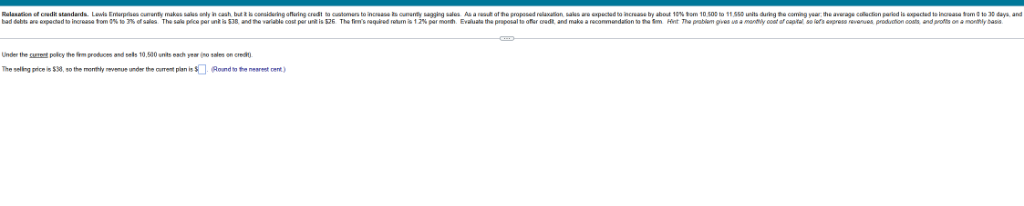
Relaxation of credit standards.
Lewis Enterprises currently makes sales only in
cash, but it is considering offering credit
to customers to increase its currently sagging sales.
As a result of the proposed
relaxation, sales are expected to increase by about
1
0
%
from
1
0
,
5
0
0
to
1
1
,
5
5
0
units during the coming
year; the average collection period is expected to increase from
0
to
3
0
days
,
and bad debts are expected to increase from
0
%
to
3
%
of sales.
The sale price per unit is
$
3
8
,
and the variable cost per unit is
$
2
6
.
The
firm's required return is
1
.
2
%
per month.
Evaluate the proposal to offer
credit, and make a recommendation to the firm.
Hint: The problem gives us a monthly cost of
capital, so
let's express
revenues, production
costs, and profits on a monthly basis.
Under the current policy the firm produces and sells
1
0
,
5
0
0
units each year
(
no sales on credit
)
.
The selling price is
\
(
\
$
3
8
\
)
,
so the monthly revenue under the current plan is
\
(
\
$
\
)
\
(
\
square
\
)
(
Round to the nearest cent.
)et 5 rr bn rp, | Gomi set)
Question:
Relaxation of credit standards.
Lewis Enterprises currently makes sales only in
cash, but it is considering offering credit
to customers to increase its currently sagging sales.
As a result of the proposed
relaxation, sales are expected to increase by about
1
0
%
from
1
0
,
5
0
0
to
1
1
,
5
5
0
units during the coming
year; the average collection period is expected to increase from
0
to
3
0
days
,
and bad debts are expected to increase from
0
%
to
3
%
of sales.
The sale price per unit is
$
3
8
,
and the variable cost per unit is
$
2
6
.
The
firm's required return is
1
.
2
%
per month.
Evaluate the proposal to offer
credit, and make a recommendation to the firm.
Hint: The problem gives us a monthly cost of
capital, so
let's express
revenues, production
costs, and profits on a monthly basis.
Under the current policy the firm produces and sells
1
0
,
5
0
0
units each year
(
no sales on credit
)
.
The selling price is
\
(
\
$
3
8
\
)
,
so the monthly revenue under the current plan is
\
(
\
$
\
)
\
(
\
square
\
)
(
Round to the nearest cent.
)et 5 rr bn rp, | Gomi set)
This is AI generated Response.
Asked by: Veera manikanta
Created at: 2025-07-28 06:52:23
Final Answer:
RenderedRaw Text
Did you like this answer?
Let's break down the problem step by step:
## Step 1: Calculate the firm's current monthly revenue.
- **Annual sales (current):** 10,500 units
- **Sale price per unit:** $38
### Annual Revenue (Current)
\[
\text{Annual Revenue} = 10{,}500 \times \$38 = \$399{,}000
\]
### Monthly Revenue (Current)
\[
\text{Monthly Revenue} = \frac{\$399{,}000}{12} = \$33{,}250
\]
---
## **Answer to the Box**
The monthly revenue under the current plan is **\$33,250.00**.
---
If you need further calculations for the proposal (profit, costs, bad debts, etc.), let me know!
Question:
1: Introduction:
Provide the complete necessary conceptual background concepts explanation and the
introduction required to understand and answer the given question. Add an Explanation
block at the end of the introduction by adding various relevant supporting statements and
explaining the introduction concisely.
Note: Do not use personal pronouns like I, we, you, etc. The response must look as if it is
written by a human.
Explanation: Articulate the importance of the introduction, providing more relevant
comprehensive supporting statements that link these concepts directly to the question.
This explanation should clarify how the introduction aids in comprehending the
subsequent steps.
2: Presentation of Relevant Formulas Required To Solve The Question:
List and also describe all formulas required to solve the question. Ensure each formula is
presented clearly and is directly applicable to the problem.
Explanation: Detail the derivation or rationale behind each formula, explaining its
relevance and necessity in the context of the problem-solving process. Use more relavent
comprehensive supporting statements to reinforce the significance of these mathematical
tools.
3: A Detailed Step-by-Step Solution:
Write a step-by-step in-depth comprehensive straight forward complete solution in a
structured way without missing anything as per the requirements and also include
explanation [ Write relevant supporting statements in the explanation block ] for every step
in the solution.
Conclusion:
Conclude with a concise summary of the solution, succinctly presenting the final answer
short summary derived from the calculations.
Follow These Guidelines While Answering The Question:
1. Maintain a professional and impersonal tone throughout, avoiding personal
pronouns such as 'I', 'we', 'you', etc.
2. Ensure more accuracy and adherence to the necessary concepts and correct
textbook based correct formulas and other relevant, required to solve the question.
3. Include an Explanation block at the end of each step to provide context and clarify
the methodology used by providing the necessary supporting statements.
4. Focus solely on delivering a well-explained direct and complete answer to the
question, without additional guidance [ I don’t need any guidance of how to solve
the question – I just need well-explained complete solution ] or extraneous content.
5. Make sure that strictly follow the specified format, ensuring that each section,
especially the introduction and each step of the solution, is accompanied by a
detailed relevant supporting statement in the explanation.
6. I need the exact detailed comprehensive direct step-by-step answer as I don’t need
any guidance to write the answer and strictly add the explanation for each with the
required supporting statement & Please give me the complete answer as per the
question requirements without skipping anything in the answer.
7. Always provide correct, complete detailed & well-explained solution.
8. Ensure that there are no typo/formula/calculation/programming/grammatical errors
are present in your solution.
9. Give the correct graphs/diagrams/tables/charts whenever required in the solution.
10. Ensure that there are NO Errors in Units/Notations are there in your solution.
11. Avoid missing any vital part in the solution [ Don’t miss any part in the solution ].
This is AI generated Response.
Asked by: Veera manikanta
Created at: 2025-07-28 06:55:39
Final Answer:
RenderedRaw Text
Did you like this answer?
**1. Introduction**
Understanding the implications of relaxing credit standards involves analyzing how extending credit to customers affects a firm's sales volume, accounts receivable, bad debts, and overall profitability. When a company traditionally operates on cash sales, all revenue is received immediately, and there are no concerns about collection periods or bad debts. However, offering credit introduces a delay in cash inflows, potentially increasing sales but also raising risks and costs associated with longer collection periods and higher bad debt expenses.
Key concepts relevant to this analysis include:
- **Sales Volume and Revenue:** Extending credit can stimulate higher sales volume due to increased customer convenience, which in turn affects total revenue.
- **Accounts Receivable and Collection Period:** Offering credit lengthens the time between sale and cash receipt, impacting cash flow and working capital management.
- **Bad Debts:** The risk of customers defaulting increases with credit extension, leading to potential losses.
- **Cost of Capital:** The firm’s required return on investment, which must be considered when evaluating the opportunity cost of funds tied up in receivables.
- **Incremental Analysis:** Comparing the additional revenues and costs resulting from the credit policy change helps determine financial viability.
This background provides the foundation for evaluating whether relaxing credit standards will enhance profitability and aligns with the firm’s financial goals.
**Explanation:**
This introduction emphasizes the critical financial concepts involved in credit management decisions. Understanding how sales, receivables, bad debts, and costs interplay enables a comprehensive assessment of the proposal’s impact. The concepts serve as the basis for subsequent quantitative analysis, ensuring that the evaluation considers both potential benefits and risks.
---
**2. Presentation of Relevant Formulas Required To Solve The Question**
The following formulas are essential for analyzing the impact of extending credit:
a) **Monthly Sales Revenue (Current and Proposed):**
\[
\text{Monthly Revenue} = \text{Units Sold per Month} \times \text{Price per Unit}
\]
b) **Incremental Sales Volume:**
\[
\text{New Sales Units} = \text{Current Units} \times (1 + \text{Sales Increase Percentage})
\]
c) **Average Accounts Receivable (AR):**
\[
\text{AR} = \text{Sales on Credit} \times \frac{\text{Collection Period in Days}}{30}
\]
*Note:* Since sales are on credit, the collection period affects AR.
d) **Bad Debts Expense:**
\[
\text{Bad Debts} = \text{Sales on Credit} \times \text{Bad Debt Percentage}
\]
e) **Additional Accounts Receivable (Incremental):**
\[
\Delta AR = \text{AR (Proposed)} - \text{AR (Current)}
\]
f) **Cost of Capital on Additional Receivables:**
\[
\text{Cost} = \text{Incremental AR} \times \text{Monthly Cost of Capital}
\]
where the monthly cost of capital = annual required return / 12.
g) **Incremental Profit (Contribution Margin):**
\[
\text{Contribution Margin per Unit} = \text{Sale Price per Unit} - \text{Variable Cost per Unit}
\]
\[
\text{Incremental Profit} = (\text{Incremental Units Sold} \times \text{Contribution Margin per Unit}) - \text{Additional Bad Debts} - \text{Additional Cost of Capital}
\]
---
**3. A Detailed Step-by-Step Solution**
**Step 1:** Calculate current sales volume and revenue.
- Current annual sales units: 10,500 units
- Sale price per unit: $38
**Current annual revenue:**
\[
10,500 \times \$38 = \$399,000
\]
**Current monthly revenue:**
\[
\$399,000 / 12 = \$33,250
\]
*Explanation:* The current scenario provides a baseline for revenue and sales volume, essential for comparison against the proposed credit extension.
---
**Step 2:** Determine the projected sales units after relaxation of credit standards.
- Sales are expected to increase by 10%:
\[
10,500 \times 1.10 = 11,550 \text{ units}
\]
**Projected annual revenue:**
\[
11,550 \times \$38 = \$438,900
\]
**Projected monthly revenue:**
\[
\$438,900 / 12 \approx \$36,575
\]
*Explanation:* The increase in sales volume due to credit extension directly impacts revenue. This step quantifies the expected growth.
---
**Step 3:** Calculate the increase in sales units and revenue attributable to credit extension.
- Incremental units sold:
\[
11,550 - 10,500 = 1,050 \text{ units}
\]
- Incremental monthly units:
\[
1,050 / 12 \approx 87.5 \text{ units}
\]
- Incremental monthly revenue:
\[
\$36,575 - \$33,250 = \$3,325
\]
*Explanation:* These figures represent the additional sales attributable solely to the credit extension, providing the basis for incremental profit calculation.
---
**Step 4:** Compute the accounts receivable under current and proposed policies.
- **Current:** Since all sales are cash, AR = 0.
- **Proposed:** Accounts receivable depends on the collection period (30 days) and sales on credit.
\[
\text{Average AR} = \text{Sales on Credit} \times \frac{\text{Collection Period in Days}}{30}
\]
- **Sales on Credit (Proposed):**
\[
\$438,900
\]
- **Average AR:**
\[
\$438,900 \times \frac{30}{365} \approx \$36,066
\]
*(Alternatively, since the collection period is 30 days, AR is roughly 1/12 of annual credit sales):*
\[
\text{AR} \approx \frac{\text{Annual Credit Sales}}{12} = \frac{\$438,900}{12} \approx \$36,575
\]
*Note:* For simplicity, using the method based on 30 days:
\[
\text{AR} = \text{Annual credit sales} \times \frac{30}{365} \approx \$36,066
\]
*Explanation:* The AR reflects the funds tied up due to credit sales, which have cost implications and influence working capital requirements.
---
**Step 5:** Calculate the additional bad debts resulting from the credit policy.
- Bad debt percentage increases from 0% to 3%.
- **Additional bad debts:**
\[
\$438,900 \times 3\% = \$13,167
\]
- **Bad debts attributable to incremental sales:**
\[
\$13,167 \times \frac{\text{Incremental units}}{\text{Total units}} \approx \$13,167 \times \frac{1,050}{11,550} \approx \$1,200
\]
*Explanation:* Bad debts reduce net profit; thus, the increase in bad debt expenses must be subtracted from the incremental contribution.
---
**Step 6:** Calculate the contribution margin per unit.
\[
\text{Contribution Margin} = \$38 - \$26 = \$12
\]
- **Incremental contribution:**
\[
1,050 \text{ units} \times \$12 = \$12,600
\]
*Explanation:* This represents the gross profit generated by the additional sales before considering bad debts and the cost of capital tied up in receivables.
---
**Step 7:** Determine the cost of capital on additional accounts receivable.
- **Monthly required return:**
\[
\frac{1.2\% \text{ per month}} = 0.012
\]
- **Additional AR:**
\[
\$36,066
\]
- **Monthly cost of capital:**
\[
\$36,066 \times 0.012 \approx \$433
\]
- **Annualized cost:**
\[
\$433 \times 12 \approx \$5,196
\]
*Explanation:* This cost reflects the opportunity cost of funds invested in receivables, reducing net incremental profit.
---
**Step 8:** Calculate the net incremental profit.
\[
\text{Net Incremental Profit} = \text{Incremental Contribution} - \text{Bad Debts} - \text{Cost of Capital}
\]
\[
= \$12,600 - \$1,200 - \$5,196 = \$6,204
\]
*Explanation:* The net profit considers all relevant incremental revenues and costs, providing a comprehensive view of the financial impact.
---
**Conclusion:**
The analysis indicates that relaxing credit standards would generate an estimated **\$6,204** in additional monthly profit, after accounting for increased bad debts and the cost of capital tied up in receivables. Since this figure is positive, the proposal appears financially beneficial. However, it is important to consider other qualitative factors such as collection management and credit risk policies before final decision-making.
---
**Summary:**
Relaxing credit extends sales, increases receivables, and incurs additional bad debts and capital costs. The net impact, based on the calculations, shows a monthly incremental profit of approximately **\$6,204**, suggesting that offering credit can be a profitable strategy for Lewis Enterprises under the given assumptions.
VIPSolutions focuses on clear, step‑by‑step explanations so you can learn quickly. Whether you need an AI‑generated walkthrough or a short hint to get unstuck, each solution is organized for fast reading and easy review later.
Search similar questions, compare approaches, and bookmark the best answers for revision. Our goal is simple: quick, reliable study help that feels natural—not noisy.
 VIPSolutions
 et 5 rr bn rp, | Gomi set)