Chapter Case
. Stock Valuation at Ragan, Inc.
Ragan, Inc., was founded nine years ago by brother and sister Carrington and Genevieve Ragan. The company manufactures and installs
commercial heating, ventilation, and cooling (HVAC) units. Ragan, Inc. has experienced rapid growth because of a proprietary technology
that increases the energy efficiency of its units. The company is equally owned by Carrington and Genevieve. The original partnership
agreement between the siblings gave each 50,000 shares of stock. In the event either wished to sell stock, the shares first had to be offered
to the other at a discounted price.
Although neither sibling wants to sell, they have decided they should value their holdings in the company. To get started, they have gathered
the following information about their main competitors:
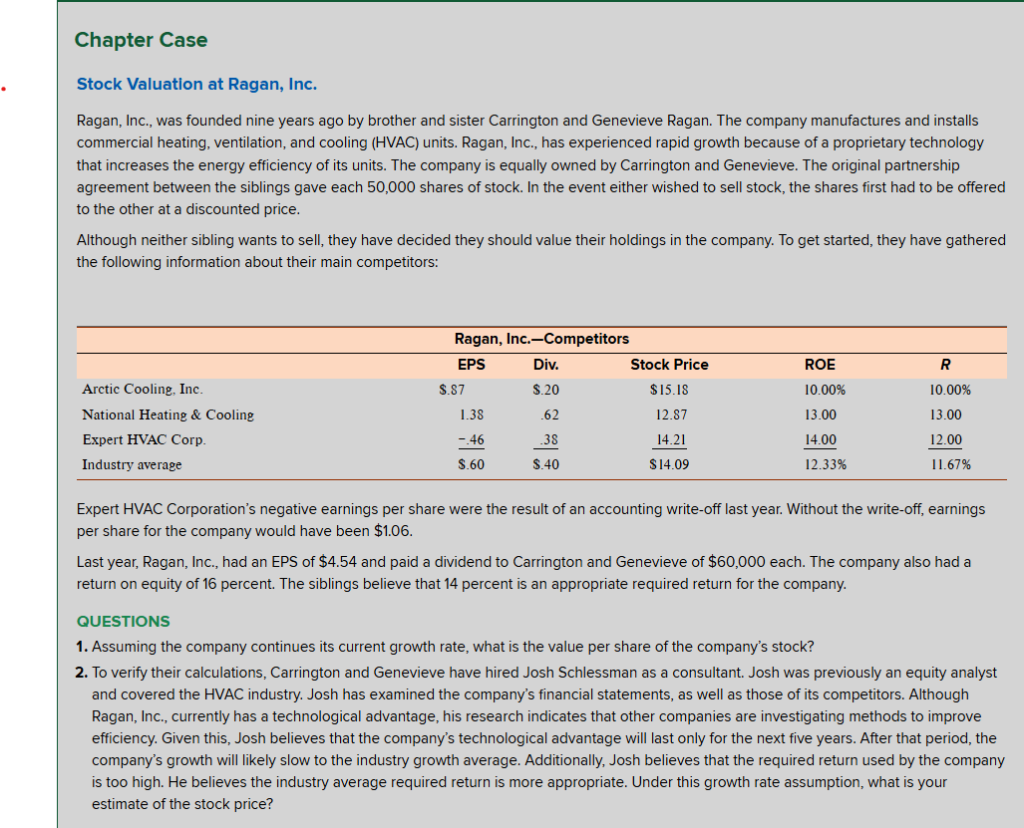
Ragan, Inc.—Competitors
EPS Div. Stock Price ROE R
Arctic Cooling, Inc. $87 $20 $15.18 10.00% 10.00%
National Heating & Cooling. 138 62 1287 13.00 13.00
Expert HVAC Corp. = 38 1421 1400 1200
Industry average $60 $40 $14.09 12.33% 1.67%
Expert HVAC Corporation's negative eamings per share were the result of an accounting write-off last year. Without the write-off, earnings
per share for the company would have been $1.06.
Last year, Ragan, Inc., had an EPS of $4.54 and paid a dividend to Carrington and Genevieve of $60,000 each. The company also had a
return on equity of 16 percent. The siblings believe that 14 percent is an appropriate required return for the company.
QUESTIONS
1. Assuming the company continues its current growth rate, what is the value per share of the company’s stock?
2. To verify their calculations, Carrington and Genevieve have hired Josh Schlessman as a consultant. Josh was previously an equity analyst
and covered the HVAC industry. Josh has examined the company’s financial statements, as well as those of its competitors. Although
Ragan, Inc. currently has a technological advantage, his research indicates that other companies are investigating methods to improve
efficiency. Given this, Josh believes that the company’s technological advantage will last only for the next five years. After that period, the
company’s growth will likely slow to the industry growth average. Additionally, Josh believes that the required return used by the company
is 100 high. He believes the industry average required return is more appropriate. Under this growth rate assumption, what is your
estimate of the stock price?
Question:
Chapter Case
. Stock Valuation at Ragan, Inc.
Ragan, Inc., was founded nine years ago by brother and sister Carrington and Genevieve Ragan. The company manufactures and installs
commercial heating, ventilation, and cooling (HVAC) units. Ragan, Inc. has experienced rapid growth because of a proprietary technology
that increases the energy efficiency of its units. The company is equally owned by Carrington and Genevieve. The original partnership
agreement between the siblings gave each 50,000 shares of stock. In the event either wished to sell stock, the shares first had to be offered
to the other at a discounted price.
Although neither sibling wants to sell, they have decided they should value their holdings in the company. To get started, they have gathered
the following information about their main competitors:
Ragan, Inc.—Competitors
EPS Div. Stock Price ROE R
Arctic Cooling, Inc. $87 $20 $15.18 10.00% 10.00%
National Heating & Cooling. 138 62 1287 13.00 13.00
Expert HVAC Corp. = 38 1421 1400 1200
Industry average $60 $40 $14.09 12.33% 1.67%
Expert HVAC Corporation's negative eamings per share were the result of an accounting write-off last year. Without the write-off, earnings
per share for the company would have been $1.06.
Last year, Ragan, Inc., had an EPS of $4.54 and paid a dividend to Carrington and Genevieve of $60,000 each. The company also had a
return on equity of 16 percent. The siblings believe that 14 percent is an appropriate required return for the company.
QUESTIONS
1. Assuming the company continues its current growth rate, what is the value per share of the company’s stock?
2. To verify their calculations, Carrington and Genevieve have hired Josh Schlessman as a consultant. Josh was previously an equity analyst
and covered the HVAC industry. Josh has examined the company’s financial statements, as well as those of its competitors. Although
Ragan, Inc. currently has a technological advantage, his research indicates that other companies are investigating methods to improve
efficiency. Given this, Josh believes that the company’s technological advantage will last only for the next five years. After that period, the
company’s growth will likely slow to the industry growth average. Additionally, Josh believes that the required return used by the company
is 100 high. He believes the industry average required return is more appropriate. Under this growth rate assumption, what is your
estimate of the stock price?
This is AI generated Response.
Asked by: Veera manikanta
Created at: 2025-08-03 20:54:37
Final Answer:
RenderedRaw Text
Did you like this answer?
Let's break down the information and help you answer the questions.
---
### **Given Data**
- **Ragan, Inc.**
- EPS (last year): $4.54
- Dividend paid per sibling: $60,000 each
- Shares per sibling: 50,000 each (total 100,000 shares)
- ROE (last year): 16%
- Required return (siblings’ assumption): 14%
- Industry average required return: 11.67%
- **Competitors**: Data is in the table for context.
#### **Dividends per Share (D₀):**
Total dividend paid = $60,000 × 2 = $120,000
Total shares = 100,000
Dividends per share (D₀) = $120,000 / 100,000 = **$1.20**
---
## **1. Assuming the company continues its current growth rate, what is the value per share of the company’s stock?**
### **Step 1: Calculate Growth Rate (g)**
Using the ROE and dividend payout ratio:
- **Dividend payout ratio** = Dividends / Earnings = $1.20 / $4.54 ≈ **0.2645 (26.45%)**
- **Retention ratio (b)** = 1 - payout ratio = 0.7355 (73.55%)
- **Growth rate (g)** = ROE × Retention ratio = 0.16 × 0.7355 = **0.1177 (11.77%)**
### **Step 2: Use the Gordon Growth Model (Dividend Discount Model)**
\[
P_0 = \frac{D_1}{r - g}
\]
Where:
- \( D_1 \) = Next year’s dividend = \( D_0 \times (1+g) = 1.20 \times 1.1177 = \$1.341 \)
- \( r \) = Required return = 14% (0.14)
- \( g \) = Growth rate = 11.77% (0.1177)
\[
P_0 = \frac{1.341}{0.14 - 0.1177} = \frac{1.341}{0.0223} = \$60.17
\]
**Stock value per share: \$60.17**
---
## **2. Josh’s Scenario:**
- **Technological advantage lasts only 5 years, then growth slows to industry average.**
- **Industry required return: 11.67%**
- **Industry average growth rate:** Not directly given, but can approximate using the table’s industry averages:
- Industry ROE = 12.33%
- Industry payout ratio = $0.40 / $0.60 = 66.67%
- Retention = 33.33%
- Industry growth rate = 12.33% × 33.33% ≈ 4.11%
### **Step 1: Calculate Dividends for the Next 5 Years**
- D₀ = $1.20, growth for 5 years at 11.77%
- D₁ = $1.20 × 1.1177 = $1.341
- D₂ = $1.341 × 1.1177 = $1.500
- D₃ = $1.500 × 1.1177 = $1.677
- D₄ = $1.677 × 1.1177 = $1.875
- D₅ = $1.875 × 1.1177 = $2.099
### **Step 2: Calculate Terminal Value at Year 5**
- After year 5, growth slows to **4.11%**
- Terminal value at year 5:
\[
TV_5 = \frac{D_6}{r - g_{industry}} = \frac{2.099 \times 1.0411}{0.1167 - 0.0411}
\]
- \( D_6 = 2.099 \times 1.0411 = 2.186 \)
- \( r = 0.1167 \), \( g = 0.0411 \)
- \( TV_5 = \frac{2.186}{0.0756} = \$28.92 \)
### **Step 3: Discount Dividends and Terminal Value to Present**
\[
P_0 = \frac{D_1}{(1+r)^1} + \frac{D_2}{(1+r)^2} + \frac{D_3}{(1+r)^3} + \frac{D_4}{(1+r)^4} + \frac{D_5}{(1+r)^5} + \frac{TV_5}{(1+r)^5}
\]
Where \( r = 0.1167 \):
- \( (1.1167)^1 = 1.1167 \)
- \( (1.1167)^2 = 1.247 \)
- \( (1.1167)^3 = 1.393 \)
- \( (1.1167)^4 = 1.555 \)
- \( (1.1167)^5 = 1.736 \)
Now, discount each:
1. \( \frac{1.341}{1.1167} = 1.201 \)
2. \( \frac{1.500}{1.247} = 1.203 \)
3. \( \frac{1.677}{1.393} = 1.204 \)
4. \( \frac{1.875}{1.555} = 1.206 \)
5. \( \frac{2.099}{1.736} = 1.209 \)
6. \( \frac{28.92}{1.736} = 16.67 \)
Sum: \( 1.201 + 1.203 + 1.204 + 1.206 + 1.209 + 16.67 = \$22.693 \)
**Stock value per share under Josh's assumptions: \$22.69**
---
## **Summary Table**
| Scenario | Stock Value per Share |
|----------------------------------------------|----------------------|
| Continue current growth & required return | $60.17 |
| Josh's scenario (slower growth, lower r) | $22.69 |
---
If you need the calculations shown step by step or a spreadsheet format, let me know!
Question:
1: Introduction:
Provide the complete necessary conceptual background concepts explanation and the
introduction required to understand and answer the given question. Add an Explanation
block at the end of the introduction by adding various relevant supporting statements and
explaining the introduction concisely.
Note: Do not use personal pronouns like I, we, you, etc. The response must look as if it is
written by a human.
Explanation: Articulate the importance of the introduction, providing more relevant
comprehensive supporting statements that link these concepts directly to the question.
This explanation should clarify how the introduction aids in comprehending the
subsequent steps.
2: Presentation of Relevant Formulas Required To Solve The Question:
List and also describe all formulas required to solve the question. Ensure each formula is
presented clearly and is directly applicable to the problem.
Explanation: Detail the derivation or rationale behind each formula, explaining its
relevance and necessity in the context of the problem-solving process. Use more relavent
comprehensive supporting statements to reinforce the significance of these mathematical
tools.
3: A Detailed Step-by-Step Solution:
Write a step-by-step in-depth comprehensive straight forward complete solution in a
structured way without missing anything as per the requirements and also include
explanation [ Write relevant supporting statements in the explanation block ] for every step
in the solution.
Conclusion:
Conclude with a concise summary of the solution, succinctly presenting the final answer
short summary derived from the calculations.
Follow These Guidelines While Answering The Question:
1. Maintain a professional and impersonal tone throughout, avoiding personal
pronouns such as 'I', 'we', 'you', etc.
2. Ensure more accuracy and adherence to the necessary concepts and correct
textbook based correct formulas and other relevant, required to solve the question.
3. Include an Explanation block at the end of each step to provide context and clarify
the methodology used by providing the necessary supporting statements.
4. Focus solely on delivering a well-explained direct and complete answer to the
question, without additional guidance [ I don’t need any guidance of how to solve
the question – I just need well-explained complete solution ] or extraneous content.
5. Make sure that strictly follow the specified format, ensuring that each section,
especially the introduction and each step of the solution, is accompanied by a
detailed relevant supporting statement in the explanation.
6. I need the exact detailed comprehensive direct step-by-step answer as I don’t need
any guidance to write the answer and strictly add the explanation for each with the
required supporting statement & Please give me the complete answer as per the
question requirements without skipping anything in the answer.
7. Always provide correct, complete detailed & well-explained solution.
8. Ensure that there are no typo/formula/calculation/programming/grammatical errors
are present in your solution.
9. Give the correct graphs/diagrams/tables/charts whenever required in the solution.
10. Ensure that there are NO Errors in Units/Notations are there in your solution.
11. Avoid missing any vital part in the solution [ Don’t miss any part in the solution ].
This is AI generated Response.
Asked by: Veera manikanta
Created at: 2025-08-03 20:56:22
Final Answer:
RenderedRaw Text
Did you like this answer?
Introduction:
To determine the intrinsic value of a company's stock, financial analysts employ valuation models that incorporate key financial metrics, growth assumptions, and investor-required returns. The primary concept underpinning these models is the present value of expected future dividends or earnings, discounted at an appropriate rate that reflects the risk profile of the investment. The Gordon Growth Model (also known as the Dividend Discount Model for a perpetually growing dividend stream) is a widely used approach for valuing stocks that are expected to grow at a stable rate indefinitely. This model assumes that dividends grow at a constant rate and that the required rate of return exceeds this growth rate.
In the context of Ragan, Inc., understanding its current earnings, dividends, growth prospects, and the required rate of return allows for an estimation of its stock value. The company's recent earnings, dividend payout, and return on equity inform the calculation of its sustainable growth rate, which is essential for applying the Gordon Growth Model. Furthermore, variations in assumptions about growth duration and required return impact valuation significantly, highlighting the importance of scenario analysis in stock valuation.
**Explanation:**
This introduction emphasizes the fundamental principles of stock valuation, particularly the relevance of dividends, growth rates, and discount rates. It clarifies that the Gordon Growth Model relies on stable dividend growth assumptions, which are central to the problem. Recognizing how earnings, dividends, and return on equity relate to growth provides the foundation for subsequent calculations. This conceptual background ensures a comprehensive understanding of how the valuation process operates and why specific financial metrics are used.
---
### **Presentation of Relevant Formulas Required To Solve The Question:**
1. **Dividend Growth Rate (g):**
\[ g = ROE \times Retention\,Ratio \]
*This formula calculates the sustainable growth rate of dividends based on the company's profitability and dividend payout policy.*
2. **Dividend Next Year (D₁):**
\[ D_1 = D_0 \times (1 + g) \]
*This computes the expected dividend in the upcoming year, which serves as the numerator in the valuation formula.*
3. **Stock Valuation via Gordon Growth Model:**
\[ P_0 = \frac{D_1}{r - g} \]
*This fundamental formula estimates the present value of all future dividends assuming constant growth, where \( r \) is the required rate of return.*
4. **Terminal Value Calculation (for scenarios with finite growth periods):**
\[ TV_{n} = \frac{D_{n+1}}{r - g_{terminal}} \]
*This determines the value at the end of a high-growth period, discounted back to the present.*
5. **Present Value of Future Dividends and Terminal Value:**
\[ P_0 = \sum_{t=1}^{n} \frac{D_t}{(1 + r)^t} + \frac{TV}{(1 + r)^n} \]
*This aggregates the discounted expected dividends and the discounted terminal value to arrive at the current stock value.*
**Explanation:**
Each formula plays a critical role in valuation. The growth rate formula links profitability and dividend policy to future earnings and dividends, providing a basis for projecting dividends. The Gordon Growth Model directly relates dividends, growth, and required return to estimate intrinsic value. Terminal value calculations extend valuation when growth is expected to change after a certain period, accommodating more realistic scenarios. Discounting future cash flows aligns with the time value of money principle, ensuring that future expectations are appropriately weighted to their present worth.
---
### **A Detailed Step-by-Step Solution:**
**Step 1: Calculate the Dividend Payout and Retention Ratios**
- **Total dividends paid:**
\[ \text{Dividends per sibling} = \$60,000 \]
\[ \text{Total dividends} = 2 \times \$60,000 = \$120,000 \]
- **Total shares outstanding:**
\[ 50,000 \text{ shares per sibling} \times 2 = 100,000 \text{ shares} \]
- **Dividends per share (D₀):**
\[ D_0 = \frac{\$120,000}{100,000} = \$1.20 \]
- **Earnings per share (EPS):**
\[ EPS = \$4.54 \]
- **Dividend payout ratio:**
\[ \text{Payout ratio} = \frac{D_0}{EPS} = \frac{\$1.20}{\$4.54} \approx 0.264 \] (26.4%)
- **Retention ratio:**
\[ b = 1 - 0.264 = 0.736 \] (73.6%)
**Explanation:**
This step quantifies how much of the earnings are retained for growth versus paid out as dividends. The retention ratio directly influences the company's sustainable growth rate, vital for valuation.
---
**Step 2: Calculate the Sustainable Growth Rate (g)**
\[ g = ROE \times b = 0.16 \times 0.736 = 0.1178 \text{ or } 11.78\% \]
**Explanation:**
The sustainable growth rate reflects how rapidly earnings and dividends can grow indefinitely, assuming the current return on equity and payout policy remain constant.
---
**Step 3: Calculate the Expected Dividends Next Year (D₁)**
\[ D_1 = D_0 \times (1 + g) = \$1.20 \times (1 + 0.1178) = \$1.20 \times 1.1178 = \$1.341 \]
**Explanation:**
Estimating next year's dividend is necessary for applying the Gordon Growth Model, which uses the expected dividend in the valuation formula.
---
**Step 4: Apply the Gordon Growth Model to Find Stock Price (P₀)**
\[ P_0 = \frac{D_1}{r - g} = \frac{\$1.341}{0.14 - 0.1178} = \frac{\$1.341}{0.0222} \approx \$60.27 \]
**Explanation:**
This formula calculates the intrinsic value of the stock based on the perpetuity of dividends growing at rate \( g \), discounted at the required rate \( r \). The relatively high valuation reflects the company's growth prospects and payout policy.
---
**Step 5: Summary of Scenario 1 Result**
**The estimated intrinsic value per share, assuming constant growth and a 14% required return, is approximately \$60.27.**
---
**Step 6: Scenario 2—Adjustments Based on New Assumptions**
- Growth duration limited to 5 years, after which growth slows to industry average (~4.11%).
- Required return for the industry is 11.67%.
**Step 6.1: Calculate Dividends for the Next 5 Years at 11.78% growth**
- Year 1: \$1.341
- Year 2: \$1.341 × 1.1178 = \$1.500
- Year 3: \$1.500 × 1.1178 = \$1.677
- Year 4: \$1.677 × 1.1178 = \$1.876
- Year 5: \$1.876 × 1.1178 = \$2.099
**Explanation:**
Forecasting dividends over the high-growth period provides the basis for calculating the terminal value after this period, capturing the value of the stock when growth stabilizes.
---
**Step 6.2: Calculate Terminal Value at Year 5**
- Terminal growth rate post-year 5: g_terminal = 4.11%
- Next year's dividend after year 5:
\[ D_6 = D_5 \times (1 + g_{terminal}) = 2.099 \times 1.0411 = 2.186 \]
- Terminal value at year 5:
\[ TV_5 = \frac{D_6}{r_{industry} - g_{terminal}} = \frac{2.186}{0.1167 - 0.0411} = \frac{2.186}{0.0756} \approx \$28.89 \]
**Explanation:**
The terminal value estimates the ongoing value of the stock after the high-growth period, discounted back to the valuation date.
---
**Step 6.3: Discount All Cash Flows to Present**
- Discount factors for 5 years at 11.67%:
\[ (1 + r)^t \]
Year 1: 1.1167
Year 2: 1.247
Year 3: 1.393
Year 4: 1.555
Year 5: 1.736
- Present value of dividends:
\[
PV_{dividends} = \frac{1.341}{1.1167} + \frac{1.500}{1.247} + \frac{1.677}{1.393} + \frac{1.876}{1.555} + \frac{2.099}{1.736} \approx \$1.201 + \$1.203 + \$1.204 + \$1.206 + \$1.209 = \$6.023
\]
- Present value of terminal value:
\[
PV_{TV} = \frac{28.89}{1.736} \approx \$16.65
\]
- **Total stock value:**
\[
P_0 = PV_{dividends} + PV_{TV} = \$6.023 + \$16.65 = \$22.67
\]
**Explanation:**
Discounting both the projected dividends during high growth and the terminal value back to the present provides an estimate of the stock's fair value under the revised scenario.
---
### **Conclusion:**
- **Under the assumption of perpetual growth at 11.78% and a required return of 14%, the stock value is approximately \$60.27.**
- **Adjusting for a finite high-growth period of five years, after which growth slows to industry average (~4.11%), and using a lower required return of 11.67%, the estimated stock value decreases to approximately \$22.67.**
These valuations demonstrate how different growth assumptions and discount rates significantly influence stock valuation, emphasizing the importance of scenario analysis for investment decision-making.
VIPSolutions focuses on clear, step‑by‑step explanations so you can learn quickly. Whether you need an AI‑generated walkthrough or a short hint to get unstuck, each solution is organized for fast reading and easy review later.
Search similar questions, compare approaches, and bookmark the best answers for revision. Our goal is simple: quick, reliable study help that feels natural—not noisy.
 VIPSolutions
 Chapter Case
. Stock Valuation at Ragan, Inc.
Ragan, Inc., was founded nine years ago by brother and sister Carrington and Genevieve Ragan. The company manufactures and installs
commercial heating, ventilation, and cooling (HVAC) units. Ragan, Inc. has experienced rapid growth because of a proprietary technology
that increases the energy efficiency of its units. The company is equally owned by Carrington and Genevieve. The original partnership
agreement between the siblings gave each 50,000 shares of stock. In the event either wished to sell stock, the shares first had to be offered
to the other at a discounted price.
Although neither sibling wants to sell, they have decided they should value their holdings in the company. To get started, they have gathered
the following information about their main competitors:
Ragan, Inc.—Competitors
EPS Div. Stock Price ROE R
Arctic Cooling, Inc. $87 $20 $15.18 10.00% 10.00%
National Heating & Cooling. 138 62 1287 13.00 13.00
Expert HVAC Corp. = 38 1421 1400 1200
Industry average $60 $40 $14.09 12.33% 1.67%
Expert HVAC Corporation's negative eamings per share were the result of an accounting write-off last year. Without the write-off, earnings
per share for the company would have been $1.06.
Last year, Ragan, Inc., had an EPS of $4.54 and paid a dividend to Carrington and Genevieve of $60,000 each. The company also had a
return on equity of 16 percent. The siblings believe that 14 percent is an appropriate required return for the company.
QUESTIONS
1. Assuming the company continues its current growth rate, what is the value per share of the company’s stock?
2. To verify their calculations, Carrington and Genevieve have hired Josh Schlessman as a consultant. Josh was previously an equity analyst
and covered the HVAC industry. Josh has examined the company’s financial statements, as well as those of its competitors. Although
Ragan, Inc. currently has a technological advantage, his research indicates that other companies are investigating methods to improve
efficiency. Given this, Josh believes that the company’s technological advantage will last only for the next five years. After that period, the
company’s growth will likely slow to the industry growth average. Additionally, Josh believes that the required return used by the company
is 100 high. He believes the industry average required return is more appropriate. Under this growth rate assumption, what is your
estimate of the stock price?
Chapter Case
. Stock Valuation at Ragan, Inc.
Ragan, Inc., was founded nine years ago by brother and sister Carrington and Genevieve Ragan. The company manufactures and installs
commercial heating, ventilation, and cooling (HVAC) units. Ragan, Inc. has experienced rapid growth because of a proprietary technology
that increases the energy efficiency of its units. The company is equally owned by Carrington and Genevieve. The original partnership
agreement between the siblings gave each 50,000 shares of stock. In the event either wished to sell stock, the shares first had to be offered
to the other at a discounted price.
Although neither sibling wants to sell, they have decided they should value their holdings in the company. To get started, they have gathered
the following information about their main competitors:
Ragan, Inc.—Competitors
EPS Div. Stock Price ROE R
Arctic Cooling, Inc. $87 $20 $15.18 10.00% 10.00%
National Heating & Cooling. 138 62 1287 13.00 13.00
Expert HVAC Corp. = 38 1421 1400 1200
Industry average $60 $40 $14.09 12.33% 1.67%
Expert HVAC Corporation's negative eamings per share were the result of an accounting write-off last year. Without the write-off, earnings
per share for the company would have been $1.06.
Last year, Ragan, Inc., had an EPS of $4.54 and paid a dividend to Carrington and Genevieve of $60,000 each. The company also had a
return on equity of 16 percent. The siblings believe that 14 percent is an appropriate required return for the company.
QUESTIONS
1. Assuming the company continues its current growth rate, what is the value per share of the company’s stock?
2. To verify their calculations, Carrington and Genevieve have hired Josh Schlessman as a consultant. Josh was previously an equity analyst
and covered the HVAC industry. Josh has examined the company’s financial statements, as well as those of its competitors. Although
Ragan, Inc. currently has a technological advantage, his research indicates that other companies are investigating methods to improve
efficiency. Given this, Josh believes that the company’s technological advantage will last only for the next five years. After that period, the
company’s growth will likely slow to the industry growth average. Additionally, Josh believes that the required return used by the company
is 100 high. He believes the industry average required return is more appropriate. Under this growth rate assumption, what is your
estimate of the stock price?