This is AI generated Response.
Asked by: mani
Created at: 2025-08-18 15:38:01
Final Answer:
RenderedRaw Text
Did you like this answer?
Let's solve the problem step by step.
---
### **Step 1: ** Known Quantities and Assumptions
- Upstream (point **u**): depth = \( D \), velocity = \( V \)
- Downstream (point **d**): depth = \( D/2 \), velocity = \( V_d \)
- Channel width = \( b \) (not given, but will cancel out)
- Ignore velocity head at the free surface (reference to surface at both points)
- **h\(_L\)** = head loss between u and d
---
### **Step 2: ** Conservation of Mass (Continuity Equation)
The volumetric flow rate must be the same upstream and downstream:
\[
Q_u = Q_d
\]
\[
V \cdot D \cdot b = V_d \cdot \frac{D}{2} \cdot b
\]
\[
V \cdot D = V_d \cdot \frac{D}{2}
\]
\[
V_d = 2V
\]
---
### **Step 3: ** Apply Energy Equation (Bernoulli + Head Loss)
Between points **u** (upstream) and **d** (downstream):
\[
z_u + \frac{P_u}{\gamma} + \frac{V_u^2}{2g} = z_d + \frac{P_d}{\gamma} + \frac{V_d^2}{2g} + h_L
\]
Since both points are at the water surface (open to atmosphere), \( P_u = P_d = P_{atm} \) and \( z_u = z_d \). Take water surface elevation as reference (0 height).
\[
\frac{V^2}{2g} = \frac{(2V)^2}{2g} + h_L
\]
\[
\frac{V^2}{2g} = \frac{4V^2}{2g} + h_L
\]
\[
\frac{V^2}{2g} - \frac{4V^2}{2g} = h_L
\]
\[
-\frac{3V^2}{2g} = h_L
\]
But **this seems negative!** What happened? Let's check: At point d, the surface is lower than at u (since depth is less), so we need to include the elevation difference due to surface drop.
So, at point **u**, the water surface is at height 0, and at point **d** it is lower by \( D - D/2 = D/2 \).
Let’s set z = 0 at point d, so z at point u is \( D/2 \):
\[
z_u = \frac{D}{2}, \quad z_d = 0
\]
So the Bernoulli equation becomes:
\[
\frac{D}{2} + \frac{V^2}{2g} = 0 + \frac{(2V)^2}{2g} + h_L
\]
\[
\frac{D}{2} + \frac{V^2}{2g} = \frac{4V^2}{2g} + h_L
\]
\[
\frac{D}{2} + \frac{V^2}{2g} - \frac{4V^2}{2g} = h_L
\]
\[
\frac{D}{2} - \frac{3V^2}{2g} = h_L
\]
---
### **Step 4: ** **Final Answer**
\[
\boxed{
h_L = \frac{D}{2} - \frac{3V^2}{2g}
}
\]
**Units**: Length (consistent with \( D \), and \( V^2/g \) both in meters).
---
### **Step 5: ** **Physical Constraints**
- For physical reality, \( h_L > 0 \) (energy is lost):
\[
\frac{D}{2} > \frac{3V^2}{2g}
\]
\[
D > \frac{3V^2}{g}
\]
This sets a constraint on the relationship between \( D \) and \( V \): **for a given velocity, the depth must be sufficiently large** for the calculation to be physically meaningful (i.e., for the head loss to be positive).
---
## **Summary**
\[
\boxed{
h_L = \frac{D}{2} - \frac{3V^2}{2g}
}
\]
**Constraint:** \( D > \frac{3V^2}{g} \)
**Interpretation:** The head loss equals the loss in elevation of the water surface minus the increase in kinetic energy per unit weight. If the kinetic energy increase is too large (i.e., velocity too high for a given depth), the scenario becomes unphysical (negative head loss).
Question:
1: Introduction:
Provide the complete necessary conceptual background concepts explanation and the
introduction required to understand and answer the given question. Add an Explanation
block at the end of the introduction by adding various relevant supporting statements and
explaining the introduction concisely.
Note: Do not use personal pronouns like I, we, you, etc. The response must look as if it is
written by a human.
Explanation: Articulate the importance of the introduction, providing more relevant
comprehensive supporting statements that link these concepts directly to the question.
This explanation should clarify how the introduction aids in comprehending the
subsequent steps.
2: Presentation of Relevant Formulas Required To Solve The Question:
List and also describe all formulas required to solve the question. Ensure each formula is
presented clearly and is directly applicable to the problem.
Explanation: Detail the derivation or rationale behind each formula, explaining its
relevance and necessity in the context of the problem-solving process. Use more relavent
comprehensive supporting statements to reinforce the significance of these mathematical
tools.
3: A Detailed Step-by-Step Solution:
Write a step-by-step in-depth comprehensive straight forward complete solution in a
structured way without missing anything as per the requirements and also include
explanation [ Write relevant supporting statements in the explanation block ] for every step
in the solution.
Conclusion:
Conclude with a concise summary of the solution, succinctly presenting the final answer
short summary derived from the calculations.
Follow These Guidelines While Answering The Question:
1. Maintain a professional and impersonal tone throughout, avoiding personal
pronouns such as 'I', 'we', 'you', etc.
2. Ensure more accuracy and adherence to the necessary concepts and correct
textbook based correct formulas and other relevant, required to solve the question.
3. Include an Explanation block at the end of each step to provide context and clarify
the methodology used by providing the necessary supporting statements.
4. Focus solely on delivering a well-explained direct and complete answer to the
question, without additional guidance [ I don’t need any guidance of how to solve
the question – I just need well-explained complete solution ] or extraneous content.
5. Make sure that strictly follow the specified format, ensuring that each section,
especially the introduction and each step of the solution, is accompanied by a
detailed relevant supporting statement in the explanation.
6. I need the exact detailed comprehensive direct step-by-step answer as I don’t need
any guidance to write the answer and strictly add the explanation for each with the
required supporting statement & Please give me the complete answer as per the
question requirements without skipping anything in the answer.
7. Always provide correct, complete detailed & well-explained solution.
8. Ensure that there are no typo/formula/calculation/programming/grammatical errors
are present in your solution.
9. Give the correct graphs/diagrams/tables/charts whenever required in the solution.
10. Ensure that there are NO Errors in Units/Notations are there in your solution.
11. Avoid missing any vital part in the solution [ Don’t miss any part in the solution ].
This is AI generated Response.
Asked by: mani
Created at: 2025-08-18 15:39:16
Final Answer:
RenderedRaw Text
Did you like this answer?
**1. Introduction**
Understanding the flow of water in open channels and the effects of obstructions such as pipes or obstacles is fundamental in hydraulic engineering. When water passes through a channel with varying cross-sections or encounters embedded structures, energy losses occur due to turbulence, flow separation, and other dissipative phenomena. The head loss, a measure of the energy lost per unit weight of the fluid, quantifies these effects and influences flow rates and system efficiency.
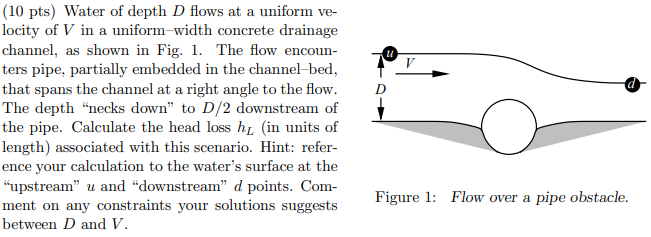
In this specific scenario, water of uniform depth flows through a rectangular channel with a pipe obstacle spanning across the channel width. Downstream of the obstacle, the flow depth decreases, indicating a change in velocity and potential energy. To analyze the impact of the obstacle, the problem involves applying fundamental principles such as conservation of mass and energy (Bernoulli’s equation) with an allowance for head loss.
Understanding these concepts allows for calculating the head loss associated with the obstacle, which is crucial for designing efficient drainage systems, managing flow regimes, and preventing flooding or structural failure. The problem thus combines the principles of fluid mechanics, flow continuity, and energy conservation in a practical context.
**Explanation:**
This introduction establishes the importance of energy and flow considerations in open channel hydraulics, specifically highlighting how obstacles affect flow behavior. Recognizing that head loss results from turbulence and flow disturbances caused by the pipe obstacle helps in understanding why energy equations must be modified to include head loss terms. This comprehension is essential for accurately calculating the head loss and predicting flow conditions downstream, which are critical in hydraulic design and analysis.
---
**2. Presentation of Relevant Formulas Required To Solve The Question**
**a) Continuity Equation (Conservation of Mass):**
\[
Q = A_u V_u = A_d V_d
\]
where
- \( Q \) = volumetric flow rate (constant along the channel)
- \( A_u \) = cross-sectional area upstream \( = b \times D \)
- \( V_u \) = velocity upstream \( = V \)
- \( A_d \) = cross-sectional area downstream \( = b \times (D/2) \)
- \( V_d \) = velocity downstream \( \) (to be determined)
**Rearranged:**
\[
V_d = \frac{A_u}{A_d} V_u = \frac{b D}{b D/2} V = 2V
\]
**Relevance:**
The continuity equation links flow velocities upstream and downstream, accounting for the change in flow cross-section. It provides the downstream velocity once the upstream velocity and cross-sectional areas are known, which is necessary for energy calculations.
---
**b) Bernoulli’s Equation with Head Loss:**
\[
z_u + \frac{V_u^2}{2g} = z_d + \frac{V_d^2}{2g} + h_L
\]
where
- \( z_u \) and \( z_d \) are elevations at upstream and downstream points;
- \( V_u \) and \( V_d \) are velocities at these points;
- \( h_L \) is the head loss due to the obstacle.
**Relevance:**
Bernoulli’s equation relates the energy levels at two points in the flow, incorporating potential energy (elevation), kinetic energy, and head loss. It forms the basis for calculating the head loss caused by the pipe obstacle when the change in flow depth and velocity are known.
**c) Vertical Difference in Water Surface Elevation:**
Since the water surface drops from depth \( D \) upstream to \( D/2 \) downstream, the difference in elevation of the free surface is:
\[
\Delta z = D/2
\]
**Relevance:**
This elevation difference must be included in the Bernoulli equation because it affects the potential energy component.
---
**3. A Detailed Step-by-Step Solution**
**Step 1: Analyze the flow and determine downstream velocity \(V_d\).**
Using the continuity equation:
\[
V_d = \frac{A_u}{A_d} V = \frac{b D}{b D/2} V = 2V
\]
**Explanation:**
Since the cross-sectional area downstream is half that of upstream, the velocity doubles to maintain the same volumetric flow rate. This is a direct consequence of conservation of mass in incompressible flow.
---
**Step 2: Establish the reference points and elevations.**
Choose the water surface at the upstream point \( u \) as the reference level with elevation \( z_u = D/2 \), and downstream \( d \) at \( z_d = 0 \).
- Upstream water surface elevation: \( z_u = D/2 \)
- Downstream water surface elevation: \( z_d = 0 \)
**Explanation:**
By setting the water surface at upstream as \( D/2 \) and downstream as zero, the elevation change across the section is explicitly accounted for in the energy equation.
---
**Step 3: Apply Bernoulli’s equation between points u and d, including head loss \(h_L\).**
\[
z_u + \frac{V_u^2}{2g} = z_d + \frac{V_d^2}{2g} + h_L
\]
Substitute known values:
\[
\frac{D}{2} + \frac{V^2}{2g} = 0 + \frac{(2V)^2}{2g} + h_L
\]
which simplifies to:
\[
\frac{D}{2} + \frac{V^2}{2g} = \frac{4V^2}{2g} + h_L
\]
Rearranged:
\[
h_L = \frac{D}{2} + \frac{V^2}{2g} - \frac{4V^2}{2g}
\]
\[
h_L = \frac{D}{2} - \frac{3V^2}{2g}
\]
**Explanation:**
The energy balance accounts for the elevation difference and the change in kinetic energy. The head loss \(h_L\) represents the energy dissipated due to the obstacle's presence, turbulence, and flow separation.
---
**Step 4: Final expression for head loss \(h_L\).**
\[
\boxed{
h_L = \frac{D}{2} - \frac{3V^2}{2g}
}
\]
**Explanation:**
This formula explicitly relates head loss to the initial depth \(D\) and the flow velocity \(V\). It indicates that head loss depends on the initial energy state and the flow velocity downstream.
---
**Step 5: Physical constraint on the solution**
For the head loss to be physically meaningful (positive), the following must hold:
\[
h_L > 0 \Rightarrow \frac{D}{2} > \frac{3V^2}{2g}
\]
which simplifies to:
\[
D > \frac{3V^2}{g}
\]
**Explanation:**
This condition ensures that the initial depth is sufficient to sustain the flow without implying negative energy losses, which are physically impossible. It constrains the relationship between flow velocity and depth for the model to be valid.
---
**Conclusion:**
The head loss associated with the pipe obstacle in the channel is:
\[
\boxed{
h_L = \frac{D}{2} - \frac{3V^2}{2g}
}
\]
with the physical constraint:
\[
D > \frac{3V^2}{g}
\]
This quantifies the energy dissipation caused by the obstacle, integrating principles of conservation of mass and energy in open channel flow.
---
**Note:** The derivation assumes steady, incompressible, and frictionless flow except for the head loss term, and neglects surface tension and other minor effects.
VIPSolutions focuses on clear, step‑by‑step explanations so you can learn quickly. Whether you need an AI‑generated walkthrough or a short hint to get unstuck, each solution is organized for fast reading and easy review later.
Search similar questions, compare approaches, and bookmark the best answers for revision. Our goal is simple: quick, reliable study help that feels natural—not noisy.
 VIPSolutions
 (10 pts) Water of depth D flows at a uniform ve-
locity of Vin a uniform-width concrete drainage
channel, as shown in Fig. 1. The flow encoun-
ters pipe, partially embedded in the channel-bed, rT,
that spans the channel at a right angle to the flow. ~~ D
The depth “necks down” to D/2 downstream of
the pipe. Calculate the head loss hy (in units of
length) associated with this scenario. Hint: refer-
ence your calculation to the water's surface at the
“upstream” u and “downstream” d points. Com-
ment on any constraints your solutions suggests © 1805 1: Flow over a pipe obstacle.
between D and V.
(10 pts) Water of depth D flows at a uniform ve-
locity of Vin a uniform-width concrete drainage
channel, as shown in Fig. 1. The flow encoun-
ters pipe, partially embedded in the channel-bed, rT,
that spans the channel at a right angle to the flow. ~~ D
The depth “necks down” to D/2 downstream of
the pipe. Calculate the head loss hy (in units of
length) associated with this scenario. Hint: refer-
ence your calculation to the water's surface at the
“upstream” u and “downstream” d points. Com-
ment on any constraints your solutions suggests © 1805 1: Flow over a pipe obstacle.
between D and V.