 VIPSolutions
NER Ee LR Cras eri J amareo has found a "favorable" authority directly on point for his tax question. = =a a. If the authority is an administrative authority, which specific type of authority would he prefer to answer his question? —— le = i ~ b. Which administrative authority would he least prefer to answer his question? ir = § ad = CN Ee = = = 3 SE Ho pa MALL IH J mn a Ef = bidity. He E ee PTET EE. | Required | Required B : = | Jil H 5 - © Ifthe authority is an administrative authority, which specific type of authority would he prefer to answer his 8 - Revenue Ruling : Private Letter Ruling — EE | Revenue Procedure = | Treasury Department Regulation FE a pr = Be Wa i a amareo has! four il avorable" authority directly on point for his tax question. oT CT HR oa eau oadl nn EF Ce HL a a. If the au tho ty Is an administrative authority, which specific type of authority would he prefer to answer his g on | /hich administrative authority would he least prefer to answer his question? I E E | Co I i ma LL = HE ARE eA bed fim gle 5 men Ii de - ; 2 redA | Required B Hin = BE ii ii i s = = aE I TT = =u Which administrative authority would he least prefer to answer his question? as Ee EE | | li i = FE Ll ee i = I 3 =i | | < Previous | | Revenue ing : | Povate Letter Ruling Treasury Department Regulation | —
Question:
 NER Ee
LR Cras eri
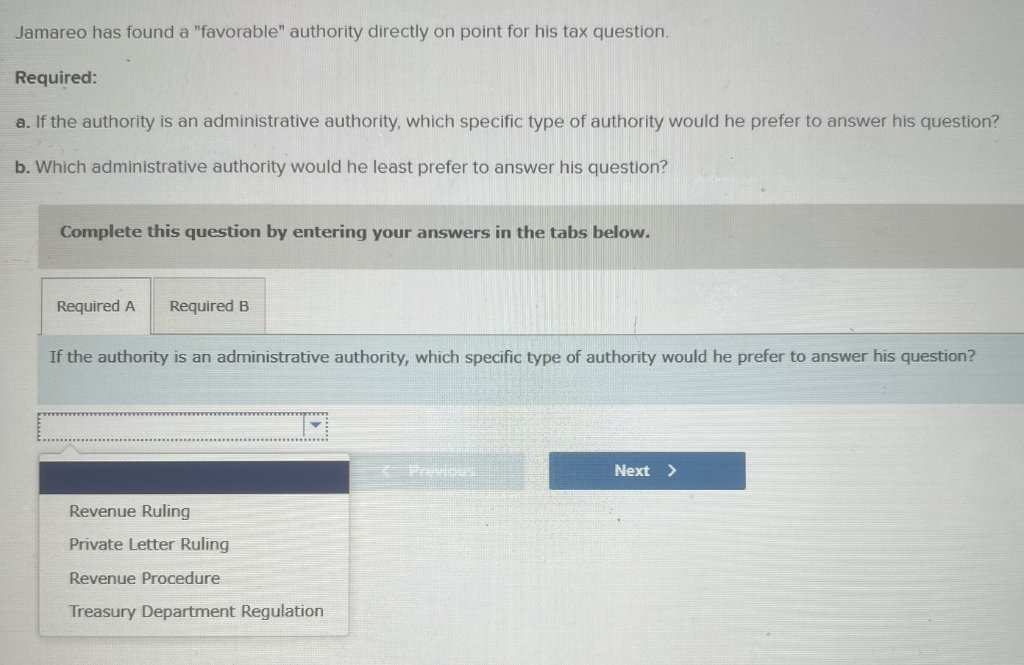
J amareo has found a "favorable" authority directly on point for his tax question. = =a
a. If the authority is an administrative authority, which specific type of authority would he prefer to answer his question?
—— le
= i
~ b. Which administrative authority would he least prefer to answer his question? ir
= § ad
= CN Ee =
= = 3 SE Ho pa MALL IH J mn a
Ef = bidity. He
E ee PTET EE.
| Required | Required B :
= | Jil H 5 -
© Ifthe authority is an administrative authority, which specific type of authority would he prefer to answer his 8
- Revenue Ruling :
Private Letter Ruling —
EE
| Revenue Procedure =
| Treasury Department Regulation FE
a pr =
Be Wa i a
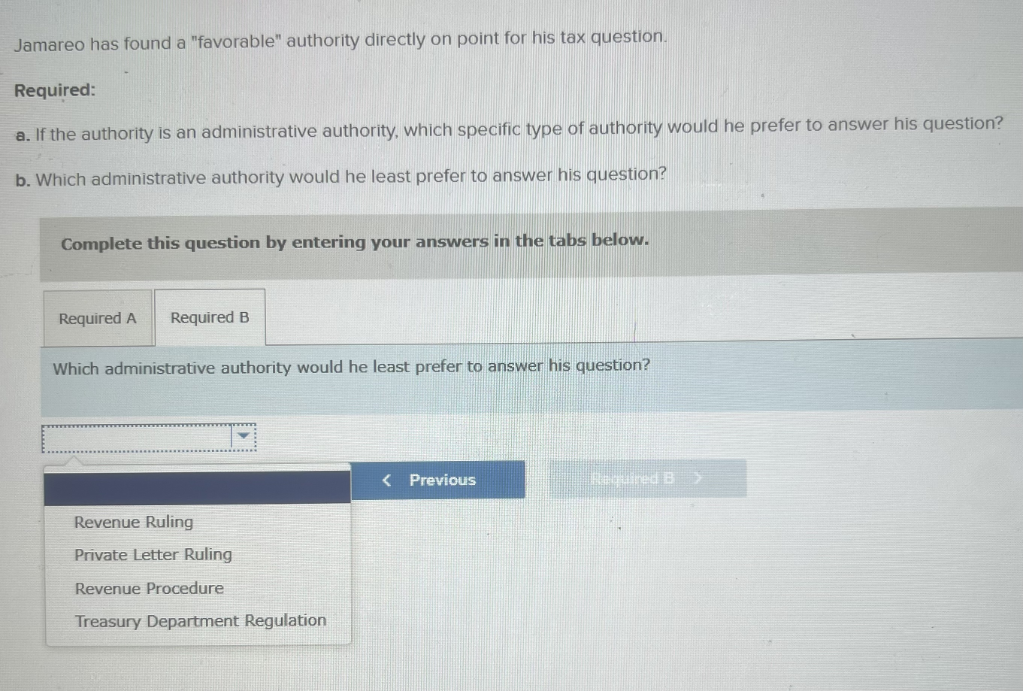
amareo has! four il avorable" authority directly on point for his tax question. oT
CT HR oa
eau oadl nn EF
Ce HL a
a. If the au tho ty Is an administrative authority, which specific type of authority would he prefer to answer his g on |
/hich administrative authority would he least prefer to answer his question? I E
E | Co I i ma LL
= HE ARE eA bed fim gle
5 men Ii de - ;
2 redA | Required B Hin
= BE ii ii i s =
= aE I TT = =u
Which administrative authority would he least prefer to answer his question? as
Ee EE | | li i = FE
Ll ee i =
I 3 =i |
| < Previous |
| Revenue ing :
| Povate Letter Ruling
Treasury Department Regulation | —
NER Ee
LR Cras eri
J amareo has found a "favorable" authority directly on point for his tax question. = =a
a. If the authority is an administrative authority, which specific type of authority would he prefer to answer his question?
—— le
= i
~ b. Which administrative authority would he least prefer to answer his question? ir
= § ad
= CN Ee =
= = 3 SE Ho pa MALL IH J mn a
Ef = bidity. He
E ee PTET EE.
| Required | Required B :
= | Jil H 5 -
© Ifthe authority is an administrative authority, which specific type of authority would he prefer to answer his 8
- Revenue Ruling :
Private Letter Ruling —
EE
| Revenue Procedure =
| Treasury Department Regulation FE
a pr =
Be Wa i a
amareo has! four il avorable" authority directly on point for his tax question. oT
CT HR oa
eau oadl nn EF
Ce HL a
a. If the au tho ty Is an administrative authority, which specific type of authority would he prefer to answer his g on |
/hich administrative authority would he least prefer to answer his question? I E
E | Co I i ma LL
= HE ARE eA bed fim gle
5 men Ii de - ;
2 redA | Required B Hin
= BE ii ii i s =
= aE I TT = =u
Which administrative authority would he least prefer to answer his question? as
Ee EE | | li i = FE
Ll ee i =
I 3 =i |
| < Previous |
| Revenue ing :
| Povate Letter Ruling
Treasury Department Regulation | —
Asked by: Veera manikanta
Created at: 2025-07-28 06:42:54
Final Answer:
Question:
1: Introduction: Provide the necessary conceptual background and introduction required to understand and answer the given question. Add an Explanation block at the end of the introduction by adding various relevant supporting statements and explaining the introduction concisely. Note: Do not use personal pronouns like I, we, you, etc. The response must look as if it is written by a human. Explanation: Clearly elucidate the introductory concepts, with more relevant comprehensive supporting the narrative with necessary statements that establish the context and relevance of the concepts in answering the question. 2: Identifying the Correct Option Among The Choices: Identify the correct choice from the provided options. Explanation: Provide a comprehensive justification for why this option is correct. Enhance your explanation with detailed reasoning, incorporating relevant concepts, theories, or formulas as necessary. 3: Analysis of why other Options are Incorrect: List the options that are incorrect. Explanation: Offer a detailed analysis as to why each of these options does not satisfy the question's requirements. Support each explanation with logical reasoning or conceptual discrepancies. Conclusion: Conclude with a brief yet complete summary of the answer, encapsulating the main points addressed and the solution's effectiveness. Follow These Guidelines While Answering The Question: 1. Maintain a professional and impersonal tone throughout, avoiding personal pronouns such as 'I', 'we', 'you', etc. 2. Ensure more accuracy and adherence to the necessary concepts and correct textbook based correct formulas and other relevant, required to solve the question. 3. Include an Explanation block at the end of each step to provide context and clarify the methodology used by providing the necessary supporting statements. 4. Focus solely on delivering a well-explained direct and complete answer to the question, without additional guidance [ I don’t need any guidance of how to solve the question – I just need well-explained complete solution ] or extraneous content. 5. Make sure that strictly follow the specified format, ensuring that each section, especially the introduction and each step of the solution, is accompanied by a detailed relevant supporting statement in the explanation. 6. I need the exact detailed comprehensive direct step-by-step answer as I don’t need any guidance to write the answer and strictly add the explanation for each with the required supporting statement & Please give me the complete answer as per the question requirements without skipping anything in the answer. 7. Always provide correct, complete detailed & well-explained solution. 8. Ensure that there are no typo/formula/calculation/programming/grammatical errors are present in your solution. 9. Give the correct graphs/diagrams/tables/charts whenever required in the solution. 10. Ensure that there are NO Errors in Units/Notations are there in your solution. 11. Avoid missing any vital part in the solution [ Don’t miss any part in the solution
Asked by: Veera manikanta
Created at: 2025-07-28 06:44:46
Final Answer:
📢 Instructions:
- Ask anything relatd to above question only.
- For new Question goto :