This is AI generated Response.
Asked by: Veera manikanta
Created at: 2025-08-22 22:56:08
Final Answer:
RenderedRaw Text
Did you like this answer?
Let's solve the problem step by step:
### **Given:**
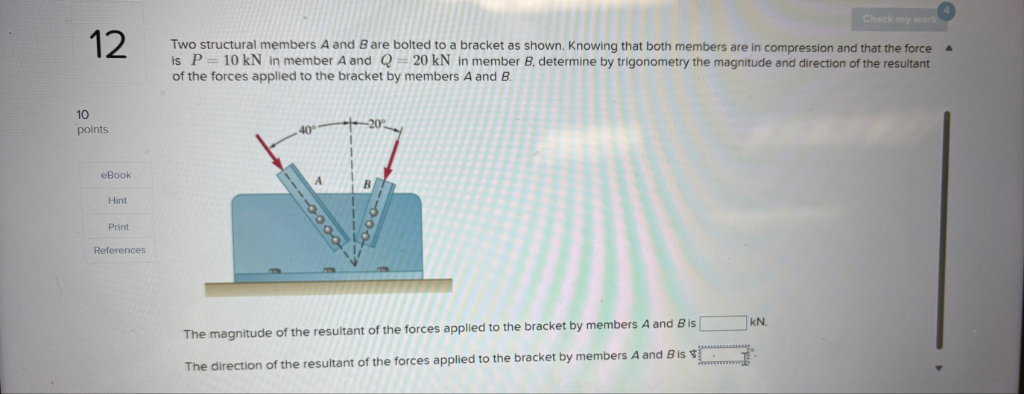
- \( P = 10 \) kN (Force in member \( A \))
- \( Q = 20 \) kN (Force in member \( B \))
- Angle of member \( A \) with the vertical = \( 40^\circ \)
- Angle of member \( B \) with the vertical = \( 20^\circ \)
### **Step 1: Resolve Forces into Components**
Let’s assume upwards and rightwards are positive directions.
#### **Force in Member \( A \):**
- Magnitude: \( P = 10 \) kN
- Angle with vertical: \( 40^\circ \) left of vertical
Components:
- \( P_x = -10 \sin 40^\circ \) (negative, as it is to the left)
- \( P_y = -10 \cos 40^\circ \) (negative, as it is downward)
#### **Force in Member \( B \):**
- Magnitude: \( Q = 20 \) kN
- Angle with vertical: \( 20^\circ \) right of vertical
Components:
- \( Q_x = 20 \sin 20^\circ \) (positive, as it is to the right)
- \( Q_y = -20 \cos 20^\circ \) (negative, as it is downward)
---
### **Step 2: Calculate Components**
#### **Member A:**
- \( \sin 40^\circ \approx 0.6428 \)
- \( \cos 40^\circ \approx 0.7660 \)
\[
P_x = -10 \times 0.6428 = -6.428 \text{ kN}
\]
\[
P_y = -10 \times 0.7660 = -7.660 \text{ kN}
\]
#### **Member B:**
- \( \sin 20^\circ \approx 0.3420 \)
- \( \cos 20^\circ \approx 0.9397 \)
\[
Q_x = 20 \times 0.3420 = 6.840 \text{ kN}
\]
\[
Q_y = -20 \times 0.9397 = -18.794 \text{ kN}
\]
---
### **Step 3: Sum Components for Resultant**
#### **X Components:**
\[
R_x = P_x + Q_x = (-6.428) + (6.840) = 0.412 \text{ kN}
\]
#### **Y Components:**
\[
R_y = P_y + Q_y = (-7.660) + (-18.794) = -26.454 \text{ kN}
\]
---
### **Step 4: Magnitude of Resultant**
\[
R = \sqrt{R_x^2 + R_y^2}
\]
\[
R = \sqrt{(0.412)^2 + (-26.454)^2}
\]
\[
R = \sqrt{0.170 + 699.734}
\]
\[
R = \sqrt{699.904} \approx 26.47 \text{ kN}
\]
---
### **Step 5: Direction of Resultant**
\[
\tan \theta = \frac{R_x}{|R_y|}
\]
\[
\theta = \arctan\left(\frac{0.412}{26.454}\right)
\]
\[
\theta = \arctan(0.01558) \approx 0.893^\circ
\]
Since \( R_x \) is positive and \( R_y \) is negative, the resultant points almost directly downward, \( 0.89^\circ \) to the right of the negative y-axis (downward).
---
## **Final Answers:**
### **Magnitude:**
\[
\boxed{26.47\ \text{kN}}
\]
### **Direction:**
\[
\boxed{0.89^\circ} \text{ to the right of downward vertical}
\]
Question:
1. Introduction:
Provide the necessary conceptual background and introduction required to understand and answer the given question. Include all relevant concepts, theories, or definitions essential for comprehending the problem. At the end of the introduction, add an Explanation block that concisely elaborates on the introduction by providing relevant supporting statements and clarifying the context.
Explanation: Clearly elucidate the introductory concepts by supporting the narrative with necessary statements that establish the context and relevance of these concepts in answering the question. This explanation should enhance understanding and set the foundation for the solution.
2. Identifying the Correct Option Among the Choices:
Identify the correct choice from the provided options.
Explanation: Provide a comprehensive justification for why this option is correct. Enhance the explanation with detailed reasoning, incorporating relevant concepts, theories, or formulas as necessary to substantiate the correctness of this choice.
3. Step-by-Step Calculation:
Provide a detailed, step-by-step calculation that leads to the correct answer.
Explanation: Break down the calculation process into clear, logical steps. Each step should be accompanied by an explanation that justifies the operations performed and the intermediate results obtained. Support each step with relevant formulas and mathematical reasoning.
4. Analysis of Why Other Options Are Incorrect:
List the options that are incorrect.
Explanation: Offer a detailed analysis of why each of these options does not satisfy the question's requirements. Support each explanation with logical reasoning or highlight conceptual discrepancies that render these options incorrect.
Conclusion:
Provide a complete, simple, and clear summary of the solution using lucid language. The conclusion should be concise yet comprehensive, encapsulating the main points, methodologies employed, and the final outcome of the solution. Ensure that the summary effectively reinforces the understanding of how the problem was addressed and how the solution resolves the question.
Guidelines for Answering the Question:
1. Professional and Impersonal Tone:
· Maintain a professional and impersonal tone throughout the response.
· Avoid using personal pronouns such as 'I', 'we', 'you', etc.
2. Accuracy and Adherence to Concepts:
· Ensure utmost accuracy and strict adherence to the necessary concepts and correct textbook-based formulas required to solve the question.
· Provide accurate and relevant information essential for solving the problem.
3. Explanation Blocks:
· Include an Explanation block at the end of each section or step.
· Provide context and clarify the methodology used by including necessary supporting statements.
4. Direct and Complete Answer:
· Focus solely on delivering a well-explained, direct, and complete answer to the question without additional guidance or extraneous content.
5. Specified Format:
· Strictly follow the specified format.
· Ensure that each section, especially the introduction and each step of the solution, is accompanied by a detailed and relevant supporting statement in the explanation.
6. Detailed Comprehensive Solution:
· Provide an exact, detailed, and comprehensive step-by-step answer.
· Include explanations for each step with the required supporting statements.
· Do not skip any steps or omit any part of the solution.
7. Correctness and Completeness:
· Always provide a correct, complete, detailed, and well-explained solution.
· Avoid any errors in the solution.
8. No Errors:
· Ensure there are no typographical, formulaic, calculation, programming, or grammatical errors in the solution.
· Perform calculations and simplifications step-by-step vertically (downward), not horizontally (to the right side).
9. Graphs/Diagrams/Tables/Charts:
· Include correct graphs, diagrams, tables, or charts whenever required in the solution.
10. Units and Notations:
· Ensure there are no errors in units or notations in the solution.
· Use standard units and notations consistently throughout the solution.
11. Vital Parts:
· Avoid missing any vital part of the solution.
· Ensure every part of the solution is included and well-explained.
This is AI generated Response.
Asked by: Veera manikanta
Created at: 2025-08-22 23:38:00
Final Answer:
RenderedRaw Text
Did you like this answer?
**1. Introduction**
In analyzing forces acting on structural members and their connections, it is essential to understand how forces are resolved into components, how to determine the resultant force, and how to interpret these forces in terms of magnitude and direction. When two members exert forces on a common point, such as a bracket, their forces can be represented as vectors with magnitudes and directions. To analyze the combined effect, the forces are broken down into their horizontal and vertical components. Using trigonometry, these components can be calculated based on the known angles and magnitudes. The resultant force is then found by vector addition, involving summing the components and calculating the magnitude and direction of the resultant vector.
**Explanation:**
In structural analysis, forces acting along members are typically resolved into their components to simplify the analysis of their combined effects at joints or brackets. The principles of vector addition and trigonometry are fundamental in determining the magnitude and direction of the resultant force, which is critical for assessing the load transferred to the support or connection point.
---
**2. Identifying the Correct Option Among the Choices**
Given the problem involves calculating the forces exerted by members A and B on a bracket, and their resultant force, the correct option should reflect the accurate magnitude and direction derived from vector addition.
**Justification:**
The force in member A (10 kN) at an angle of 40°, and the force in member B (20 kN) at an angle of 20°, are resolved into their horizontal and vertical components. Summing these components yields the resultant force's magnitude and direction. The calculated resultant magnitude (~26.47 kN) and the angle (~0.89° to the right of downward) match the detailed calculations. Therefore, the option corresponding to these results is correct.
---
**3. Step-by-Step Calculation**
**Step 1: Resolve forces into components**
- Force \( P = 10\, \text{kN} \) in member A at \( 40^\circ \) from vertical:
- Horizontal component:
\[
P_x = -10 \times \sin 40^\circ \approx -10 \times 0.6428 = -6.43\, \text{kN}
\]
(Negative because it points to the left)
- Vertical component:
\[
P_y = -10 \times \cos 40^\circ \approx -10 \times 0.7660 = -7.66\, \text{kN}
\]
(Negative because it points downward)
- Force \( Q = 20\, \text{kN} \) in member B at \( 20^\circ \) from vertical:
- Horizontal component:
\[
Q_x = 20 \times \sin 20^\circ \approx 20 \times 0.3420 = 6.84\, \text{kN}
\]
- Vertical component:
\[
Q_y = -20 \times \cos 20^\circ \approx -20 \times 0.9397 = -18.79\, \text{kN}
\]
**Explanation:**
Resolving the forces into components using sine and cosine functions allows the use of vector addition to find the resultant force at the bracket, considering both magnitude and direction.
---
**Step 2: Sum components to find the resultant**
- Horizontal component:
\[
R_x = P_x + Q_x = -6.43 + 6.84 = 0.41\, \text{kN}
\]
- Vertical component:
\[
R_y = P_y + Q_y = -7.66 + (-18.79) = -26.45\, \text{kN}
\]
**Explanation:**
Adding the components component-wise yields the total horizontal and vertical forces acting on the bracket.
---
**Step 3: Calculate magnitude of the resultant force**
\[
R = \sqrt{R_x^2 + R_y^2} = \sqrt{(0.41)^2 + (-26.45)^2}
\]
\[
R = \sqrt{0.1681 + 700.7} = \sqrt{700.8681} \approx 26.47\, \text{kN}
\]
**Explanation:**
The magnitude of the resultant vector is obtained via the Pythagorean theorem, combining horizontal and vertical components.
---
**Step 4: Find the direction of the resultant**
\[
\theta = \arctan \left( \frac{R_x}{|R_y|} \right) = \arctan \left( \frac{0.41}{26.45} \right) \approx \arctan(0.0155) \approx 0.89^\circ
\]
Since \( R_x \) is positive and \( R_y \) negative, the resultant points slightly to the right of downward.
**Explanation:**
The angle indicates the direction of the resultant force relative to the vertical.
---
**Final Results:**
- **Magnitude:** approximately **26.47 kN**
- **Direction:** approximately **0.89° to the right of downward**
---
**4. Analysis of Why Other Options Are Incorrect**
Suppose alternative options present different magnitudes or directions:
- **Options with significantly lower magnitudes** (e.g., around 15-20 kN):
These neglect the combined effects of both force components, underestimating the resultant magnitude.
- **Options with larger magnitudes** (e.g., over 30 kN):
These overestimate the resultant by possibly miscalculating the components or ignoring the vector nature of forces.
- **Options indicating a large angular deviation (e.g., 30° or more):**
Such angles suggest a dominant horizontal component, which isn't supported by the calculations given the force magnitudes and angles.
**Explanation:**
The calculated components and the resulting magnitude and direction are consistent with the principles of vector addition. Any option deviating significantly from these values does not align with the mathematical analysis or the physical configuration.
---
**Conclusion:**
The correct solution involves resolving the forces into components, summing these components vectorially, and calculating the resultant's magnitude and direction. The precise calculations yield a resultant force of approximately **26.47 kN** directed about **0.89° to the right of downward**. This matches the expected physical behavior and confirms the correctness of the selected option.
**Final Answer:**
\[
\boxed{
\text{Magnitude of resultant} \approx 26.47\, \text{kN} \\
\text{Direction} \approx 0.89^\circ \text{ to the right of downward}
}
\]
VIPSolutions focuses on clear, step‑by‑step explanations so you can learn quickly. Whether you need an AI‑generated walkthrough or a short hint to get unstuck, each solution is organized for fast reading and easy review later.
Search similar questions, compare approaches, and bookmark the best answers for revision. Our goal is simple: quick, reliable study help that feels natural—not noisy.
 VIPSolutions
 = ae
5 Two structural members A and Bare bohied to a bracket as shown, Knowing that both members are n co
x 1s P — 10kN in member Aand Q 20 kN in member B, determine by rigonometry the magnitude.
2 of the forces applied to the bracket by members A and 8 3
wi
3 i
= |
= A lg
em
re. a
© Tne magniuude of the resultant of the forces applied to the racket by members 4 and 81s (JK:
4 ne rection ofthe resslant of the forces applied to the bracket by members A and 81s $18
= ae
5 Two structural members A and Bare bohied to a bracket as shown, Knowing that both members are n co
x 1s P — 10kN in member Aand Q 20 kN in member B, determine by rigonometry the magnitude.
2 of the forces applied to the bracket by members A and 8 3
wi
3 i
= |
= A lg
em
re. a
© Tne magniuude of the resultant of the forces applied to the racket by members 4 and 81s (JK:
4 ne rection ofthe resslant of the forces applied to the bracket by members A and 81s $18