 VIPSolutions
2)Updated Calculations Question Prompt: 1: Introduction: Provide the complete necessary conceptual background concepts explanation and the introduction required to understand and answer the given question. Add an Explanation block at the end of the introduction by adding various relevant supporting statements and explaining the introduction concisely. Note: Do not use personal pronouns like I, we, you, etc. The response must look as if it is written by a human. Explanation: Articulate the importance of the introduction, providing more relevant comprehensive supporting statements that link these concepts directly to the question. This explanation should clarify how the introduction aids in comprehending the subsequent steps. 2: Presentation of Relevant Formulas Required To Solve The Question: List and also describe all formulas required to solve the question. Ensure each formula is presented clearly and is directly applicable to the problem. Explanation: Detail the derivation or rationale behind each formula, explaining its relevance and necessity in the context of the problem-solving process. Use more relavent comprehensive supporting statements to reinforce the significance of these mathematical tools. 3: A Detailed Step-by-Step Solution: Write a step-by-step in-depth comprehensive straight forward complete solution in a structured way without missing anything as per the requirements and also include explanation [ Write relevant supporting statements in the explanation block ] for every step in the solution. Conclusion: Conclude with a concise summary of the solution, succinctly presenting the final answer short summary derived from the calculations. Follow These Guidelines While Answering The Question: 1. Maintain a professional and impersonal tone throughout, avoiding personal pronouns such as 'I', 'we', 'you', etc. 2. Ensure more accuracy and adherence to the necessary concepts and correct textbook based correct formulas and other relevant, required to solve the question. 3. Include an Explanation block at the end of each step to provide context and clarify the methodology used by providing the necessary supporting statements. 4. Focus solely on delivering a well-explained direct and complete answer to the question, without additional guidance [ I don’t need any guidance of how to solve the question – I just need well-explained complete solution ] or extraneous content. 5. Make sure that strictly follow the specified format, ensuring that each section, especially the introduction and each step of the solution, is accompanied by a detailed relevant supporting statement in the explanation. 6. I need the exact detailed comprehensive direct step-by-step answer as I don’t need any guidance to write the answer and strictly add the explanation for each with the required supporting statement & Please give me the complete answer as per the question requirements without skipping anything in the answer. 7. Always provide correct, complete detailed & well-explained solution. 8. Ensure that there are no typo/formula/calculation/programming/grammatical errors are present in your solution. 9. Give the correct graphs/diagrams/tables/charts whenever required in the solution. 10. Ensure that there are NO Errors in Units/Notations are there in your solution. 11. Avoid missing any vital part in the solution [ Don’t miss any part in the solution ].Reaured nformaton The caneve arin he furs is mace fom a duce materi an ssc osc wi Fy — 250.01 nd FoF. DIB The eng of ne roa DC sence by Smciedormusia ms s gen’ be 1400in The engin of 1h 03 45 dency SemccsrorUSTI25 Mk Gens 4 100 1 ASN L 3 Sa A Forth crc sess semen, Getarmin ne principal sess an ie maximum shar sess. Th prncipa sess is cetemined tobe [host Th principe sess os Setnine tobe [vps (ncluc minus sgn necessary) Round he fl sero ree cecil paces) The miu shee ses Tau scetemined tobe [host
Question:
2)Updated Calculations Question Prompt:
1: Introduction:
Provide the complete necessary conceptual background concepts explanation and the
introduction required to understand and answer the given question. Add an Explanation
block at the end of the introduction by adding various relevant supporting statements and
explaining the introduction concisely.
Note: Do not use personal pronouns like I, we, you, etc. The response must look as if it is
written by a human.
Explanation: Articulate the importance of the introduction, providing more relevant
comprehensive supporting statements that link these concepts directly to the question.
This explanation should clarify how the introduction aids in comprehending the
subsequent steps.
2: Presentation of Relevant Formulas Required To Solve The Question:
List and also describe all formulas required to solve the question. Ensure each formula is
presented clearly and is directly applicable to the problem.
Explanation: Detail the derivation or rationale behind each formula, explaining its
relevance and necessity in the context of the problem-solving process. Use more relavent
comprehensive supporting statements to reinforce the significance of these mathematical
tools.
3: A Detailed Step-by-Step Solution:
Write a step-by-step in-depth comprehensive straight forward complete solution in a
structured way without missing anything as per the requirements and also include
explanation [ Write relevant supporting statements in the explanation block ] for every step
in the solution.
Conclusion:
Conclude with a concise summary of the solution, succinctly presenting the final answer
short summary derived from the calculations.
Follow These Guidelines While Answering The Question:
1. Maintain a professional and impersonal tone throughout, avoiding personal
pronouns such as 'I', 'we', 'you', etc.
2. Ensure more accuracy and adherence to the necessary concepts and correct
textbook based correct formulas and other relevant, required to solve the question.
3. Include an Explanation block at the end of each step to provide context and clarify
the methodology used by providing the necessary supporting statements.
4. Focus solely on delivering a well-explained direct and complete answer to the
question, without additional guidance [ I don’t need any guidance of how to solve
the question – I just need well-explained complete solution ] or extraneous content.
5. Make sure that strictly follow the specified format, ensuring that each section,
especially the introduction and each step of the solution, is accompanied by a
detailed relevant supporting statement in the explanation.
6. I need the exact detailed comprehensive direct step-by-step answer as I don’t need
any guidance to write the answer and strictly add the explanation for each with the
required supporting statement & Please give me the complete answer as per the
question requirements without skipping anything in the answer.
7. Always provide correct, complete detailed & well-explained solution.
8. Ensure that there are no typo/formula/calculation/programming/grammatical errors
are present in your solution.
9. Give the correct graphs/diagrams/tables/charts whenever required in the solution.
10. Ensure that there are NO Errors in Units/Notations are there in your solution.
11. Avoid missing any vital part in the solution [ Don’t miss any part in the solution ].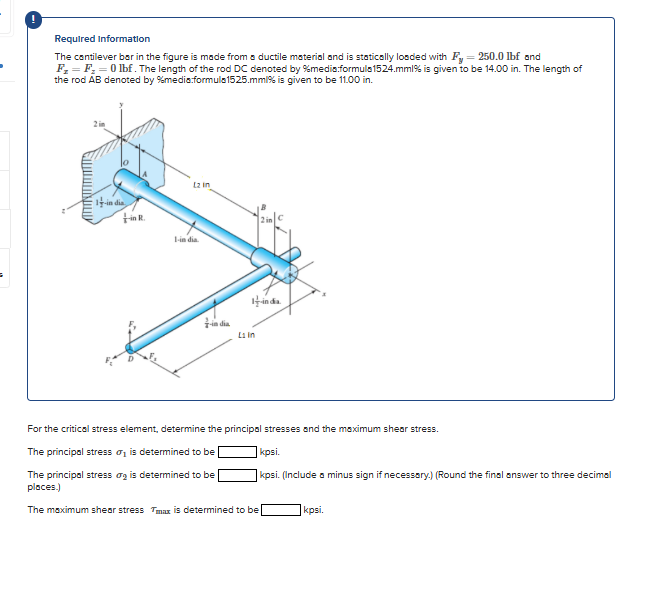 Reaured nformaton
The caneve arin he furs is mace fom a duce materi an ssc osc wi Fy — 250.01 nd
FoF. DIB The eng of ne roa DC sence by Smciedormusia ms s gen’ be 1400in The engin of
1h 03 45 dency SemccsrorUSTI25 Mk Gens 4 100 1
ASN L
3 Sa
A
Forth crc sess semen, Getarmin ne principal sess an ie maximum shar sess.
Th prncipa sess is cetemined tobe [host
Th principe sess os Setnine tobe [vps (ncluc minus sgn necessary) Round he fl sero ree cecil
paces)
The miu shee ses Tau scetemined tobe [host
Reaured nformaton
The caneve arin he furs is mace fom a duce materi an ssc osc wi Fy — 250.01 nd
FoF. DIB The eng of ne roa DC sence by Smciedormusia ms s gen’ be 1400in The engin of
1h 03 45 dency SemccsrorUSTI25 Mk Gens 4 100 1
ASN L
3 Sa
A
Forth crc sess semen, Getarmin ne principal sess an ie maximum shar sess.
Th prncipa sess is cetemined tobe [host
Th principe sess os Setnine tobe [vps (ncluc minus sgn necessary) Round he fl sero ree cecil
paces)
The miu shee ses Tau scetemined tobe [host
Asked by: RAJESH POTHALA
Created at: 2025-09-19 07:08:37
Final Answer:
📢 Instructions:
- Ask anything relatd to above question only.
- For new Question goto :