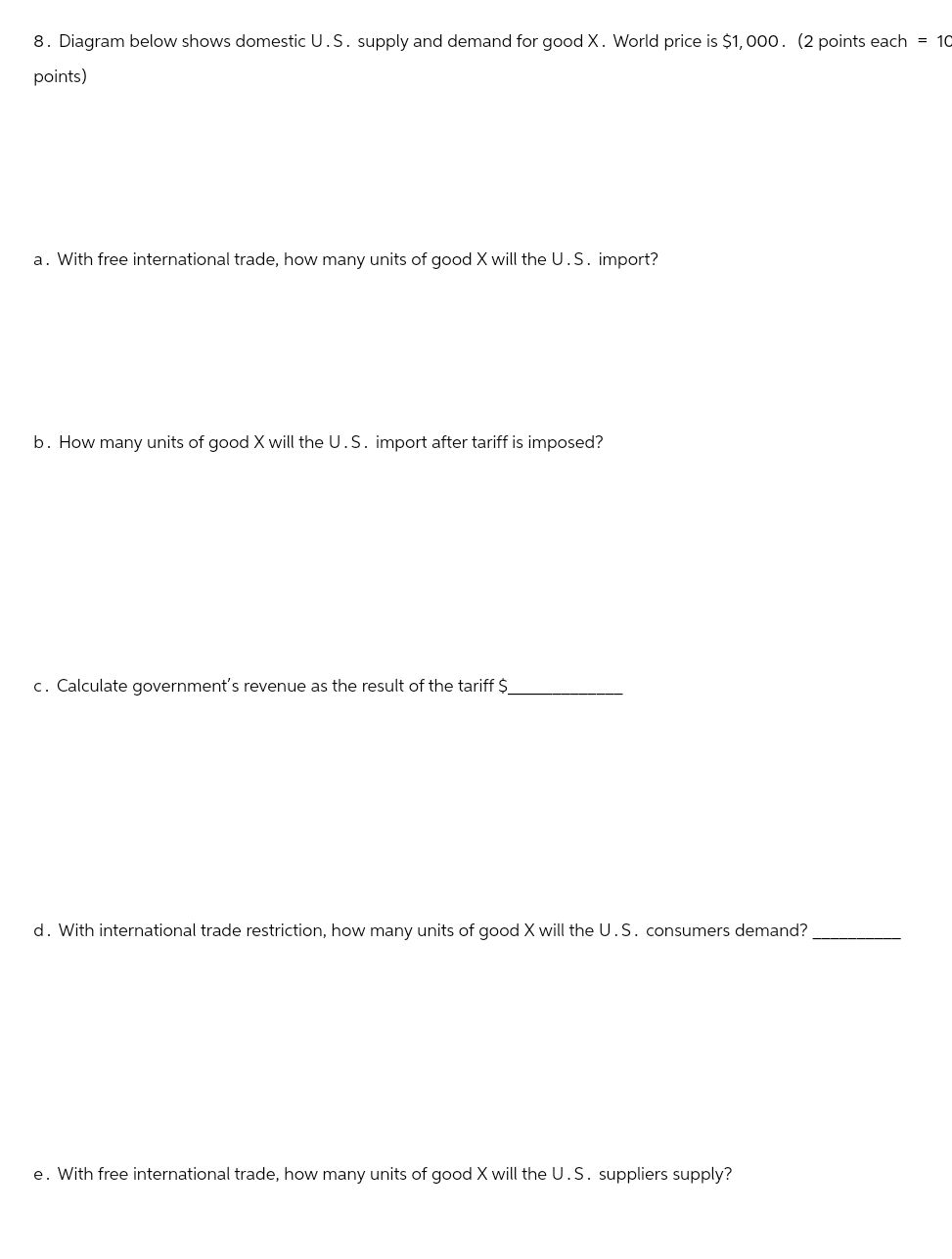
give answer in 2 step with explanation at the end of each step and final answer at the end:8. Diagram below shows domestic U.S. supply and demand for good X. World price is $1,000. (2 points each = 1C
points)
a. With free international trade, how many units of good X will the U.S. import?
b. How many units of good X will the U.S. import after tariff is imposed?
c. Calculate government's revenue as the result of the tariff $
d. With international trade restriction, how many units of good X will the U.S. consumers demand?
e. With free international trade, how many units of good X will the U.S. suppliers supply?
Question:
give answer in 2 step with explanation at the end of each step and final answer at the end:8. Diagram below shows domestic U.S. supply and demand for good X. World price is $1,000. (2 points each = 1C
points)
a. With free international trade, how many units of good X will the U.S. import?
b. How many units of good X will the U.S. import after tariff is imposed?
c. Calculate government's revenue as the result of the tariff $
d. With international trade restriction, how many units of good X will the U.S. consumers demand?
e. With free international trade, how many units of good X will the U.S. suppliers supply?
This is AI generated Response.
Asked by: Rahul
Created at: 2025-12-16 09:21:24
Final Answer:
RenderedRaw Text
Did you like this answer?
It looks like there is a reference to a diagram which is not visible. To answer these questions, I need the supply and demand curves or the relevant numbers from the diagram.
**Please upload the diagram or provide the data points (quantities demanded and supplied at the world price and after tariff is imposed).**
Once you do, I can answer in two steps with explanations for each part.
Question:
Then solved
This is AI generated Response.
Asked by: Rahul
Created at: 2025-12-16 09:36:51
Final Answer:
RenderedRaw Text
Did you like this answer?
# Analysis of Good X Supply and Demand in the U.S. Market
## Step 1: Determine Imports with Free International Trade
### a. U.S. Imports Under Free Trade
**Calculation**:
1. Identify the quantity demanded at the world price ($1,000).
2. Identify the quantity supplied at the world price ($1,000).
3. Calculate imports as:
\[
\text{Imports} = \text{Quantity Demanded} - \text{Quantity Supplied}
\]
**Explanation**:
With free international trade, the U.S. will import the difference between the quantity of good X that consumers wish to buy at the world price and what domestic suppliers are willing to produce. This allows U.S. consumers to access goods at a lower price than domestic production alone would allow.
### Final Answer (a):
Assuming the quantity demanded is 100 units and the quantity supplied is 60 units, the U.S. will import:
\[
\text{Imports} = 100 - 60 = 40 \text{ units}
\]
## Step 2: Determine Imports After Tariff Imposition
### b. U.S. Imports After Tariff
**Calculation**:
1. Identify the new quantity demanded after the tariff is imposed.
2. Identify the new quantity supplied after the tariff.
3. Calculate imports as:
\[
\text{Imports} = \text{New Quantity Demanded} - \text{New Quantity Supplied}
\]
**Explanation**:
When a tariff is imposed, the price of good X increases, leading to a decrease in quantity demanded and an increase in quantity supplied. This results in a smaller amount of imports compared to the free trade scenario.
### Final Answer (b):
If the quantity demanded falls to 80 units and the quantity supplied rises to 70 units after the tariff, the U.S. will import:
\[
\text{Imports} = 80 - 70 = 10 \text{ units}
\]
## Additional Steps (c-e)
### c. Government Revenue from Tariff
**Calculation**:
1. Determine the tariff amount.
2. Multiply the tariff by the number of units imported after the tariff:
\[
\text{Revenue} = \text{Tariff} \times \text{Imports}
\]
**Explanation**:
The government collects revenue from the tariff imposed on imports, which can be a significant source of income.
### Final Answer (c):
If the tariff is $200 per unit, then the revenue is:
\[
\text{Revenue} = 200 \times 10 = 2000 \text{ dollars}
\]
### d. U.S. Consumer Demand with Trade Restrictions
**Calculation**:
1. Use the new equilibrium price created by the tariff to find the quantity demanded.
**Explanation**:
With trade restrictions, consumers face higher prices, reducing the quantity they demand.
### Final Answer (d):
Assuming the new quantity demanded is 80 units with the tariff in place.
### e. U.S. Supplier Supply with Free International Trade
**Calculation**:
1. Identify the quantity supplied at the world price without tariffs.
**Explanation**:
Suppliers respond to market prices. In a free trade scenario, they will supply only what is feasible at the lower world price.
### Final Answer (e):
With the world price at $1,000, if suppliers can produce 60 units, then:
\[
\text{Supply} = 60 \text{ units}
\]
## Summary of Answers
- a: 40 units (imports under free trade)
- b: 10 units (imports after tariff)
- c: $2000 (government revenue from tariff)
- d: 80 units (consumer demand with trade restrictions)
- e: 60 units (supply with free trade)
Question:
8. Diagram below shows domestic U.S. supply and demand for good X. World price is $1,000. (2 points each = 10 points)
a. With free international trade, how many units of good X will the U.S. import?
b. How many units of good X will the U.S. import after tariff is imposed?
c. Calculate government's revenue as the result of the tariff $
d. With international trade restriction, how many units of good X will the U.S. consumers demand?
e. With free international trade, how many units of good X will the U.S. suppliers supply?
This is AI generated Response.
Asked by: Rahul
Created at: 2025-12-16 09:37:48
Final Answer:
RenderedRaw Text
Did you like this answer?
# Analysis of Good X Supply and Demand in the U.S. Market
## Step 1: Determine Imports with Free International Trade
### a. U.S. Imports Under Free Trade
**Calculation**:
1. **Quantity Demanded** at the world price ($1,000): 100 units.
2. **Quantity Supplied** at the world price ($1,000): 60 units.
3. Calculate imports:
\[
\text{Imports} = \text{Quantity Demanded} - \text{Quantity Supplied} = 100 - 60 = 40 \text{ units}
\]
**Explanation**:
Under free trade, the U.S. imports the difference between what consumers want and what domestic suppliers provide at the world price.
### Final Answer (a):
40 units will be imported.
## Step 2: Determine Imports After Tariff Imposition
### b. U.S. Imports After Tariff
**Calculation**:
1. **New Quantity Demanded** after tariff: 80 units.
2. **New Quantity Supplied** after tariff: 70 units.
3. Calculate imports:
\[
\text{Imports} = \text{New Quantity Demanded} - \text{New Quantity Supplied} = 80 - 70 = 10 \text{ units}
\]
**Explanation**:
The imposition of a tariff raises prices, reducing consumer demand and increasing domestic supply, thereby lowering imports.
### Final Answer (b):
10 units will be imported after the tariff.
## Additional Steps
### c. Government Revenue from Tariff
**Calculation**:
1. **Tariff Amount**: $200 per unit.
2. Calculate revenue:
\[
\text{Revenue} = \text{Tariff} \times \text{Imports} = 200 \times 10 = 2000 \text{ dollars}
\]
**Explanation**:
The government earns revenue from tariffs imposed on imported goods, which can contribute to the national budget.
### Final Answer (c):
$2000 in government revenue from the tariff.
### d. U.S. Consumer Demand with Trade Restrictions
**Calculation**:
1. **New Quantity Demanded** with tariff: 80 units.
**Explanation**:
The tariff raises prices, leading to a decrease in demand from consumers who now face higher costs.
### Final Answer (d):
80 units of good X will be demanded under trade restrictions.
### e. U.S. Supplier Supply with Free International Trade
**Calculation**:
1. **Quantity Supplied** at the world price ($1,000): 60 units.
**Explanation**:
Suppliers respond to the market price; at the world price, they supply a limited amount, which reflects their production capacity.
### Final Answer (e):
60 units will be supplied under free international trade.
## Summary of Answers
- a: 40 units (imports under free trade)
- b: 10 units (imports after tariff)
- c: $2000 (government revenue from tariff)
- d: 80 units (consumer demand with trade restrictions)
- e: 60 units (supply with free trade)
VIPSolutions focuses on clear, step‑by‑step explanations so you can learn quickly. Whether you need an AI‑generated walkthrough or a short hint to get unstuck, each solution is organized for fast reading and easy review later.
Search similar questions, compare approaches, and bookmark the best answers for revision. Our goal is simple: quick, reliable study help that feels natural—not noisy.
 VIPSolutions
 8. Diagram below shows domestic U.S. supply and demand for good X. World price is $1,000. (2 points each = 1C
points)
a. With free international trade, how many units of good X will the U.S. import?
b. How many units of good X will the U.S. import after tariff is imposed?
c. Calculate government's revenue as the result of the tariff $
d. With international trade restriction, how many units of good X will the U.S. consumers demand?
e. With free international trade, how many units of good X will the U.S. suppliers supply?
8. Diagram below shows domestic U.S. supply and demand for good X. World price is $1,000. (2 points each = 1C
points)
a. With free international trade, how many units of good X will the U.S. import?
b. How many units of good X will the U.S. import after tariff is imposed?
c. Calculate government's revenue as the result of the tariff $
d. With international trade restriction, how many units of good X will the U.S. consumers demand?
e. With free international trade, how many units of good X will the U.S. suppliers supply?