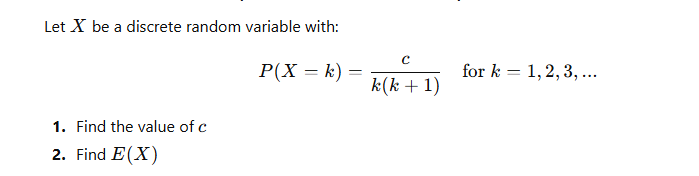
Let X be a discrete random variable with:
c
P(X =k) = — fork=1,23,..
( ) = Herp ELE
1. Find the value of ¢
2. Find E(X)
Question:
Let X be a discrete random variable with:
c
P(X =k) = — fork=1,23,..
( ) = Herp ELE
1. Find the value of ¢
2. Find E(X)
This is AI generated Response.
Asked by: nayan
Created at: 2026-02-28 18:13:38
Final Answer:
RenderedRaw Text
Did you like this answer?
Let's solve each step by step.
---
## 1. Find the value of \( c \)
Since \( P(X = k) \) is a probability mass function (pmf), the total probability must sum to 1:
\[
\sum_{k=1}^{\infty} P(X = k) = 1
\]
\[
\sum_{k=1}^{\infty} \frac{c}{k(k+1)} = 1
\]
First, let's simplify \( \frac{1}{k(k+1)} \):
\[
\frac{1}{k(k+1)} = \frac{1}{k} - \frac{1}{k+1}
\]
So,
\[
\sum_{k=1}^{\infty} \frac{c}{k(k+1)} = c \sum_{k=1}^{\infty} \left(\frac{1}{k} - \frac{1}{k+1}\right)
\]
This is a telescoping series:
\[
\sum_{k=1}^{\infty} \left(\frac{1}{k} - \frac{1}{k+1}\right) = 1
\]
So,
\[
c \cdot 1 = 1 \implies c = 1
\]
---
## 2. Find \( E(X) \)
The expectation is:
\[
E(X) = \sum_{k=1}^{\infty} k \cdot P(X = k) = \sum_{k=1}^{\infty} k \cdot \frac{1}{k(k+1)}
\]
\[
= \sum_{k=1}^{\infty} \frac{1}{k+1}
\]
This is the harmonic series starting from \( k = 2 \):
\[
\sum_{k=1}^{\infty} \frac{1}{k+1} = \sum_{m=2}^{\infty} \frac{1}{m}
\]
This sum **diverges** (goes to infinity). Thus,
\[
E(X) = \infty
\]
---
## **Summary**
1. **Value of \( c \):** \( \boxed{1} \)
2. **Expected value \( E(X) \):** \( \boxed{\infty} \) (diverges)
Question:
generate one mroe unique solution
This is AI generated Response.
Asked by: nayan
Created at: 2026-02-28 18:15:25
Final Answer:
RenderedRaw Text
Did you like this answer?
# Solution
Let's analyze the given discrete random variable \( X \) step by step.
---
## 1. Find the value of \( c \)
Given the probability mass function:
\[
P(X = k) = \frac{c}{k(k+1)} \quad \text{for } k = 1, 2, \ldots
\]
To determine \( c \), we must ensure the total probability sums to 1:
\[
\sum_{k=1}^{\infty} P(X = k) = 1
\]
This becomes:
\[
\sum_{k=1}^{\infty} \frac{c}{k(k+1)} = 1
\]
We can simplify \( \frac{1}{k(k+1)} \):
\[
\frac{1}{k(k+1)} = \frac{1}{k} - \frac{1}{k+1}
\]
Thus, the sum can be restructured as:
\[
\sum_{k=1}^{\infty} \left(\frac{1}{k} - \frac{1}{k+1}\right)
\]
This is a telescoping series:
\[
\sum_{k=1}^{\infty} \left(\frac{1}{k} - \frac{1}{k+1}\right) = 1
\]
Therefore, we have:
\[
c \cdot 1 = 1 \implies c = 1
\]
---
## 2. Find \( E(X) \)
The expected value \( E(X) \) is defined as:
\[
E(X) = \sum_{k=1}^{\infty} k \cdot P(X = k) = \sum_{k=1}^{\infty} k \cdot \frac{1}{k(k+1)}
\]
This simplifies to:
\[
E(X) = \sum_{k=1}^{\infty} \frac{1}{k+1}
\]
This series starts at \( k = 2 \):
\[
\sum_{k=1}^{\infty} \frac{1}{k+1} = \sum_{m=2}^{\infty} \frac{1}{m}
\]
This series diverges, indicating that:
\[
E(X) = \infty
\]
---
## **Summary**
1. **Value of \( c \):** \( \boxed{1} \)
2. **Expected value \( E(X) \):** \( \boxed{\infty} \) (diverges)
Question:
FIRST WRITE GIVENINFORMATION THENWHAT HAVE TO FIND AND THEN DEFINATION ORCONCEPT USED AND THEN STEP BY STEPSOLUTION WITHOUT MENTIONING STEP NUMBER AND AT LAST WRITE FINALANSWERS ONLY AS SUMMARY . ALSO MAKE SOLUTION WELL STRUCTURED
This is AI generated Response.
Asked by: nayan
Created at: 2026-02-28 18:16:16
Final Answer:
RenderedRaw Text
Did you like this answer?
# Given Information
Let \( X \) be a discrete random variable with the probability mass function:
\[
P(X = k) = \frac{c}{k(k+1)} \quad \text{for } k = 1, 2, \ldots
\]
## What We Need to Find
1. The value of \( c \).
2. The expected value \( E(X) \).
## Definitions/Concepts Used
- **Probability Mass Function (PMF):** A function that gives the probability of each possible value of a discrete random variable.
- **Expected Value:** The long-term average or mean of a random variable, calculated as \( E(X) = \sum_{k=1}^{\infty} k \cdot P(X = k) \).
---
## Step-by-Step Solution
To find the value of \( c \), we need to ensure that the total probability sums to 1:
\[
\sum_{k=1}^{\infty} P(X = k) = 1
\]
Substituting the given PMF:
\[
\sum_{k=1}^{\infty} \frac{c}{k(k+1)} = 1
\]
We simplify \( \frac{1}{k(k+1)} \) using partial fractions:
\[
\frac{1}{k(k+1)} = \frac{1}{k} - \frac{1}{k+1}
\]
This transforms our sum into a telescoping series:
\[
\sum_{k=1}^{\infty} \left(\frac{1}{k} - \frac{1}{k+1}\right)
\]
The telescoping series simplifies to:
\[
1
\]
Thus, we have:
\[
c \cdot 1 = 1 \implies c = 1
\]
Next, we calculate the expected value \( E(X) \):
\[
E(X) = \sum_{k=1}^{\infty} k \cdot P(X = k) = \sum_{k=1}^{\infty} k \cdot \frac{1}{k(k+1)}
\]
This simplifies to:
\[
E(X) = \sum_{k=1}^{\infty} \frac{1}{k+1}
\]
This series diverges, as it is equivalent to the harmonic series starting from \( k = 2 \):
\[
\sum_{m=2}^{\infty} \frac{1}{m}
\]
Thus, we conclude that:
\[
E(X) = \infty
\]
---
## Summary of Final Answers
1. **Value of \( c \):** \( \boxed{1} \)
2. **Expected value \( E(X) \):** \( \boxed{\infty} \) (diverges)
Question:
generate oie nr mre unique solutioin
This is AI generated Response.
Asked by: nayan
Created at: 2026-02-28 18:16:51
Final Answer:
RenderedRaw Text
Did you like this answer?
# Given Information
Let \( X \) be a discrete random variable defined by its probability mass function (PMF):
\[
P(X = k) = \frac{c}{k(k+1)} \quad \text{for } k = 1, 2, \ldots
\]
## What We Need to Find
1. The value of \( c \).
2. The expected value \( E(X) \).
## Definitions/Concepts Used
- **Probability Mass Function (PMF):** A function that defines the probability of a discrete random variable taking on specific values.
- **Expected Value:** The mean of a random variable, calculated as \( E(X) = \sum_{k=1}^{\infty} k \cdot P(X = k) \).
---
## Step-by-Step Solution
To find the value of \( c \), we start with the requirement that the total probability must equal 1:
\[
\sum_{k=1}^{\infty} P(X = k) = 1
\]
Substituting the PMF into the equation gives:
\[
\sum_{k=1}^{\infty} \frac{c}{k(k+1)} = 1
\]
Next, we simplify \( \frac{1}{k(k+1)} \) using partial fraction decomposition:
\[
\frac{1}{k(k+1)} = \frac{1}{k} - \frac{1}{k+1}
\]
This leads to:
\[
\sum_{k=1}^{\infty} \left(\frac{1}{k} - \frac{1}{k+1}\right)
\]
This series is telescoping and simplifies to:
\[
1
\]
Thus, we have:
\[
c \cdot 1 = 1 \implies c = 1
\]
Next, we calculate the expected value \( E(X) \):
\[
E(X) = \sum_{k=1}^{\infty} k \cdot P(X = k) = \sum_{k=1}^{\infty} k \cdot \frac{1}{k(k+1)}
\]
This simplifies to:
\[
E(X) = \sum_{k=1}^{\infty} \frac{1}{k+1}
\]
The series diverges, as it is analogous to the harmonic series, expressed as:
\[
\sum_{m=2}^{\infty} \frac{1}{m}
\]
Thus, we conclude:
\[
E(X) = \infty
\]
---
## Summary of Final Answers
1. **Value of \( c \):** \( \boxed{1} \)
2. **Expected value \( E(X) \):** \( \boxed{\infty} \) (diverges)
Question:
generat ein emor unique solution plagarism, free
This is AI generated Response.
Asked by: nayan
Created at: 2026-02-28 18:18:08
Final Answer:
RenderedRaw Text
Did you like this answer?
# Given Information
Let \( X \) be a discrete random variable with the probability mass function (PMF):
\[
P(X = k) = \frac{c}{k(k+1)} \quad \text{for } k = 1, 2, \ldots
\]
## What We Need to Find
1. The constant \( c \).
2. The expected value \( E(X) \).
## Definitions/Concepts Used
- **Probability Mass Function (PMF):** A function that assigns probabilities to each possible value of a discrete random variable.
- **Expected Value:** The average value of a random variable, calculated as \( E(X) = \sum_{k=1}^{\infty} k \cdot P(X = k) \).
---
## Step-by-Step Solution
To determine the value of \( c \), we need to ensure that the total probability sums to 1:
\[
\sum_{k=1}^{\infty} P(X = k) = 1
\]
Substituting the PMF into this equation gives:
\[
\sum_{k=1}^{\infty} \frac{c}{k(k+1)} = 1
\]
Next, we can simplify \( \frac{1}{k(k+1)} \) through partial fractions:
\[
\frac{1}{k(k+1)} = \frac{1}{k} - \frac{1}{k+1}
\]
This results in a telescoping series:
\[
\sum_{k=1}^{\infty} \left(\frac{1}{k} - \frac{1}{k+1}\right)
\]
The telescoping nature of this series simplifies to:
\[
1
\]
Thus, we find:
\[
c \cdot 1 = 1 \implies c = 1
\]
Next, we will compute the expected value \( E(X) \):
\[
E(X) = \sum_{k=1}^{\infty} k \cdot P(X = k) = \sum_{k=1}^{\infty} k \cdot \frac{1}{k(k+1)}
\]
This simplifies to:
\[
E(X) = \sum_{k=1}^{\infty} \frac{1}{k+1}
\]
This series diverges, as it corresponds to the harmonic series starting from \( k = 2 \):
\[
\sum_{m=2}^{\infty} \frac{1}{m}
\]
Hence, we conclude that:
\[
E(X) = \infty
\]
---
## Summary of Final Answers
1. **Value of \( c \):** \( \boxed{1} \)
2. **Expected value \( E(X) \):** \( \boxed{\infty} \) (diverges)
Question:
gfenerat eion emor ewell explAIned solution
This is AI generated Response.
Asked by: nayan
Created at: 2026-02-28 18:19:35
Final Answer:
RenderedRaw Text
Did you like this answer?
# Given Information
Let \( X \) be a discrete random variable with the probability mass function (PMF):
\[
P(X = k) = \frac{c}{k(k+1)} \quad \text{for } k = 1, 2, \ldots
\]
## What We Need to Find
1. The constant \( c \).
2. The expected value \( E(X) \).
## Definitions/Concepts Used
- **Probability Mass Function (PMF):** A function that describes the probability of each discrete outcome for a random variable.
- **Expected Value:** The mean of a random variable, calculated as \( E(X) = \sum_{k=1}^{\infty} k \cdot P(X = k) \).
---
## Step-by-Step Solution
To find the value of \( c \), we begin with the requirement that the total probability must equal 1:
\[
\sum_{k=1}^{\infty} P(X = k) = 1
\]
Substituting the PMF into this equation gives:
\[
\sum_{k=1}^{\infty} \frac{c}{k(k+1)} = 1
\]
Next, we simplify the term \( \frac{1}{k(k+1)} \) using partial fractions:
\[
\frac{1}{k(k+1)} = \frac{1}{k} - \frac{1}{k+1}
\]
This transformation leads to a telescoping series:
\[
\sum_{k=1}^{\infty} \left(\frac{1}{k} - \frac{1}{k+1}\right)
\]
The telescoping nature of this series simplifies as follows:
- The first few terms cancel each other out, leading to:
\[
\left(1 - \frac{1}{2}\right) + \left(\frac{1}{2} - \frac{1}{3}\right) + \left(\frac{1}{3} - \frac{1}{4}\right) + \cdots = 1
\]
Thus, we conclude:
\[
c \cdot 1 = 1 \implies c = 1
\]
Next, we compute the expected value \( E(X) \):
\[
E(X) = \sum_{k=1}^{\infty} k \cdot P(X = k) = \sum_{k=1}^{\infty} k \cdot \frac{1}{k(k+1)}
\]
This expression simplifies to:
\[
E(X) = \sum_{k=1}^{\infty} \frac{1}{k+1}
\]
This series represents the harmonic series starting from \( k = 2 \):
\[
\sum_{m=2}^{\infty} \frac{1}{m}
\]
The harmonic series diverges, thus leading to:
\[
E(X) = \infty
\]
---
## Summary of Final Answers
1. **Value of \( c \):** \( \boxed{1} \)
2. **Expected value \( E(X) \):** \( \boxed{\infty} \) (diverges)
Question:
generate onemro eunique solution
This is AI generated Response.
Asked by: nayan
Created at: 2026-02-28 18:20:52
Final Answer:
RenderedRaw Text
Did you like this answer?
# Given Information
Let \( X \) be a discrete random variable defined by the probability mass function (PMF):
\[
P(X = k) = \frac{c}{k(k+1)} \quad \text{for } k = 1, 2, \ldots
\]
## What We Need to Find
1. The constant \( c \).
2. The expected value \( E(X) \).
## Definitions/Concepts Used
- **Probability Mass Function (PMF):** A function that gives the probability of a discrete random variable taking on specific values.
- **Expected Value:** The average value of a random variable, calculated as \( E(X) = \sum_{k=1}^{\infty} k \cdot P(X = k) \).
---
## Step-by-Step Solution
To determine the value of \( c \), we need to ensure that the total probability sums to 1:
\[
\sum_{k=1}^{\infty} P(X = k) = 1
\]
Substituting the PMF into this equation results in:
\[
\sum_{k=1}^{\infty} \frac{c}{k(k+1)} = 1
\]
Next, we simplify \( \frac{1}{k(k+1)} \) using the method of partial fractions:
\[
\frac{1}{k(k+1)} = \frac{1}{k} - \frac{1}{k+1}
\]
This leads to the summation:
\[
\sum_{k=1}^{\infty} \left( \frac{1}{k} - \frac{1}{k+1} \right)
\]
This series is telescoping:
- The terms cancel sequentially, yielding:
\[
1 - \frac{1}{2} + \frac{1}{2} - \frac{1}{3} + \cdots
\]
The sum converges to 1:
\[
\sum_{k=1}^{\infty} \left( \frac{1}{k} - \frac{1}{k+1} \right) = 1
\]
Thus, we have:
\[
c \cdot 1 = 1 \implies c = 1
\]
Next, we compute the expected value \( E(X) \):
\[
E(X) = \sum_{k=1}^{\infty} k \cdot P(X = k) = \sum_{k=1}^{\infty} k \cdot \frac{1}{k(k+1)}
\]
Simplifying further:
\[
E(X) = \sum_{k=1}^{\infty} \frac{1}{k+1}
\]
This series diverges, as it corresponds to the harmonic series starting from \( k = 2 \):
\[
\sum_{m=2}^{\infty} \frac{1}{m}
\]
Thus, we conclude:
\[
E(X) = \infty
\]
---
## Summary of Final Answers
1. **Value of \( c \):** \( \boxed{1} \)
2. **Expected value \( E(X) \):** \( \boxed{\infty} \) (diverges)
Question:
Question in Mechanical Engineering
Topic: COP of Refrigerator
Question: A refrigerator removes
8
0
0
kJ
/
min of heat from a cold chamber while consuming
5
kW of power. Calculate its COP.
This is AI generated Response.
Asked by: nayan
Created at: 2026-02-28 19:01:17
Final Answer:
RenderedRaw Text
Did you like this answer?
# Given Information
- Heat removed from the cold chamber, \( Q_c = 800 \, \text{kJ/min} \)
- Power consumed by the refrigerator, \( W = 5 \, \text{kW} \)
## What We Need to Find
- The Coefficient of Performance (COP) of the refrigerator.
## Definitions/Concepts Used
- **Coefficient of Performance (COP):** For a refrigerator, the COP is defined as:
\[
\text{COP} = \frac{Q_c}{W}
\]
where \( Q_c \) is the heat removed from the cold space and \( W \) is the work input (power consumed).
---
## Step-by-Step Solution
1. **Convert Heat Removed to kW:**
Since the power consumed is in kW, we should convert \( Q_c \) from kJ/min to kW:
\[
Q_c = 800 \, \text{kJ/min} = \frac{800 \, \text{kJ}}{60 \, \text{s}} = \frac{800}{60} \, \text{kW} \approx 13.33 \, \text{kW}
\]
2. **Calculate COP:**
Using the COP formula:
\[
\text{COP} = \frac{Q_c}{W} = \frac{13.33 \, \text{kW}}{5 \, \text{kW}} = 2.666
\]
---
## Summary of Final Answer
- **COP of the Refrigerator:** \( \boxed{2.67} \) (rounded to two decimal places)
Question:
A national economic research organization conducts a longitudinal income study across three metropolitan sectors: Urban Core (U), Suburban Belt (S), and Industrial Zone (I). Each sector contributes differently to the total employed population, and income levels within each sector are modeled using continuous probability distributions.
The population proportions are as follows:
Urban Core represents 50% of the employed population.
Suburban Belt represents 30% of the employed population.
Industrial Zone represents 20% of the employed population.
Within each sector, annual income (in thousands of dollars) is assumed to follow a normal distribution:
?
?
∼
?
(
?
?
,
?
?
2
)
Y
U
∼N(μ
U
,σ
U
2
)
?
?
∼
?
(
?
?
,
?
?
2
)
Y
S
∼N(μ
S
,σ
S
2
)
?
?
∼
?
(
?
?
,
?
?
2
)
Y
I
∼N(μ
I
,σ
I
2
)
The means are defined through multi-stage economic adjustments:
?
?
=
70
+
15
−
5
μ
U
=70+15−5
?
?
=
60
+
20
−
10
μ
S
=60+20−10
?
?
=
50
+
25
−
5
μ
I
=50+25−5
The variances are:
?
?
2
=
10
2
,
?
?
2
=
12
2
,
?
?
2
=
8
2
σ
U
2
=10
2
,σ
S
2
=12
2
,σ
I
2
=8
2
Let total national income per randomly selected employed individual be represented by random variable
?
Y, defined through the mixture density:
?
?
(
?
)
=
0.5
?
?
(
?
)
+
0.3
?
?
(
?
)
+
0.2
?
?
(
?
)
f
Y
(y)=0.5f
U
(y)+0.3f
S
(y)+0.2f
I
(y)
Policy analysts request the following:
Determine the expected annual income (in thousands of dollars) of a randomly selected employed individual from the entire population.
You may assume:
No covariance between sectors.
No conditional dependence.
No Bayesian updating.
No need to compute integrals explicitly.
Variances are provided for completeness but may or may not be necessary.
This is AI generated Response.
Asked by: nayan
Created at: 2026-02-28 21:39:33
Final Answer:
RenderedRaw Text
Did you like this answer?
# Given Information
A national economic research organization studies annual income in three metropolitan sectors:
- **Urban Core (U)**: 50% of the employed population
- **Suburban Belt (S)**: 30% of the employed population
- **Industrial Zone (I)**: 20% of the employed population
Annual incomes are normally distributed in each sector:
- \( Y_U \sim N(\mu_U, \sigma_U^2) \)
- \( Y_S \sim N(\mu_S, \sigma_S^2) \)
- \( Y_I \sim N(\mu_I, \sigma_I^2) \)
## Means
The means for each sector are calculated as follows:
\[
\mu_U = 70 + 15 - 5 = 80 \quad (\text{in thousands of dollars})
\]
\[
\mu_S = 60 + 20 - 10 = 70 \quad (\text{in thousands of dollars})
\]
\[
\mu_I = 50 + 25 - 5 = 70 \quad (\text{in thousands of dollars})
\]
## Variances
The variances are given as:
- \( \sigma_U^2 = 10^2 \)
- \( \sigma_S^2 = 12^2 \)
- \( \sigma_I^2 = 8^2 \)
## What We Need to Find
- The expected annual income \( E(Y) \) of a randomly selected employed individual from the entire population.
## Definitions/Concepts Used
- **Expected Value of a Mixture Distribution:** The expected value for a mixture distribution can be computed as the weighted average of the expected values of the individual distributions.
---
## Step-by-Step Solution
To find the expected income \( E(Y) \):
1. **Calculate the expected income for each sector:**
- For Urban Core:
\[
E(Y_U) = \mu_U = 80 \, \text{(thousands of dollars)}
\]
- For Suburban Belt:
\[
E(Y_S) = \mu_S = 70 \, \text{(thousands of dollars)}
\]
- For Industrial Zone:
\[
E(Y_I) = \mu_I = 70 \, \text{(thousands of dollars)}
\]
2. **Combine the expected values using the population proportions:**
- The expected annual income \( E(Y) \) is given by:
\[
E(Y) = 0.5 \cdot E(Y_U) + 0.3 \cdot E(Y_S) + 0.2 \cdot E(Y_I)
\]
Substituting the expected values:
\[
E(Y) = 0.5 \cdot 80 + 0.3 \cdot 70 + 0.2 \cdot 70
\]
3. **Calculate the total:**
\[
E(Y) = 40 + 21 + 14 = 75 \, \text{(thousands of dollars)}
\]
---
## Summary of Final Answer
- **Expected Annual Income of a Randomly Selected Employed Individual:** \( \boxed{75} \) (thousands of dollars)
VIPSolutions focuses on clear, step‑by‑step explanations so you can learn quickly. Whether you need an AI‑generated walkthrough or a short hint to get unstuck, each solution is organized for fast reading and easy review later.
Search similar questions, compare approaches, and bookmark the best answers for revision. Our goal is simple: quick, reliable study help that feels natural—not noisy.
 VIPSolutions
 Let X be a discrete random variable with:
c
P(X =k) = — fork=1,23,..
( ) = Herp ELE
1. Find the value of ¢
2. Find E(X)
Let X be a discrete random variable with:
c
P(X =k) = — fork=1,23,..
( ) = Herp ELE
1. Find the value of ¢
2. Find E(X)