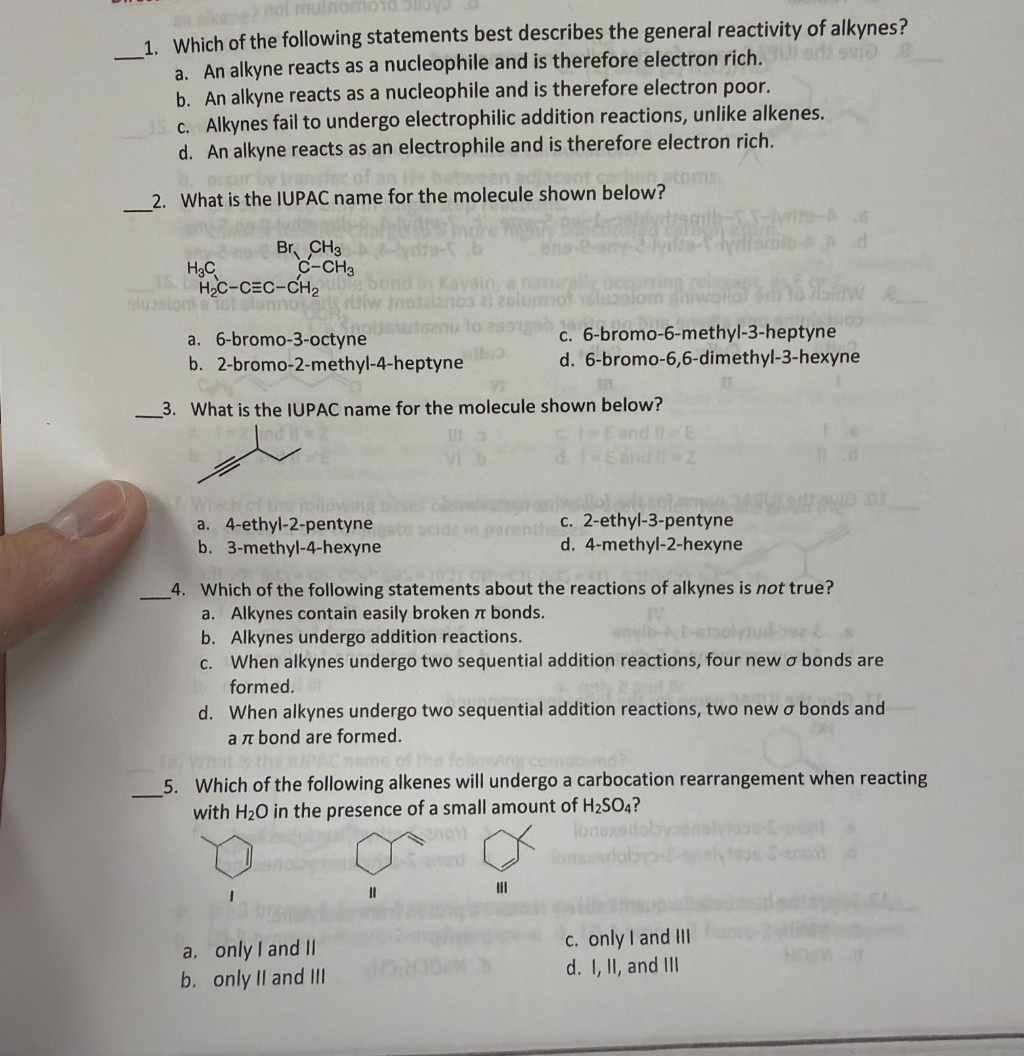
Act like a helpful tutor and exlain me :1. Which of the following statements best describes the general reactivity of alkynes?
Ta Analkynereactsasa nucleophile and is therefore electron rich.
b. An alkyne reacts as a nucleophile and is therefore electron poor.
¢. Alkynes fail to undergo electrophilic addition reactions, unlike alkenes.
d. An alkyne reacts as an electrophile and is therefore electron rich.
2. What is the IUPAC name for the molecule shown below?
Br, CHs
HG, C-CHy
HoC-C=C—-CHj,
a. 6-bromo-3-octyne c. 6-bromo-6-methyl-3-heptyne
b. 2-bromo-2-methyl-4-heptyne d. 6-bromo-6,6-dimethyl-3-hexyne
__3. What is the IUPAC name for the molecule shown below?
Pp
8 LJ a. 4-ethyl-2-pentyne c. 2-ethyl-3-pentyne
Fr b. 3-methyl-4-hexyne d. 4-methyl-2-hexyne
___4. Which of the following statements about the reactions of alkynes is not true?
a. Alkynes contain easily broken rr bonds.
b. Alkynes undergo addition reactions.
c. When alkynes undergo two sequential addition reactions, four new o bonds are
ke formed.
ie d. When alkynes undergo two sequential addition reactions, two new o bonds and
E a mbond are formed.
- 5. Which of the following alkenes will undergo a carbocation rearrangement when reacting
Br with H20 in the presence of a small amount of H;504?
fF x
E BRE ol es
E: : | " [1
1 a. onlylandll c. only land ll
b. only land Ill d. 1,1, and Il
hy a ——————
Question:
Act like a helpful tutor and exlain me :1. Which of the following statements best describes the general reactivity of alkynes?
Ta Analkynereactsasa nucleophile and is therefore electron rich.
b. An alkyne reacts as a nucleophile and is therefore electron poor.
¢. Alkynes fail to undergo electrophilic addition reactions, unlike alkenes.
d. An alkyne reacts as an electrophile and is therefore electron rich.
2. What is the IUPAC name for the molecule shown below?
Br, CHs
HG, C-CHy
HoC-C=C—-CHj,
a. 6-bromo-3-octyne c. 6-bromo-6-methyl-3-heptyne
b. 2-bromo-2-methyl-4-heptyne d. 6-bromo-6,6-dimethyl-3-hexyne
__3. What is the IUPAC name for the molecule shown below?
Pp
8 LJ a. 4-ethyl-2-pentyne c. 2-ethyl-3-pentyne
Fr b. 3-methyl-4-hexyne d. 4-methyl-2-hexyne
___4. Which of the following statements about the reactions of alkynes is not true?
a. Alkynes contain easily broken rr bonds.
b. Alkynes undergo addition reactions.
c. When alkynes undergo two sequential addition reactions, four new o bonds are
ke formed.
ie d. When alkynes undergo two sequential addition reactions, two new o bonds and
E a mbond are formed.
- 5. Which of the following alkenes will undergo a carbocation rearrangement when reacting
Br with H20 in the presence of a small amount of H;504?
fF x
E BRE ol es
E: : | " [1
1 a. onlylandll c. only land ll
b. only land Ill d. 1,1, and Il
hy a ——————
This is AI generated Response.
Asked by: Alok Kumar
Created at: 2026-03-02 03:39:46
Final Answer:
RenderedRaw Text
Did you like this answer?
Sure! Let’s go through each question in detail:
---
## 1. General Reactivity of Alkynes
**Question:**
Which of the following statements best describes the general reactivity of alkynes?
**Options:**
- a. An alkyne reacts as a nucleophile and is therefore electron rich.
- b. An alkyne reacts a nucleophile is therefore electron poor.
- c. Alkynes fail to undergo electrophilic addition reactions, unlike alkenes.
- d. An alkyne reacts as an electrophile and is therefore electron rich.
**Explanation:**
- Alkynes have π electrons, making them electron-rich, so they act as nucleophiles (electron pair donors).
- Electrophilic addition is a common reaction for alkynes, similar to alkenes.
- They are not electron poor.
- They do not act as electrophiles.
**Answer:**
**a. An alkyne reacts as a nucleophile and is therefore electron rich.**
---
## 2. IUPAC Name of the Molecule
**Structure:**
```
Br CH3
| |
H3C-C≡C-CH2-C-CH3
|
CH3
```
**Steps:**
- Find the longest carbon chain containing the triple bond.
- Number from the end nearest the triple bond.
- Assign locants to substituents.
**Longest Chain:** 7 carbons (heptyne), triple bond starts at C-4.
**Substituents:**
- Br at C-6
- Two methyls at C-6
**Correct Name:**
6-bromo-6,6-dimethyl-3-hexyne
**Answer:**
**d. 6-bromo-6,6-dimethyl-3-hexyne**
---
## 3. IUPAC Name of the Molecule (Structure)
**Structure:**
```
/\
/ \
/ \
---------
|
CH2
|
CH3
```
(There is a triple bond at the end with an ethyl group attached to the 4th carbon.)
**Steps:**
- Longest chain: 5 carbons (pent-2-yne)
- Ethyl at C-4
**Answer:**
**a. 4-ethyl-2-pentyne**
---
## 4. Statements About Alkyne Reactions
**Which statement is NOT true?**
- a. Alkynes contain easily broken π bonds. *(True)*
- b. Alkynes undergo addition reactions. *(True)*
- c. When alkynes undergo two sequential addition reactions, four new σ bonds are formed. *(True)*
- d. When alkynes undergo two sequential addition reactions, two new σ bonds and a π bond are formed. *(**NOT TRUE**: both π bonds are replaced by σ bonds.)*
**Answer:**
**d. When alkynes undergo two sequential addition reactions, two new σ bonds and a π bond are formed.**
---
## 5. Carbocation Rearrangement with H₂O/H₂SO₄
- **Carbocation rearrangement** happens if a more stable carbocation can be formed by shifting a hydrogen or alkyl group.
- **Look for secondary or tertiary carbons adjacent to the double bond.**
I: Yes, can rearrange for more stability.
II: Yes, can rearrange for more stability.
III: No, rearrangement would not lead to increased stability.
**Answer:**
**a. only I and II**
---
If you need further breakdowns or have follow-up questions, feel free to ask!
Question:
summary pls
This is AI generated Response.
Asked by: Alok Kumar
Created at: 2026-03-02 03:41:56
Final Answer:
RenderedRaw Text
Did you like this answer?
# Summary of Alkynes and Related Questions
## 1. General Reactivity of Alkynes
- **Correct Statement:**
a. An alkyne reacts as a nucleophile and is therefore electron rich.
## 2. IUPAC Name of the Molecule
- **Structure:** Contains a triple bond, Br at C-6, and two methyl groups at C-6.
- **Correct Name:**
d. 6-bromo-6,6-dimethyl-3-hexyne
## 3. IUPAC Name of Another Molecule
- **Structure:** Includes a triple bond and an ethyl group at C-4.
- **Correct Name:**
a. 4-ethyl-2-pentyne
## 4. Statements About Alkyne Reactions
- **Incorrect Statement:**
d. When alkynes undergo two sequential addition reactions, two new σ bonds and a π bond are formed.
## 5. Carbocation Rearrangement
- **Correct Answer:**
a. only I and II (Carbocation rearrangement occurs in structures I and II, but not in III).
If you have further questions or need clarification, let me know!
VIPSolutions focuses on clear, step‑by‑step explanations so you can learn quickly. Whether you need an AI‑generated walkthrough or a short hint to get unstuck, each solution is organized for fast reading and easy review later.
Search similar questions, compare approaches, and bookmark the best answers for revision. Our goal is simple: quick, reliable study help that feels natural—not noisy.
 VIPSolutions
 1. Which of the following statements best describes the general reactivity of alkynes?
Ta Analkynereactsasa nucleophile and is therefore electron rich.
b. An alkyne reacts as a nucleophile and is therefore electron poor.
¢. Alkynes fail to undergo electrophilic addition reactions, unlike alkenes.
d. An alkyne reacts as an electrophile and is therefore electron rich.
2. What is the IUPAC name for the molecule shown below?
Br, CHs
HG, C-CHy
HoC-C=C—-CHj,
a. 6-bromo-3-octyne c. 6-bromo-6-methyl-3-heptyne
b. 2-bromo-2-methyl-4-heptyne d. 6-bromo-6,6-dimethyl-3-hexyne
__3. What is the IUPAC name for the molecule shown below?
Pp
8 LJ a. 4-ethyl-2-pentyne c. 2-ethyl-3-pentyne
Fr b. 3-methyl-4-hexyne d. 4-methyl-2-hexyne
___4. Which of the following statements about the reactions of alkynes is not true?
a. Alkynes contain easily broken rr bonds.
b. Alkynes undergo addition reactions.
c. When alkynes undergo two sequential addition reactions, four new o bonds are
ke formed.
ie d. When alkynes undergo two sequential addition reactions, two new o bonds and
E a mbond are formed.
- 5. Which of the following alkenes will undergo a carbocation rearrangement when reacting
Br with H20 in the presence of a small amount of H;504?
fF x
E BRE ol es
E: : | " [1
1 a. onlylandll c. only land ll
b. only land Ill d. 1,1, and Il
hy a ——————
1. Which of the following statements best describes the general reactivity of alkynes?
Ta Analkynereactsasa nucleophile and is therefore electron rich.
b. An alkyne reacts as a nucleophile and is therefore electron poor.
¢. Alkynes fail to undergo electrophilic addition reactions, unlike alkenes.
d. An alkyne reacts as an electrophile and is therefore electron rich.
2. What is the IUPAC name for the molecule shown below?
Br, CHs
HG, C-CHy
HoC-C=C—-CHj,
a. 6-bromo-3-octyne c. 6-bromo-6-methyl-3-heptyne
b. 2-bromo-2-methyl-4-heptyne d. 6-bromo-6,6-dimethyl-3-hexyne
__3. What is the IUPAC name for the molecule shown below?
Pp
8 LJ a. 4-ethyl-2-pentyne c. 2-ethyl-3-pentyne
Fr b. 3-methyl-4-hexyne d. 4-methyl-2-hexyne
___4. Which of the following statements about the reactions of alkynes is not true?
a. Alkynes contain easily broken rr bonds.
b. Alkynes undergo addition reactions.
c. When alkynes undergo two sequential addition reactions, four new o bonds are
ke formed.
ie d. When alkynes undergo two sequential addition reactions, two new o bonds and
E a mbond are formed.
- 5. Which of the following alkenes will undergo a carbocation rearrangement when reacting
Br with H20 in the presence of a small amount of H;504?
fF x
E BRE ol es
E: : | " [1
1 a. onlylandll c. only land ll
b. only land Ill d. 1,1, and Il
hy a ——————