 VIPSolutions
Act like a helpful tutor and exlain me :2 (10 pts). Show that the cone (9,2) eRe? + ay” — 2% = 0} @ is a ruled surface (write down the parametrization as a ruled surface). Show that the origin (0,0,0) is the only singular point, and find the "line" of striction.
Question:
Act like a helpful tutor and exlain me :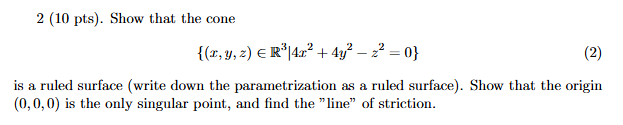 2 (10 pts). Show that the cone
(9,2) eRe? + ay” — 2% = 0} @
is a ruled surface (write down the parametrization as a ruled surface). Show that the origin
(0,0,0) is the only singular point, and find the "line" of striction.
2 (10 pts). Show that the cone
(9,2) eRe? + ay” — 2% = 0} @
is a ruled surface (write down the parametrization as a ruled surface). Show that the origin
(0,0,0) is the only singular point, and find the "line" of striction.
This is AI generated Response.
Asked by: Alok Kumar
Created at: 2026-01-29 05:10:03
Asked by: Alok Kumar
Created at: 2026-01-29 05:10:03
Final Answer:
Rendered
Raw Text
Did you like this answer?
Let’s break down **each part** of the problem for the cone:
\[
\{(x, y, z) \in \mathbb{R}^3 \mid 4x^2 + 4y^2 - z^2 = \}
\]
---
## 1. **Show it's a Ruled Surface (Parametrization)**
A **ruled surface** is a surface that can be swept out by moving a straight line.
### **Rewriting the Equation**
\[
4x^2 + 4y^2 - z^2 = \implies z^2 = 4(x^2 + y^2) \implies z = 2\sqrt{x^2 + y^2} \text{ or } z = -2\sqrt{x^2 + y^2}
\]
### **Parametric Representation as a Ruled Surface**
Let’s parametrize the cone using a fixed point (vertex at the origin) and a direction.
Let’s set \( y = t x \) (so for every \( t \), we get a line in the \( x-y \) plane through the origin):
Let \( x = u \), \( y = t u \), \( z = 2\sqrt{x^2 + y^2} = 2|u|\sqrt{1 + t^2} \)
But to keep it linear in \( u \), allow \( u \) to be any real number (positive or negative):
\[
(x, y, z) = (u, tu, 2u\sqrt{1 + t^2})
\]
for all \( u \in \mathbb{R} \), \( t \in \mathbb{R} \).
This is a ruled surface: for each value of \( t \), the set of all points as \( u \) varies gives a line passing through the origin (vertex of the cone) and lying on the cone.
Alternatively, you can use a trigonometric parametrization:
\[
x = r\cos\theta,\, y = r\sin\theta,\, z = 2r
\]
for \( r \in \mathbb{R} \), \( \theta \in [, 2\pi) \).
---
## 2. **Show the Origin \((,,)\) is the Only Singular Point**
A **singular point** on a surface defined by \( F(x, y, z) = \) is where the gradient \( \nabla F = \).
Here, \( F(x, y, z) = 4x^2 + 4y^2 - z^2 \):
\[
\nabla F = (8x,\, 8y,\, -2z)
\]
Set each partial derivative to :
- \( 8x = \implies x = \)
- \( 8y = \implies y = \)
- \( -2z = \implies z = \)
So, **the only singular point is \((, , )\)**.
---
## 3. **Find the "Line" of Striction**
The **line of striction** of a ruled surface is the locus of the closest points between adjacent rulings (lines). For a cone with vertex at the origin, **the line of striction is the vertex itself**, i.e., the origin.
But if you want the more general answer:
- For a cone, all rulings pass through the vertex (origin).
- Thus, the "line" of striction degenerates to the **point (,,)**.
---
## **Summary**
- **Ruled surface parametrization:** \((x, y, z) = (u, tu, 2u\sqrt{1 + t^2})\)
- **Only singular point:** \((,,)\)
- **Line of striction:** The origin \((,,)\)
Let me know if you want a more geometric or visual explanation!
📢 Instructions:
- Ask anything relatd to above question only.
- For new Question goto :