 VIPSolutions
Act like a helpful tutor and exlain me :5. Given Pus = 45 mW for each GaAs diode 4) Determine the maximum current rating of each diode. b) What type of circuit is represented in the figure below. ©) Determine maximum current for each of the parallel diodes. d) Determine the current through each diode at imax. ©) Can this circuit function with fewer number of diodes? Would your conclusion be the same 2.2K resistor is replaced with 6k Vi ax — 100 V ° o + 0 [i v 22kQ 68kQ
Question:
Act like a helpful tutor and exlain me :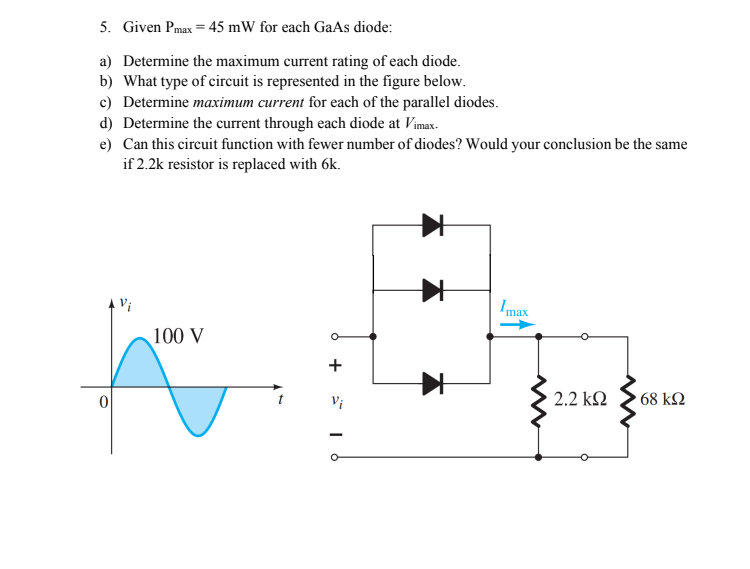 5. Given Pus = 45 mW for each GaAs diode
4) Determine the maximum current rating of each diode.
b) What type of circuit is represented in the figure below.
©) Determine maximum current for each of the parallel diodes.
d) Determine the current through each diode at imax.
©) Can this circuit function with fewer number of diodes? Would your conclusion be the same
2.2K resistor is replaced with 6k
Vi ax
—
100 V ° o
+
0 [i v 22kQ 68kQ
5. Given Pus = 45 mW for each GaAs diode
4) Determine the maximum current rating of each diode.
b) What type of circuit is represented in the figure below.
©) Determine maximum current for each of the parallel diodes.
d) Determine the current through each diode at imax.
©) Can this circuit function with fewer number of diodes? Would your conclusion be the same
2.2K resistor is replaced with 6k
Vi ax
—
100 V ° o
+
0 [i v 22kQ 68kQ
This is AI generated Response.
Asked by: Alok Kumar
Created at: 2026-01-26 04:43:49
Asked by: Alok Kumar
Created at: 2026-01-26 04:43:49
Final Answer:
Rendered
Raw Text
Did you like this answer?
Let's break down and explain each part of the problem step by step:
---
## **a) Maximum Current Rating of Each Diode**
Given:
- Maximum power rating of each GaAs diode, \( P_{max} = 45\,\text{mW} \)
- Assume each diode drops about \( V_D \) volts (for GaAs, typically \( V_D \approx 1.2\,\text{V} \); if not given, use this value unless your course specifies otherwise).
**Formula:**
\[
P_{max} = V_D \cdot I_{max}
\]
**Solving for \( I_{max} \):**
\[
I_{max} = \frac{P_{max}}{V_D}
\]
\[
I_{max} = \frac{45\,\text{mW}}{1.2\,\text{V}} = \frac{.045\,\text{W}}{1.2\,\text{V}} = .0375\,\text{A} = 37.5\,\text{mA}
\]
---
## **b) Type of Circuit**
This is a **clipping circuit** (or voltage limiter) using **series diodes** to limit the output voltage.
- It is also called a **parallel diode limiter** (since the diodes are in parallel with the load).
---
## **c) Maximum Current for Each Parallel Diode**
When the input voltage is at its peak, the diodes conduct and **share the total current** through the parallel branch.
- Let's assume three diodes share the current equally.
- The **maximum current** through each diode is \( I_{max} \) (from part a): **37.5 mA**.
---
## **d) Current Through Each Diode at \( V_{imax} \)**
1. **Find \( V_{imax} \):**
- The maximum input voltage \( V_{i(max)} = 100\,\text{V} \).
- When the input exceeds the total diode drop (3 × 1.2 V = 3.6 V), the diodes conduct.
- The voltage across the parallel resistors (output) is about \( 3 \times 1.2 = 3.6\,\text{V} \) (assuming all three diodes conduct simultaneously).
2. **Total load resistance:**
\[
R_{total} = \left( \frac{1}{2.2k} + \frac{1}{68k} \right)^{-1}
\approx 2.13\,k\Omega
\]
3. **Total current through the diodes at peak:**
\[
I_{total} = \frac{V_{imax} - V_{out}}{R_{total}}
\]
But since \( V_{out} \) is clamped to 3.6 V, the current is:
\[
I_{total} = \frac{3.6\,\text{V}}{2.13\,k\Omega} \approx 1.69\,\text{mA}
\]
- This is the current through the parallel combination, shared among the diodes.
\[
I_{diode} = \frac{I_{total}}{3} \approx \frac{1.69\,\text{mA}}{3} \approx .56\,\text{mA}
\]
---
## **e) Can the Circuit Function with Fewer Diodes?**
- The **number of diodes** determines the maximum clamped voltage (\( V_{out,max} = N \cdot V_D \)).
- If you use **fewer diodes**, the clamp voltage drops (e.g., 2 diodes → 2.4 V).
- The power per diode increases since each diode must handle more voltage and possibly more current, possibly **exceeding their power rating**.
- **Replacing the 2.2 kΩ with 6 kΩ:**
- The current through the circuit decreases, so the power dissipation in each diode drops.
- This may allow the circuit to function with fewer diodes, **but the clamp voltage will still be lower**.
---
## **Summary Table**
| Question | Answer |
|----------|--------|
| (a) | \( 37.5\,\text{mA} \) per diode |
| (b) | Clipping/Limiter circuit |
| (c) | \( 37.5\,\text{mA} \) (max current per diode) |
| (d) | \( .56\,\text{mA} \) per diode at \( V_{imax} \) |
| (e) | Fewer diodes reduce clamp voltage; safe if power rating not exceeded. With 6kΩ, less current, so possibly safe with fewer diodes. |
---
**If you have any follow-up or want to see calculations for a different assumption, let me know!**
📢 Instructions:
- Ask anything relatd to above question only.
- For new Question goto :