 VIPSolutions
Act like a helpful tutor and exlain me :5: Moved Honours svdert was ble 1 mak co of theo mrs of 1 Ere adare hp Vn or det hols Beeb. Sn Pace tae on Coty oe we Fre ble roca: pny ma (te og po rt Ee ta 0 rt hi re we ee
Question:
Act like a helpful tutor and exlain me :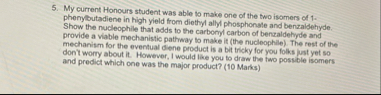 5: Moved Honours svdert was ble 1 mak co of theo mrs of 1
Ere adare hp Vn or det hols Beeb.
Sn Pace tae on Coty oe we
Fre ble roca: pny ma (te og po
rt Ee ta
0 rt hi re we ee
5: Moved Honours svdert was ble 1 mak co of theo mrs of 1
Ere adare hp Vn or det hols Beeb.
Sn Pace tae on Coty oe we
Fre ble roca: pny ma (te og po
rt Ee ta
0 rt hi re we ee
This is AI generated Response.
Asked by: Alok Kumar
Created at: 2026-01-29 06:04:33
Asked by: Alok Kumar
Created at: 2026-01-29 06:04:33
Final Answer:
Rendered
Raw Text
Did you like this answer?
# Explanation of the Question
Let's break down the task step by step:
### Question Summary
- The reaction is between **diethyl allyl phosphonate** and **benzaldehyde**.
- The product is one of two isomers of **1-phenylbutadiene**.
- You need to:
1. Identify the nucleophile that adds to the carbonyl carbon of benzaldehyde.
2. Provide a mechanistic pathway for this step.
3. Draw the two possible isomers of 1-phenylbutadiene.
4. Predict which isomer is the major product.
---
## 1. **Identifying the Nucleophile and the Reaction**
### **Reactants**
- **Diethyl allyl phosphonate**:
Structure: `CH2=CH-CH2-P(O)(OEt)2`
- **Benzaldehyde**:
Structure: `Ph-CHO` (Ph = phenyl group)
This is a **Horner–Wadsworth–Emmons (HWE) reaction**, a variant of the Wittig reaction.
### **Nucleophile**
The nucleophile is the **carbanion** formed by deprotonating the carbon next to the phosphonate:
```
CH2=CH-CH2-P(O)(OEt)2 + base → CH2=CH-CH^(-)-P(O)(OEt)2
```
This carbanion attacks the carbonyl carbon of benzaldehyde.
---
## 2. **Mechanism Outline**
1. **Deprotonation:**
A strong base (e.g., NaH or NaOEt) removes a proton from the methylene next to the phosphonate group, forming a stabilized ylide/carbanion.
2. **Nucleophilic Addition:**
The carbanion attacks the electrophilic carbonyl carbon of benzaldehyde, forming a **betaine intermediate**.
3. **Elimination:**
The intermediate collapses, eliminating the phosphonate group and forming a double bond, giving a **1,3-diene** (1-phenylbutadiene).
### **Mechanism Diagram**
```
Step 1: Generation of carbanion
CH2=CH-CH2-P(O)(OEt)2 + Base → CH2=CH-CH^(-)-P(O)(OEt)2
Step 2: Nucleophilic attack
CH2=CH-CH^(-)-P(O)(OEt)2 + Ph-CHO → [Intermediate]
Step 3: Elimination (Horner–Wadsworth–Emmons)
[Intermediate] → 1-phenylbutadiene + (by-products)
```
---
## 3. **Drawing the Two Possible Isomers**
### **1-Phenylbutadiene**
General structure: `Ph-CH=CH-CH=CH2`
There are two possible geometric isomers around the central double bond:
- (E)-1-Phenyl-1,3-butadiene
- (Z)-1-Phenyl-1,3-butadiene
### **Structural Representation**
#### **(E)-Isomer (Trans)**
```
Ph
\
C=C
/ \
H CH=CH2
```
#### **(Z)-Isomer (Cis)**
```
Ph
\
C=C
/ \
CH=CH2 H
```
---
## 4. **Which Isomer is the Major Product?**
The **Horner–Wadsworth–Emmons reaction** generally favors formation of the **E-alkene (trans)** product due to steric and thermodynamic stability.
### **Prediction**
- **Major product:** (E)-1-phenyl-1,3-butadiene
---
## **Summary Table**
| Step | Details |
|-----------------------|----------------------------------------------------------------------------|
| Nucleophile | Carbanion from diethyl allyl phosphonate |
| Mechanism | HWE reaction: deprotonation, nucleophilic attack, elimination |
| Possible Isomers | (E)- and (Z)-1-phenyl-1,3-butadiene |
| Major Product | (E)-1-phenyl-1,3-butadiene (trans) |
---
## **Drawings**
### **1. (E)-1-phenyl-1,3-butadiene**
```
Ph-CH=CH-CH=CH2
(E)-isomer (trans)
```
### **2. (Z)-1-phenyl-1,3-butadiene**
```
Ph
\
CH=CH
\
CH=CH2
(Z)-isomer (cis)
```
---
**Let me know if you need a stepwise arrow-pushing mechanism or further clarification!**
📢 Instructions:
- Ask anything relatd to above question only.
- For new Question goto :