 VIPSolutions
Act like a helpful tutor and exlain me :Case Problem Dealer’s Absorbing State Probabilities in Blackjack The game of blackjack (sometimes called “21) is a popular casino game. The goal js 1, have a hand with a value of 21 or as close to 21 as possible without exceeding 21, Tp, player and the dealer are each dealt two cards initially. Both the pl 1 dealer may dray, additional cards (called “taking a hit”) in order to improve th f cither the playe or dealer takes a hit and the value of the hand exceeds 2 P r dealer is said to have gone broke and loses. Face cards and tens count 10 poinf t nted as | or 11, and all other cards count at their face value. The d hat the player must decide on whether to take a hit first. The player wh r 21 goes broke and loses, even if the dealer later goes brok or 1 has 16 and draws any card with a value higher than a 5, the pla For this re son, players will often decide not to take a hit when th or greater The dealer's hand is dealt with one card up an ayer’s deci. sion of whether to take a hit is based on knowledg gambling professional asks you to help determine the prob: e dealer's hand given different up cards. House rules at casir nue to take a hit until the dealer’s hand reaches a value of d Markoy processes, you suggest that the dealer's process of tak a Markov process with absorbing states. Managerial Report Prepare a report for the professional gambler that summariz Include the following 1. At some casinos, the dealer is required to stay (stop taking hits) when the dealer hand reaches soft or hard 17. A hand of soft 17 is one including an ace that may be counted as 1 or 11. In all casinos, the dealer is required to stay with soft 18,19, 20, or 21. For each possible up card, determine the probability that the ending value of the dealer's hand is 17, 18, 19, 20, 21, or broke, 2. At other casinos, the dealer is required to take a hit on soft 17, but must stay on all other hands with a value of 17, 18, 19, 20, or 21. For this situation, determine the probability of the ending value of the dealer's hand. 3. Comment on whether the house rule of staying on soft 17 or hitting on soft 17 appears better for the player
Question:
Act like a helpful tutor and exlain me :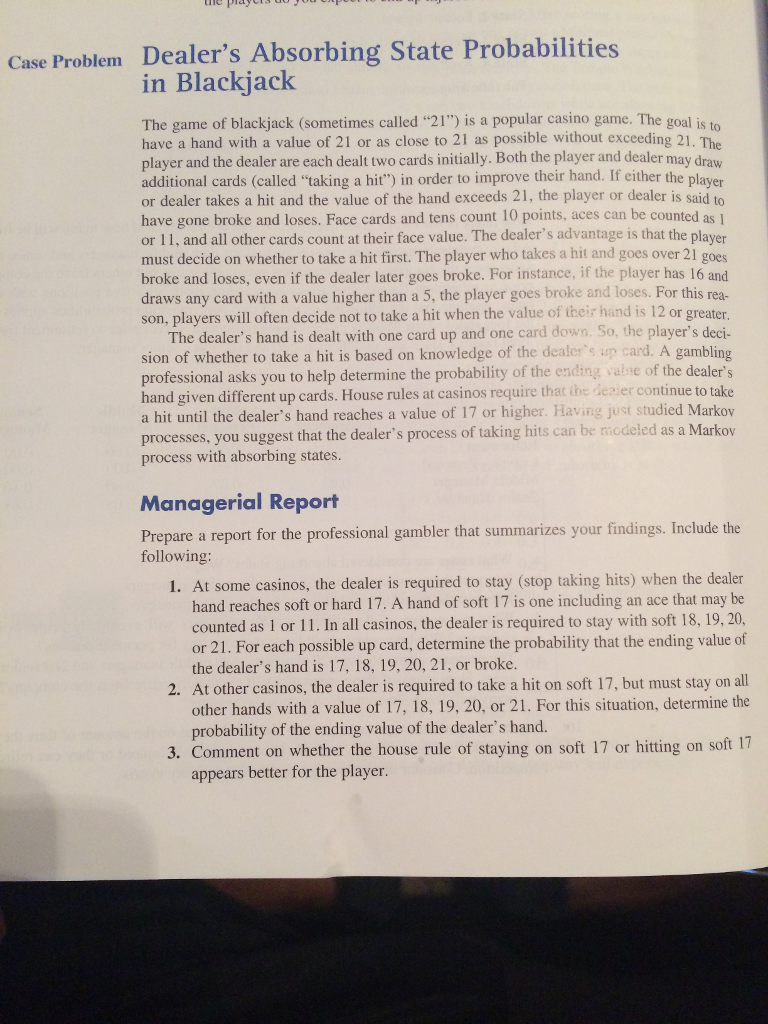 Case Problem Dealer’s Absorbing State Probabilities
in Blackjack
The game of blackjack (sometimes called “21) is a popular casino game. The goal js 1,
have a hand with a value of 21 or as close to 21 as possible without exceeding 21, Tp,
player and the dealer are each dealt two cards initially. Both the pl 1 dealer may dray,
additional cards (called “taking a hit”) in order to improve th f cither the playe
or dealer takes a hit and the value of the hand exceeds 2 P r dealer is said to
have gone broke and loses. Face cards and tens count 10 poinf t nted as |
or 11, and all other cards count at their face value. The d hat the player
must decide on whether to take a hit first. The player wh r 21 goes
broke and loses, even if the dealer later goes brok or 1 has 16 and
draws any card with a value higher than a 5, the pla For this re
son, players will often decide not to take a hit when th or greater
The dealer's hand is dealt with one card up an ayer’s deci.
sion of whether to take a hit is based on knowledg gambling
professional asks you to help determine the prob: e dealer's
hand given different up cards. House rules at casir nue to take
a hit until the dealer’s hand reaches a value of d Markoy
processes, you suggest that the dealer's process of tak a Markov
process with absorbing states.
Managerial Report
Prepare a report for the professional gambler that summariz Include the
following
1. At some casinos, the dealer is required to stay (stop taking hits) when the dealer
hand reaches soft or hard 17. A hand of soft 17 is one including an ace that may be
counted as 1 or 11. In all casinos, the dealer is required to stay with soft 18,19, 20,
or 21. For each possible up card, determine the probability that the ending value of
the dealer's hand is 17, 18, 19, 20, 21, or broke,
2. At other casinos, the dealer is required to take a hit on soft 17, but must stay on all
other hands with a value of 17, 18, 19, 20, or 21. For this situation, determine the
probability of the ending value of the dealer's hand.
3. Comment on whether the house rule of staying on soft 17 or hitting on soft 17
appears better for the player
Case Problem Dealer’s Absorbing State Probabilities
in Blackjack
The game of blackjack (sometimes called “21) is a popular casino game. The goal js 1,
have a hand with a value of 21 or as close to 21 as possible without exceeding 21, Tp,
player and the dealer are each dealt two cards initially. Both the pl 1 dealer may dray,
additional cards (called “taking a hit”) in order to improve th f cither the playe
or dealer takes a hit and the value of the hand exceeds 2 P r dealer is said to
have gone broke and loses. Face cards and tens count 10 poinf t nted as |
or 11, and all other cards count at their face value. The d hat the player
must decide on whether to take a hit first. The player wh r 21 goes
broke and loses, even if the dealer later goes brok or 1 has 16 and
draws any card with a value higher than a 5, the pla For this re
son, players will often decide not to take a hit when th or greater
The dealer's hand is dealt with one card up an ayer’s deci.
sion of whether to take a hit is based on knowledg gambling
professional asks you to help determine the prob: e dealer's
hand given different up cards. House rules at casir nue to take
a hit until the dealer’s hand reaches a value of d Markoy
processes, you suggest that the dealer's process of tak a Markov
process with absorbing states.
Managerial Report
Prepare a report for the professional gambler that summariz Include the
following
1. At some casinos, the dealer is required to stay (stop taking hits) when the dealer
hand reaches soft or hard 17. A hand of soft 17 is one including an ace that may be
counted as 1 or 11. In all casinos, the dealer is required to stay with soft 18,19, 20,
or 21. For each possible up card, determine the probability that the ending value of
the dealer's hand is 17, 18, 19, 20, 21, or broke,
2. At other casinos, the dealer is required to take a hit on soft 17, but must stay on all
other hands with a value of 17, 18, 19, 20, or 21. For this situation, determine the
probability of the ending value of the dealer's hand.
3. Comment on whether the house rule of staying on soft 17 or hitting on soft 17
appears better for the player
Asked by: Umesh
Created at: 2025-08-01 22:37:22
Final Answer:
📢 Instructions:
- Ask anything relatd to above question only.
- For new Question goto :