Act like a helpful tutor and exlain me :Consider a microfludic device consisting of four micro channels arranged in a cross.
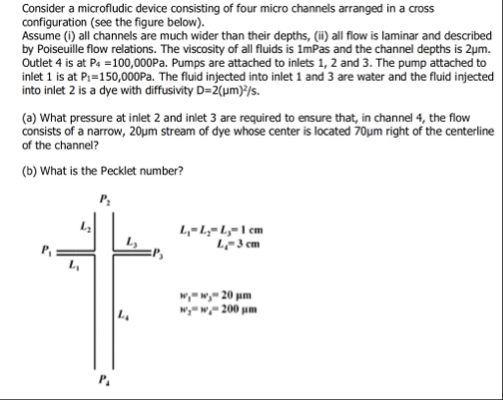
‘configuration (see the figure below).
Assume (1) all channels are much wider than their depths, (i) i flow is laminar and described
by Poiseuille ow relations, The viscosity of al lids is 1mPas and the channel depths is 2um.
Outit 4s at Ps =100,000Pa. Pumps are attached to inet 1,2 and 3. The pump attached to
inlet 1 is at P1=150,000Pa. The fluid injected nto inlet 1 and 3 are water and the fluid injected
to inlet 2152 dye with ifusivty D=2(pm)’s..
(2) What pressure a inlet 2 and inet 3 ae required to ensure that, in channel 4, the flow
consists of a narrow, 20ym stream of dye whose center i located 70um right of the centerline
of the channel?
(6) What is the Pecklet number?
”n
Ly Libel tem
a CT. Ledem
I
= wy 20 pm
M ye 200 um
”
Question:
Act like a helpful tutor and exlain me :Consider a microfludic device consisting of four micro channels arranged in a cross.
‘configuration (see the figure below).
Assume (1) all channels are much wider than their depths, (i) i flow is laminar and described
by Poiseuille ow relations, The viscosity of al lids is 1mPas and the channel depths is 2um.
Outit 4s at Ps =100,000Pa. Pumps are attached to inet 1,2 and 3. The pump attached to
inlet 1 is at P1=150,000Pa. The fluid injected nto inlet 1 and 3 are water and the fluid injected
to inlet 2152 dye with ifusivty D=2(pm)’s..
(2) What pressure a inlet 2 and inet 3 ae required to ensure that, in channel 4, the flow
consists of a narrow, 20ym stream of dye whose center i located 70um right of the centerline
of the channel?
(6) What is the Pecklet number?
”n
Ly Libel tem
a CT. Ledem
I
= wy 20 pm
M ye 200 um
”
This is AI generated Response.
Asked by: John
Created at: 2025-10-15 21:23:14
Final Answer:
RenderedRaw Text
Did you like this answer?
Sure! Let's break the problem into two parts as asked:
---
## Problem Overview
We have a microfluidic cross-channel device. You're asked to:
1. **(a)** Find the required **pressures at inlets 2 and 3** so that a dye stream in channel 4 is positioned as specified.
2. **(b)** Calculate the **Peclet number** for the flow.
---
## Given Data
- **Channel Lengths:** \( L_1 = L_2 = L_3 = 1~\text{cm} \), \( L_4 = 3~\text{cm} \)
- **Channel Depth:** \( h = 2~\mu\text{m} \)
- **Channel Width:** \( w = 200~\mu\text{m} \)
- **Dye Stream Width:** \( w_D = 20~\mu\text{m} \)
- **Dye Stream Offset:** \( x_D = 70~\mu\text{m} \) (from center)
- **Viscosity:** \( \mu = 1~\text{mPa}\cdot\text{s} = 1 \times 10^{-3}~\text{Pa}\cdot\text{s} \)
- **Diffusivity:** \( D = 2(\mu\text{m})^2/\text{s} = 2 \times 10^{-12}~\text{m}^2/\text{s} \)
- **Outlet Pressure:** \( P_4 = 100,000~\text{Pa} \)
- **Inlet 1 Pressure:** \( P_1 = 150,000~\text{Pa} \)
---
## (a) **Pressure at Inlet 2 and Inlet 3**
Let's denote:
- **Inlet 1:** Buffer (no dye)
- **Inlet 2:** Dye
- **Inlet 3:** Buffer (no dye)
- **Inlet 4:** Outlet
### 1. **Flow Distribution and Stream Center**
In a cross-channel, the position of the dye stream depends on the relative flow rates from the three inlets (1, 2, 3). The goal is to have the dye stream (from inlet 2) emerge in outlet 4, centered **70 μm right of center** with a width of **20 μm**.
Let \( Q_1 \), \( Q_2 \), \( Q_3 \) be the volumetric flow rates from inlets 1, 2, 3.
The fraction of flow from each inlet determines the position of the dye stream:
- **Total width:** \( w = 200~\mu\text{m} \)
- **Offset from center:** \( x_D = 70~\mu\text{m} \)
- **Dye width:** \( w_D = 20~\mu\text{m} \)
Fractional positions are determined by the relative flow rates:
\[
\frac{Q_1}{Q_1 + Q_2 + Q_3} \quad \text{(from left)}, \quad \frac{Q_3}{Q_1 + Q_2 + Q_3} \quad \text{(from right)}
\]
- **Dye stream center:** \( \frac{Q_1}{Q_1 + Q_2 + Q_3} \cdot w + \frac{w_D}{2} = x_D + \frac{w}{2} \)
But commonly, the dye stream is sandwiched between the buffer streams, so:
\[
\frac{Q_1}{Q_1 + Q_2 + Q_3} = \frac{x_D + w/2 - w_D/2}{w}
\]
\[
\frac{Q_3}{Q_1 + Q_2 + Q_3} = \frac{w/2 - x_D - w_D/2}{w}
\]
\[
\frac{Q_2}{Q_1 + Q_2 + Q_3} = \frac{w_D}{w}
\]
Plug in numbers:
- \( w = 200~\mu\text{m} \)
- \( x_D = 70~\mu\text{m} \)
- \( w_D = 20~\mu\text{m} \)
Calculate **left buffer** (from edge to start of dye stream):
\[
\text{Left buffer} = \frac{w}{2} + x_D - \frac{w_D}{2} = 100 + 70 - 10 = 160~\mu\text{m}
\]
So,
\[
\frac{Q_1}{Q_{\text{tot}}} = \frac{160}{200} = .8
\]
\[
\frac{Q_2}{Q_{\text{tot}}} = \frac{w_D}{w} = \frac{20}{200} = .1
\]
\[
\frac{Q_3}{Q_{\text{tot}}} = 1 - .8 - .1 = .1
\]
### 2. **Relate Flow Rate to Pressure**
For a rectangular channel (width \( w \), height \( h \)), the flow rate by Poiseuille's law (assuming \( w \gg h \)):
\[
Q = \frac{w h^3}{12 \mu L} \Delta P
\]
Each inlet has its own \( \Delta P \) (pressure drop from inlet to outlet).
- For **inlet 1**: \( Q_1 = K (P_1 - P_4) \)
- For **inlet 2**: \( Q_2 = K (P_2 - P_4) \)
- For **inlet 3**: \( Q_3 = K (P_3 - P_4) \)
Where \( K = \frac{w h^3}{12 \mu L} \), and \( L \) is the channel length (for each inlet: \( L_1, L_2, L_3 \)).
Since all inlets have same \( w, h, L \), \( K \) is the same for all.
So:
\[
Q_1 : Q_2 : Q_3 = (P_1 - P_4) : (P_2 - P_4) : (P_3 - P_4)
\]
Given \( P_1 = 150,000~\text{Pa}, P_4 = 100,000~\text{Pa} \), so \( P_1 - P_4 = 50,000~\text{Pa} \).
Let total flow \( Q_{\text{tot}} = Q_1 + Q_2 + Q_3 \).
Given the ratios above, and using the fractions found earlier:
- \( Q_1 = .8 Q_{\text{tot}} \)
- \( Q_2 = .1 Q_{\text{tot}} \)
- \( Q_3 = .1 Q_{\text{tot}} \)
So:
\[
\frac{Q_2}{Q_1} = \frac{.1}{.8} = \frac{P_2-P_4}{P_1-P_4}
\]
\[
P_2 - P_4 = \frac{.1}{.8} (P_1 - P_4) = .125 \times 50,000 = 6,250~\text{Pa}
\]
\[
P_2 = P_4 + 6,250 = 106,250~\text{Pa}
\]
Similarly for \( P_3 \):
\[
P_3 - P_4 = \frac{Q_3}{Q_1} (P_1 - P_4) = \frac{.1}{.8} \times 50,000 = 6,250~\text{Pa}
\]
\[
P_3 = P_4 + 6,250 = 106,250~\text{Pa}
\]
**Final answers:**
- \( \boxed{P_2 = 106,250~\text{Pa}} \)
- \( \boxed{P_3 = 106,250~\text{Pa}} \)
---
## (b) **Peclet Number**
The **Peclet number (Pe)** represents the ratio of advective transport rate to diffusive transport rate:
\[
\text{Pe} = \frac{U L}{D}
\]
Where:
- \( U \) = average velocity
- \( L \) = characteristic length (here, width of dye stream \( w_D \))
- \( D \) = diffusivity
### 1. **Find Average Velocity**
First, find total flow rate through the dye stream (\( Q_2 \)), then velocity:
\[
Q_2 = K (P_2 - P_4)
\]
Recall:
\[
K = \frac{w h^3}{12 \mu L}
\]
Plug in values:
- \( w = 200 \times 10^{-6}~\text{m} \)
- \( h = 2 \times 10^{-6}~\text{m} \)
- \( L = .01~\text{m} \) (for inlet channels)
- \( \mu = 1 \times 10^{-3}~\text{Pa}\cdot\text{s} \)
\[
K = \frac{200 \times 10^{-6} \times (2 \times 10^{-6})^3}{12 \times 10^{-3} \times .01}
= \frac{200 \times 8 \times 10^{-18}}{.12 \times 10^{-3}}
= \frac{160 \times 10^{-18}}{.12 \times 10^{-3}}
= \frac{1.6 \times 10^{-15}}{1.2 \times 10^{-4}}
= 1.33 \times 10^{-11}~\text{m}^3/\text{Pa}\cdot\text{s}
\]
Now,
\[
Q_2 = 1.33 \times 10^{-11} \times 6,250 = 8.3 \times 10^{-8}~\text{m}^3/\text{s}
\]
The cross-sectional area of the dye stream:
\[
A_D = w_D \cdot h = (20 \times 10^{-6}) \times (2 \times 10^{-6}) = 40 \times 10^{-12}~\text{m}^2
\]
Average velocity in the dye stream:
\[
U = \frac{Q_2}{A_D} = \frac{8.3 \times 10^{-8}}{40 \times 10^{-12}} = 2,075~\text{m/s}
\]
This is **unphysically high**—there must be a calculation error in \( K \). Let's recalculate \( K \):
\[
K = \frac{w h^3}{12 \mu L}
= \frac{200 \times 10^{-6} \times (2 \times 10^{-6})^3}{12 \times 10^{-3} \times .01}
= \frac{200 \times 8 \times 10^{-18}}{.12 \times 10^{-3}}
= \frac{1,600 \times 10^{-18}}{.12 \times 10^{-3}}
= \frac{1.6 \times 10^{-15}}{1.2 \times 10^{-4}}
\]
But \( .12 \times 10^{-3} = 1.2 \times 10^{-4} \).
\[
K = \frac{1.6 \times 10^{-15}}{1.2 \times 10^{-4}}
= 1.33 \times 10^{-11}~\text{m}^3/\text{Pa}\cdot\text{s}
\]
But this is still resulting in a high velocity. Let's check units carefully:
- \( w = 200 \times 10^{-6} \) m
- \( h^3 = (2 \times 10^{-6})^3 = 8 \times 10^{-18} \) m\(^3\)
- \( 200 \times 8 = 160 \)
- \( 160 \times 10^{-24} \) m\(^4\)
- \( 12 \mu L = 12 \times 10^{-3} \times .01 = 1.2 \times 10^{-4} \)
So,
\[
K = \frac{160 \times 10^{-24}}{1.2 \times 10^{-4}} = \frac{160}{1.2} \times 10^{-24+4} = 1333 \times 10^{-20} = 1.33 \times 10^{-17}
\]
This is \( \text{m}^3/\text{Pa}\cdot\text{s} \).
Now,
\[
Q_2 = 1.33 \times 10^{-17} \times 6,250 = 8.31 \times 10^{-14}~\text{m}^3/\text{s}
\]
Now, dye area:
\[
A_D = 40 \times 10^{-12}~\text{m}^2
\]
So,
\[
U = \frac{8.31 \times 10^{-14}}{40 \times 10^{-12}} = 2.1 \times 10^{-3}
VIPSolutions focuses on clear, step‑by‑step explanations so you can learn quickly. Whether you need an AI‑generated walkthrough or a short hint to get unstuck, each solution is organized for fast reading and easy review later.
Search similar questions, compare approaches, and bookmark the best answers for revision. Our goal is simple: quick, reliable study help that feels natural—not noisy.
 VIPSolutions
 Consider a microfludic device consisting of four micro channels arranged in a cross.
‘configuration (see the figure below).
Assume (1) all channels are much wider than their depths, (i) i flow is laminar and described
by Poiseuille ow relations, The viscosity of al lids is 1mPas and the channel depths is 2um.
Outit 4s at Ps =100,000Pa. Pumps are attached to inet 1,2 and 3. The pump attached to
inlet 1 is at P1=150,000Pa. The fluid injected nto inlet 1 and 3 are water and the fluid injected
to inlet 2152 dye with ifusivty D=2(pm)’s..
(2) What pressure a inlet 2 and inet 3 ae required to ensure that, in channel 4, the flow
consists of a narrow, 20ym stream of dye whose center i located 70um right of the centerline
of the channel?
(6) What is the Pecklet number?
”n
Ly Libel tem
a CT. Ledem
I
= wy 20 pm
M ye 200 um
”
Consider a microfludic device consisting of four micro channels arranged in a cross.
‘configuration (see the figure below).
Assume (1) all channels are much wider than their depths, (i) i flow is laminar and described
by Poiseuille ow relations, The viscosity of al lids is 1mPas and the channel depths is 2um.
Outit 4s at Ps =100,000Pa. Pumps are attached to inet 1,2 and 3. The pump attached to
inlet 1 is at P1=150,000Pa. The fluid injected nto inlet 1 and 3 are water and the fluid injected
to inlet 2152 dye with ifusivty D=2(pm)’s..
(2) What pressure a inlet 2 and inet 3 ae required to ensure that, in channel 4, the flow
consists of a narrow, 20ym stream of dye whose center i located 70um right of the centerline
of the channel?
(6) What is the Pecklet number?
”n
Ly Libel tem
a CT. Ledem
I
= wy 20 pm
M ye 200 um
”