Act like a helpful tutor and exlain me :Current Attempt in Progress
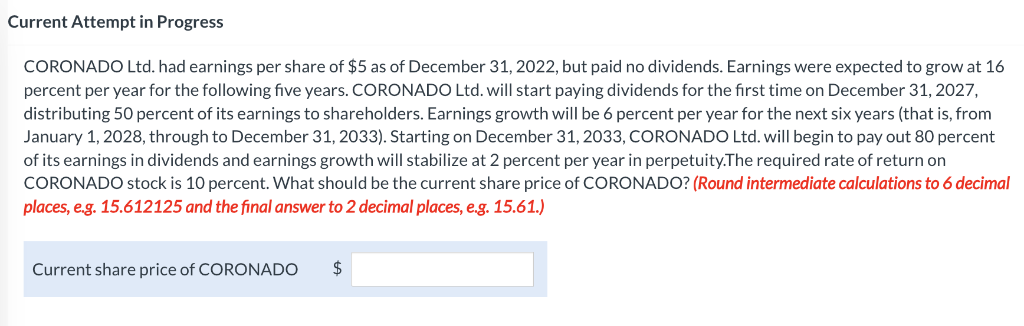
CORONADO Ltd. had earnings per share of $5 as of December 31,2022, but paid no dividends. Earnings were expected to grow at 16
percent per year for the following five years. CORONADO Ltd. will start paying dividends for the first time on December 31,2027,
distributing 50 percent of its earnings to shareholders. Earnings growth will be 6 percent per year for the next six years (that is, from
January 1, 2028, through to December 31, 2033). Starting on December 31, 2033, CORONADO Ltd. will begin to pay out 80 percent
of its earnings in dividends and earnings growth will stabilize at 2 percent per year in perpetuityThe required rate of return on
CORONADO stock is 10 percent. What should be the current share price of CORONADO? (Round intermediate calculations to é decimal
places, e.g. 15.612125 and the final answer to 2 decimal places, e.g. 15.61.)
Current share price of CORONADO $
Question:
Act like a helpful tutor and exlain me :Current Attempt in Progress
CORONADO Ltd. had earnings per share of $5 as of December 31,2022, but paid no dividends. Earnings were expected to grow at 16
percent per year for the following five years. CORONADO Ltd. will start paying dividends for the first time on December 31,2027,
distributing 50 percent of its earnings to shareholders. Earnings growth will be 6 percent per year for the next six years (that is, from
January 1, 2028, through to December 31, 2033). Starting on December 31, 2033, CORONADO Ltd. will begin to pay out 80 percent
of its earnings in dividends and earnings growth will stabilize at 2 percent per year in perpetuityThe required rate of return on
CORONADO stock is 10 percent. What should be the current share price of CORONADO? (Round intermediate calculations to é decimal
places, e.g. 15.612125 and the final answer to 2 decimal places, e.g. 15.61.)
Current share price of CORONADO $
This is AI generated Response.
Asked by: Alok Kumar
Created at: 2026-02-03 06:31:45
Final Answer:
RenderedRaw Text
Did you like this answer?
Let's break down the problem step by step:
## **Step 1: Timeline & Growth Phases**
1. **2022-2027:**
- Earnings per share (EPS) = $5 (as of 12/31/2022)
- **Earnings growth:** 16%/year for 5 years
- **No dividends paid** during this period
2. **2027-2033:**
- **Dividends begin:** 50% payout of earnings (starting 12/31/2027)
- **Earnings growth:** 6%/year for 6 years
3. **2033 and beyond:**
- **Dividend payout:** 80% of earnings
- **Earnings growth:** 2%/year in perpetuity
4. **Required return (discount rate):** 10%
---
## **Step 2: Project Future Earnings and Dividends**
### **A. Calculate EPS at Each Key Date**
#### **EPS at 2027 (after 5 years at 16% growth):**
\[
EPS_{2027} = 5 \times (1 + .16)^5 = 5 \times (2.100946) = 10.50473
\]
#### **Dividends at 2027:**
\[
Dividend_{2027} = 10.50473 \times .5 = 5.252365
\]
#### **EPS at 2033 (after 6 years at 6% growth):**
\[
EPS_{2033} = 10.50473 \times (1 + .06)^6 = 10.50473 \times (1.418519) = 14.90722
\]
#### **Dividends at 2033:**
\[
Dividend_{2033} = 14.90722 \times .8 = 11.92578
\]
---
### **B. Dividends Timeline**
- **2023-2026:** $ (no dividends)
- **2027-2032:** 50% payout, div increases by 6%/year:
- 2027: $5.252365
- 2028: $5.252365 \times 1.06 = $5.567507
- 2029: $5.567507 \times 1.06 = $5.901558
- 203: $5.901558 \times 1.06 = $6.255652
- 2031: $6.255652 \times 1.06 = $6.630991
- 2032: $6.630991 \times 1.06 = $7.028851
---
## **Step 3: Find Terminal Value at 2033**
From 2033 onward, dividend = $11.92578 and grows at 2%/year.
\[
\text{Terminal Value}_{2033} = \frac{Dividend_{2033+1}}{r - g}
\]
\[
Dividend_{2034} = 11.92578 \times 1.02 = 12.16430
\]
\[
\text{Terminal Value}_{2033} = \frac{12.16430}{.10 - .02} = \frac{12.16430}{.08} = 152.05375
\]
---
## **Step 4: Discount All Future Cash Flows to Present (2022)**
Let’s discount dividends from 2027 to 2032 and (dividend + terminal value) in 2033 to present at 10%:
\[
PV = \sum_{t=1}^{N} \frac{D_t}{(1+r)^t} + \frac{D_{N+1} + TerminalValue_{N+1}}{(1+r)^{N+1}}
\]
Where:
- \( t = 5 \) to \( 10 \) (since first dividend is paid at end of 2027, 5 years from now)
- \( r = .10 \)
### Discount Each Dividend:
| Year | \( t \) | Dividend (\( D_t \)) | \( (1.10)^t \) | PV (\( D_t / (1.10)^t \)) |
|------|---------|----------------------|----------------|---------------------------|
|2027 | 5 | 5.252365 | 1.61051 | 3.26045 |
|2028 | 6 | 5.567507 | 1.77156 | 3.14447 |
|2029 | 7 | 5.901558 | 1.94872 | 3.02707 |
|203 | 8 | 6.255652 | 2.14359 | 2.91815 |
|2031 | 9 | 6.630991 | 2.35795 | 2.81731 |
|2032 | 10 | 7.028851 | 2.59374 | 2.72487 |
|2033 | 11 | 11.92578+152.05375=163.97953 | 2.85312 | 57.47679 |
---
Sum all these present values:
\[
PV_{total} = 3.26045 + 3.14447 + 3.02707 + 2.91815 + 2.81731 + 2.72487 + 57.47679 = 75.36911
\]
---
## **Final Answer (rounded to 2 decimal places):**
\[
\boxed{75.37}
\]
---
## **Current share price of CORONADO:**
\[
\boxed{75.37}
\]
---
### **Summary Table**
| Year | Dividend | Discount Factor | PV |
|------|----------|----------------|--------|
|2027 | 5.252365 | 1.61051 | 3.26045|
|2028 | 5.567507 | 1.77156 | 3.14447|
|2029 | 5.901558 | 1.94872 | 3.02707|
|203 | 6.255652 | 2.14359 | 2.91815|
|2031 | 6.630991 | 2.35795 | 2.81731|
|2032 | 7.028851 | 2.59374 | 2.72487|
|2033 | 163.97953| 2.85312 | 57.47679|
|**Total**| | |**75.37**|
If you have any questions about any step, let me know!
Question:
Question in Electrical Engineering
Topic: Ohm's Law
Question: A resistor has
1
0
V across it and
2
A flowing through it
.
What is its resistance?
This is AI generated Response.
Asked by: Alok Kumar
Created at: 2026-02-03 06:56:47
Final Answer:
RenderedRaw Text
Did you like this answer?
# **Ohm's Law Explained**
Ohm's Law is a fundamental principle in electrical engineering that relates voltage, current, and resistance in an electrical circuit. The formula is expressed as:
\[
V = I \times R
\]
where:
- \( V \) = Voltage (in Volts)
- \( I \) = Current (in Amperes)
- \( R \) = Resistance (in Ohms)
## **Given:**
- Voltage (\( V \)) = 10 Volts
- Current (\( I \)) = 2 Amperes
## **Step 1: Rearrange the Formula for Resistance**
To find the resistance \( R \), we can rearrange the Ohm's Law formula:
\[
R = \frac{V}{I}
\]
## **Step 2: Substitute the Given Values**
Substituting the known values into the formula:
\[
R = \frac{10 \text{ V}}{2 \text{ A}} = 5 \text{ Ohms}
\]
## **Final Answer**
The resistance of the resistor is:
\[
\boxed{5 \text{ Ohms}}
\]
If you have any further questions about Ohm's Law or related topics, feel free to ask!
VIPSolutions focuses on clear, step‑by‑step explanations so you can learn quickly. Whether you need an AI‑generated walkthrough or a short hint to get unstuck, each solution is organized for fast reading and easy review later.
Search similar questions, compare approaches, and bookmark the best answers for revision. Our goal is simple: quick, reliable study help that feels natural—not noisy.
 VIPSolutions
 Current Attempt in Progress
CORONADO Ltd. had earnings per share of $5 as of December 31,2022, but paid no dividends. Earnings were expected to grow at 16
percent per year for the following five years. CORONADO Ltd. will start paying dividends for the first time on December 31,2027,
distributing 50 percent of its earnings to shareholders. Earnings growth will be 6 percent per year for the next six years (that is, from
January 1, 2028, through to December 31, 2033). Starting on December 31, 2033, CORONADO Ltd. will begin to pay out 80 percent
of its earnings in dividends and earnings growth will stabilize at 2 percent per year in perpetuityThe required rate of return on
CORONADO stock is 10 percent. What should be the current share price of CORONADO? (Round intermediate calculations to é decimal
places, e.g. 15.612125 and the final answer to 2 decimal places, e.g. 15.61.)
Current share price of CORONADO $
Current Attempt in Progress
CORONADO Ltd. had earnings per share of $5 as of December 31,2022, but paid no dividends. Earnings were expected to grow at 16
percent per year for the following five years. CORONADO Ltd. will start paying dividends for the first time on December 31,2027,
distributing 50 percent of its earnings to shareholders. Earnings growth will be 6 percent per year for the next six years (that is, from
January 1, 2028, through to December 31, 2033). Starting on December 31, 2033, CORONADO Ltd. will begin to pay out 80 percent
of its earnings in dividends and earnings growth will stabilize at 2 percent per year in perpetuityThe required rate of return on
CORONADO stock is 10 percent. What should be the current share price of CORONADO? (Round intermediate calculations to é decimal
places, e.g. 15.612125 and the final answer to 2 decimal places, e.g. 15.61.)
Current share price of CORONADO $