Act like a helpful tutor and exlain me :Extrapolate the symbolic expression for the entropy production rate a ina comple chemical
netwrk sing th princes of non-equibrium thermodynamics an grah theory. Const
the theoretical derivation for the affinity A of the j-th reaction to establish the governing
relationship between the reaction flux J and the chemical potential gradient. Map the.
mathematical progression to prove the stability of the stationary state in a Petri-net
representation the metabolism
rive tthe closed-form slutionfor the fugacity coeficient by processing the following
array of pressure P and molar volume V data obtained from a high-pressure autoclave linked
10a resk-tine data scion system.
Pb) [10 [1001500] 1000] 2000] 4000 6000
V (Lfmol
Isolate the analytical expression for the compressibility factor Z and its deviation from ideality
sing the Peng-Robinson sation of state implemented a oo fding algr
Question:
Act like a helpful tutor and exlain me :Extrapolate the symbolic expression for the entropy production rate a ina comple chemical
netwrk sing th princes of non-equibrium thermodynamics an grah theory. Const
the theoretical derivation for the affinity A of the j-th reaction to establish the governing
relationship between the reaction flux J and the chemical potential gradient. Map the.
mathematical progression to prove the stability of the stationary state in a Petri-net
representation the metabolism
rive tthe closed-form slutionfor the fugacity coeficient by processing the following
array of pressure P and molar volume V data obtained from a high-pressure autoclave linked
10a resk-tine data scion system.
Pb) [10 [1001500] 1000] 2000] 4000 6000
V (Lfmol
Isolate the analytical expression for the compressibility factor Z and its deviation from ideality
sing the Peng-Robinson sation of state implemented a oo fding algr
This is AI generated Response.
Asked by: vemuri swathi
Created at: 2025-12-24 20:00:55
Final Answer:
RenderedRaw Text
Did you like this answer?
Certainly! Let's break down each part step-by-step:
---
# 1. **Entropy Production Rate in Chemical Networks**
## **Key Concepts**
- **Non-equilibrium thermodynamics:** Studies systems not at equilibrium.
- **Entropy production rate (\(\sigma\)):** Quantifies irreversibility.
- **Reaction flux (\(J\)):** Rate at which a reaction proceeds.
- **Chemical potential gradient (\(\nabla \mu\)):** Drives mass transport.
- **Affinity (\(A\)):** Thermodynamic driving force for a reaction.
## **Symbolic Expression**
For a network of reactions:
\[
\sigma = \sum_j J_j A_j / T
\]
Where:
- \(J_j\) = Flux of reaction \(j\)
- \(A_j\) = Affinity of reaction \(j\)
- \(T\) = Temperature
**Affinity:**
\[
A_j = -\sum_i \nu_{ij} \mu_i
\]
- \(\nu_{ij}\): Stoichiometric coefficient for species \(i\) in reaction \(j\)
- \(\mu_i\): Chemical potential of species \(i\)
**Governing relationship:**
\(
J_j \propto \nabla \mu
\)
- The flux is driven by the gradient in chemical potential.
## **Stability in Petri-Net Representation**
- Use Lyapunov's method or linear stability analysis:
If the entropy production is always positive (\(\sigma > \)), the stationary state is stable.
- In a Petri-net, this maps to a network where all transitions (reactions) dissipate free energy and drive the system towards a steady state.
---
# 2. **Fugacity Coefficient (\(\phi\)) from Experimental Data**
## **Given Data**
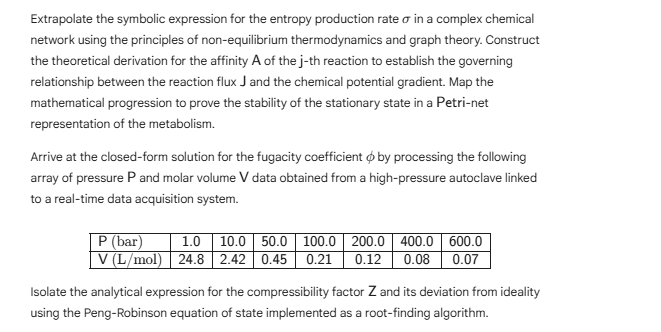
| **P (bar)** | 1. | 10. | 50. | 100. | 200. | 400. | 600. |
|-------------|-----|------|------|-------|-------|-------|-------|
| **V (L/mol)** | 24.8 | 2.42 | .45 | .21 | .12 | .08 | .07 |
## **Fugacity Coefficient Calculation**
### **General Expression**
For a real gas:
\[
\ln \phi = \int_{}^{P} \frac{Z - 1}{P} dP
\]
Where \(Z = \frac{P V}{R T}\) is the compressibility factor.
**Steps:**
1. Calculate \(Z\) for each (P, V) pair.
2. Use numerical integration (e.g., trapezoidal rule) to estimate the integral.
3. Compute \(\phi\) at each pressure.
---
# 3. **Compressibility Factor \(Z\) and Peng-Robinson EOS**
## **Peng-Robinson Equation of State:**
\[
P = \frac{R T}{V - b} - \frac{a}{V^2 + 2bV - b^2}
\]
Where:
- \(a, b\): EOS parameters (depend on critical properties and acentric factor)
- \(R\): Gas constant
- \(T\): Temperature
- \(V\): Molar volume
### **Compressibility Factor**
\[
Z = \frac{P V}{R T}
\]
### **Deviation from Ideality**
- For ideal gas: \(Z = 1\)
- For real gas: \(Z\) deviates from unity.
### **Root-Finding Algorithm**
- The Peng-Robinson EOS is cubic in \(V\) (or \(Z\)), so you solve for \(Z\) numerically for given \(P, T\).
**Algorithm Steps:**
1. Express PR-EOS in terms of \(Z\).
2. Use a root-finding method (Newton-Raphson, bisection, etc.) to solve for \(Z\).
3. Plug \(Z\) into the fugacity formula.
---
## **Summary Table**
| **Step** | **Formula/Process** | **Purpose** |
|----------|---------------------|-------------|
| Entropy Production | \(\sigma = \sum J_j A_j / T\) | Quantifies irreversibility in network |
| Fugacity Coefficient | \(\ln \phi = \int_{}^{P} \frac{Z-1}{P} dP\) | Accounts for non-ideality |
| Compressibility Factor | \(Z = \frac{PV}{RT}\) | Measures deviation from ideal gas |
| PR EOS | \(P = \frac{RT}{V-b} - \frac{a}{V^2 + 2bV - b^2}\) | EOS for real fluids |
---
## **If You Need a Detailed Example or Python Implementation**
Let me know which part you'd like to see worked out step by step, or if you want explicit calculations with the provided data!
VIPSolutions focuses on clear, step‑by‑step explanations so you can learn quickly. Whether you need an AI‑generated walkthrough or a short hint to get unstuck, each solution is organized for fast reading and easy review later.
Search similar questions, compare approaches, and bookmark the best answers for revision. Our goal is simple: quick, reliable study help that feels natural—not noisy.
 VIPSolutions
 Extrapolate the symbolic expression for the entropy production rate a ina comple chemical
netwrk sing th princes of non-equibrium thermodynamics an grah theory. Const
the theoretical derivation for the affinity A of the j-th reaction to establish the governing
relationship between the reaction flux J and the chemical potential gradient. Map the.
mathematical progression to prove the stability of the stationary state in a Petri-net
representation the metabolism
rive tthe closed-form slutionfor the fugacity coeficient by processing the following
array of pressure P and molar volume V data obtained from a high-pressure autoclave linked
10a resk-tine data scion system.
Pb) [10 [1001500] 1000] 2000] 4000 6000
V (Lfmol
Isolate the analytical expression for the compressibility factor Z and its deviation from ideality
sing the Peng-Robinson sation of state implemented a oo fding algr
Extrapolate the symbolic expression for the entropy production rate a ina comple chemical
netwrk sing th princes of non-equibrium thermodynamics an grah theory. Const
the theoretical derivation for the affinity A of the j-th reaction to establish the governing
relationship between the reaction flux J and the chemical potential gradient. Map the.
mathematical progression to prove the stability of the stationary state in a Petri-net
representation the metabolism
rive tthe closed-form slutionfor the fugacity coeficient by processing the following
array of pressure P and molar volume V data obtained from a high-pressure autoclave linked
10a resk-tine data scion system.
Pb) [10 [1001500] 1000] 2000] 4000 6000
V (Lfmol
Isolate the analytical expression for the compressibility factor Z and its deviation from ideality
sing the Peng-Robinson sation of state implemented a oo fding algr