 VIPSolutions
Act like a helpful tutor and exlain me : give answer in englishEncuentre la funcién de transferencia, Xs), para el sistema traslacional que se muestra en la figura. —x1(0) —x2() [] ft wl Z] Sin friccion donde: M; = 3 kg; My = 13 kg;B = 16 Ns/m; K = 6 N/m O a. (16,000s+6,000)/(39,000s*4+256,000s*3+96,000s"2) Ob. (3,000s+13,000)/(39,000s*4+256,000s*3+96,000s"2) O c. (13,000s*2+16,000s+6,000)/(39,000s*4+256,000s*3+96,000s"2) O d. (3,000s*2+13,000s+16,000)/(39,000s"4+256,000s*3+96,000s"2)
Question:
Act like a helpful tutor and exlain me :
give answer in english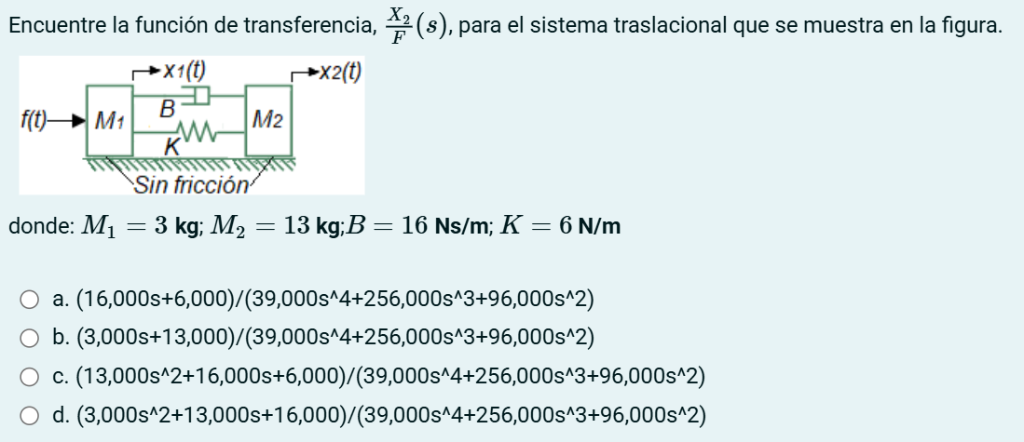 Encuentre la funcién de transferencia, Xs), para el sistema traslacional que se muestra en la figura.
—x1(0) —x2()
[]
ft wl Z]
Sin friccion
donde: M; = 3 kg; My = 13 kg;B = 16 Ns/m; K = 6 N/m
O a. (16,000s+6,000)/(39,000s*4+256,000s*3+96,000s"2)
Ob. (3,000s+13,000)/(39,000s*4+256,000s*3+96,000s"2)
O c. (13,000s*2+16,000s+6,000)/(39,000s*4+256,000s*3+96,000s"2)
O d. (3,000s*2+13,000s+16,000)/(39,000s"4+256,000s*3+96,000s"2)
Encuentre la funcién de transferencia, Xs), para el sistema traslacional que se muestra en la figura.
—x1(0) —x2()
[]
ft wl Z]
Sin friccion
donde: M; = 3 kg; My = 13 kg;B = 16 Ns/m; K = 6 N/m
O a. (16,000s+6,000)/(39,000s*4+256,000s*3+96,000s"2)
Ob. (3,000s+13,000)/(39,000s*4+256,000s*3+96,000s"2)
O c. (13,000s*2+16,000s+6,000)/(39,000s*4+256,000s*3+96,000s"2)
O d. (3,000s*2+13,000s+16,000)/(39,000s"4+256,000s*3+96,000s"2)
This is AI generated Response.
Asked by: manish kumar
Created at: 2025-09-08 21:26:35
Asked by: manish kumar
Created at: 2025-09-08 21:26:35
Final Answer:
Rendered
Raw Text
Did you like this answer?
Let's analyze the problem step by step:
### **Step 1: Understanding the System**
We have two masses \(M_1\) and \(M_2\) connected by a **damper** (B) and a **spring** (K). An external force \(f(t)\) is applied to \(M_1\).
We are asked for the **transfer function** \( \frac{X_2(s)}{F(s)} \).
Given:
- \( M_1 = 3 \) kg
- \( M_2 = 13 \) kg
- \( B = 16 \) Ns/m
- \( K = 6 \) N/m
### **Step 2: Writing the Equations of Motion**
Let \(x_1(t)\) and \(x_2(t)\) be the displacements of \(M_1\) and \(M_2\), respectively.
#### **For \(M_1\):**
\[
M_1 \ddot{x}_1 = f(t) - B(\dot{x}_1 - \dot{x}_2) - K(x_1 - x_2)
\]
#### **For \(M_2\):**
\[
M_2 \ddot{x}_2 = B(\dot{x}_1 - \dot{x}_2) + K(x_1 - x_2)
\]
### **Step 3: Laplace Transform (Zero Initial Conditions)**
Replace derivatives:
- \(\mathcal{L}\{\dot{x}(t)\} = sX(s)\)
- \(\mathcal{L}\{\ddot{x}(t)\} = s^2 X(s)\)
#### **For \(M_1\):**
\[
M_1 s^2 X_1(s) = F(s) - B[sX_1(s) - sX_2(s)] - K[X_1(s) - X_2(s)]
\]
#### **For \(M_2\):**
\[
M_2 s^2 X_2(s) = B[sX_1(s) - sX_2(s)] + K[X_1(s) - X_2(s)]
\]
### **Step 4: Arrange Equations**
#### \(M_1\):
\[
M_1 s^2 X_1 + B s (X_2 - X_1) + K(X_2 - X_1) = F(s)
\]
\[
(M_1 s^2 + B s + K) X_1 - (B s + K) X_2 = F(s)
\]
#### \(M_2\):
\[
M_2 s^2 X_2 - B s (X_1 - X_2) - K (X_1 - X_2) = 0
\]
\[
- (B s + K) X_1 + (M_2 s^2 + B s + K) X_2 = 0
\]
### **Step 5: Write in Matrix Form**
\[
\begin{bmatrix}
M_1 s^2 + B s + K & - (B s + K) \\
- (B s + K) & M_2 s^2 + B s + K
\end{bmatrix}
\begin{bmatrix}
X_1 \\ X_2
\end{bmatrix}
=
\begin{bmatrix}
F(s) \\ 0
\end{bmatrix}
\]
### **Step 6: Solve for \( X_2(s)/F(s) \)**
From Cramer's rule:
\[
\frac{X_2(s)}{F(s)} = \frac{
\begin{vmatrix}
M_1 s^2 + B s + K & 1 \\
- (B s + K) & 0
\end{vmatrix}
}{
\begin{vmatrix}
M_1 s^2 + B s + K & - (B s + K) \\
- (B s + K) & M_2 s^2 + B s + K
\end{vmatrix}
}
\]
But it's easier to use substitution:
From the 2nd equation:
\[
- (B s + K) X_1 + (M_2 s^2 + B s + K) X_2 = 0 \implies X_1 = \frac{(M_2 s^2 + B s + K)}{(B s + K)} X_2
\]
Substitute into the 1st equation:
\[
(M_1 s^2 + B s + K) X_1 - (B s + K) X_2 = F(s)
\]
\[
(M_1 s^2 + B s + K) \left( \frac{M_2 s^2 + B s + K}{B s + K} X_2 \right) - (B s + K) X_2 = F(s)
\]
\[
\frac{(M_1 s^2 + B s + K)(M_2 s^2 + B s + K) - (B s + K)^2}{B s + K} X_2 = F(s)
\]
\[
X_2(s) = \frac{B s + K}{(M_1 s^2 + B s + K)(M_2 s^2 + B s + K) - (B s + K)^2} F(s)
\]
### **Step 7: Substitute Values**
- \(M_1 = 3\)
- \(M_2 = 13\)
- \(B = 16\)
- \(K = 6\)
So, \(Bs + K = 16s + 6\)
Now:
\[
(M_1 s^2 + B s + K)(M_2 s^2 + B s + K) - (B s + K)^2
\]
\[
= (3s^2 + 16s + 6)(13s^2 + 16s + 6) - (16s + 6)^2
\]
Let's expand:
- \(3s^2 \cdot 13s^2 = 39s^4\)
- \(3s^2 \cdot 16s = 48s^3\)
- \(3s^2 \cdot 6 = 18s^2\)
- \(16s \cdot 13s^2 = 208s^3\)
- \(16s \cdot 16s = 256s^2\)
- \(16s \cdot 6 = 96s\)
- \(6 \cdot 13s^2 = 78s^2\)
- \(6 \cdot 16s = 96s\)
- \(6 \cdot 6 = 36\)
Add them up:
- \(s^4\): **39**
- \(s^3\): \(48 + 208 = 256\)
- \(s^2\): \(18 + 256 + 78 = 352\)
- \(s\): \(96 + 96 = 192\)
- constant: \(36\)
Now, subtract \((16s + 6)^2 = 256s^2 + 192s + 36\):
So, the denominator:
- \(s^4\): 39
- \(s^3\): 256
- \(s^2\): \(352 - 256 = 96\)
- \(s\): \(192 - 192 = 0\)
- constant: \(36 - 36 = 0\)
So denominator: \(39s^4 + 256s^3 + 96s^2\)
The numerator: \(16s + 6\)
### **Step 8: Write the Transfer Function**
\[
\frac{X_2(s)}{F(s)} = \frac{16s + 6}{39s^4 + 256s^3 + 96s^2}
\]
### **Step 9: Match to Options**
Option **a**:
\[
\frac{16,000s + 6,000}{39,000s^4 + 256,000s^3 + 96,000s^2}
\]
Which is the same as above but multiplied by 1,000 (which is just a scaling for clarity).
**Correct answer:**
\[
\boxed{a}
\]
---
## **Summary**
- **Correct option is (a).**
- The transfer function is:
\[
\frac{X_2(s)}{F(s)} = \frac{16s + 6}{39s^4 + 256s^3 + 96s^2}
\]
- In the format given in the options, **option (a) is correct**.
📢 Instructions:
- Ask anything relatd to above question only.
- For new Question goto :