 VIPSolutions
Act like a helpful tutor and exlain me : (give me answer in humanised style without using bullet points)Chemical Engineering — Heat Transfer in a Double-Pipe Heat Exchanger A double-pipe heat exchanger is used in a chemical engineering process to cool a hot liquid using cold water in counter-current flow. The hot liquid enters at 160 °C with a mass flow rate of 2.5 kg/s and a specific heat capacity of 2.8 ki/kg'K, and leaves at 90 °C. Cooling water enters at 30 °C with a mass flow rate of 3.0 kg/s and a specific heat capacity of 4.18 ki/kg-K. The overall heat transfer coefficient is 600 W/m®*K. Heat losses to the surroundings are negligible. (a) Calculate the rate of heat transfer in the heat exchanger. (b) Determine the outlet temperature of the cooling water. (c) Calculate the logarithmic mean temperature difference (LMTD). (d) Determine the required heat transfer area of the exchanger. (e) Calculate the effectiveness of the heat exchanger. (f) If the hot-liquid flow rate is increased by 20%, determine the new outlet temperature of the hot liquid, assuming the same heat transfer area.
Question:
Act like a helpful tutor and exlain me :
(give me answer in humanised style without using bullet points)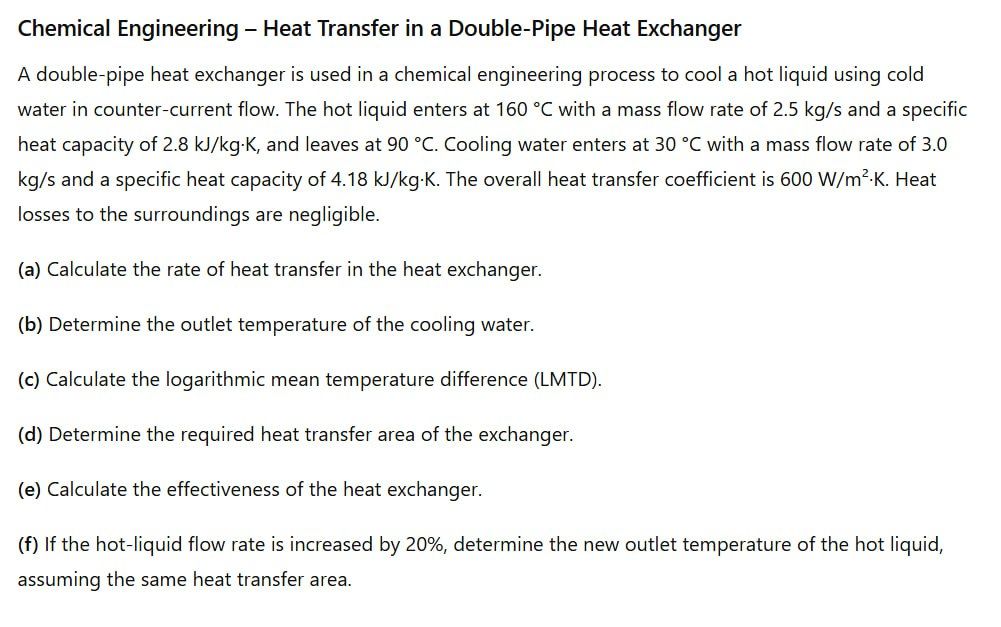 Chemical Engineering — Heat Transfer in a Double-Pipe Heat Exchanger
A double-pipe heat exchanger is used in a chemical engineering process to cool a hot liquid using cold
water in counter-current flow. The hot liquid enters at 160 °C with a mass flow rate of 2.5 kg/s and a specific
heat capacity of 2.8 ki/kg'K, and leaves at 90 °C. Cooling water enters at 30 °C with a mass flow rate of 3.0
kg/s and a specific heat capacity of 4.18 ki/kg-K. The overall heat transfer coefficient is 600 W/m®*K. Heat
losses to the surroundings are negligible.
(a) Calculate the rate of heat transfer in the heat exchanger.
(b) Determine the outlet temperature of the cooling water.
(c) Calculate the logarithmic mean temperature difference (LMTD).
(d) Determine the required heat transfer area of the exchanger.
(e) Calculate the effectiveness of the heat exchanger.
(f) If the hot-liquid flow rate is increased by 20%, determine the new outlet temperature of the hot liquid,
assuming the same heat transfer area.
Chemical Engineering — Heat Transfer in a Double-Pipe Heat Exchanger
A double-pipe heat exchanger is used in a chemical engineering process to cool a hot liquid using cold
water in counter-current flow. The hot liquid enters at 160 °C with a mass flow rate of 2.5 kg/s and a specific
heat capacity of 2.8 ki/kg'K, and leaves at 90 °C. Cooling water enters at 30 °C with a mass flow rate of 3.0
kg/s and a specific heat capacity of 4.18 ki/kg-K. The overall heat transfer coefficient is 600 W/m®*K. Heat
losses to the surroundings are negligible.
(a) Calculate the rate of heat transfer in the heat exchanger.
(b) Determine the outlet temperature of the cooling water.
(c) Calculate the logarithmic mean temperature difference (LMTD).
(d) Determine the required heat transfer area of the exchanger.
(e) Calculate the effectiveness of the heat exchanger.
(f) If the hot-liquid flow rate is increased by 20%, determine the new outlet temperature of the hot liquid,
assuming the same heat transfer area.
Asked by: Francis
Created at: 2026-01-11 22:12:34
Final Answer:
📢 Instructions:
- Ask anything relatd to above question only.
- For new Question goto :