 VIPSolutions
Act like a helpful tutor and exlain me : (give me answer in humanised mode without using bullet points)A continuous flow activated sludge reactor maintains a steady biomass concentration X where the substrate utilization rate r, is governed by the Monod identity x, = 5%. Synthesize an expression for the critical mean cell residence time f. by evaluating the mass balance at the washout limit where the effluent substrate concentration § approaches the influent concentration S,, assuming the endogenous decay coefficient b remains invariant under high organic loading rates. The oxygen transfer rate OTR in a diffused aeration tank is monitored as the liquid temperature. T varies from the standard datum. Given a constant power input, the saturation concentration is determined by the Henry relationship. Co = Blase ioisty: Evaluate the required air flow rate to maintain a dissolved oxygen level of 2. 5mg/L at a field elevation where the pressure Py is 88. 5kPa. A secondary clarifier thickening behavior is modeled using the solids flux theory where the total flux G, deviates from the batch settling velocity by more than 127% at high sludge volume index. Extrapolate the recycle ratio r for a system where the underflow concentration X, is suppressed by the high compression depth of the sludge blanket. Graph the specific substrate utilization rate U as a function of substrate concentration S for a biofilter operating in the diffusion-limited regime. The plot must illustrate the transition from first-order to zero-order kinetics as the system reaches saturation, incorporating the half- velocity constant K, as the coordinate corresponding to 0 . 5Uges in the U — § plane. An anaerobic digester measures the methane production rate Vy for a sludge stabilization process across a range of volatile solids loadings. The state is defined by the following differential form: av = (3) ata+ (%) a ) « Determine the total change in biogas yield for the mesophilic transition.
Question:
Act like a helpful tutor and exlain me :
(give me answer in humanised mode without using bullet points)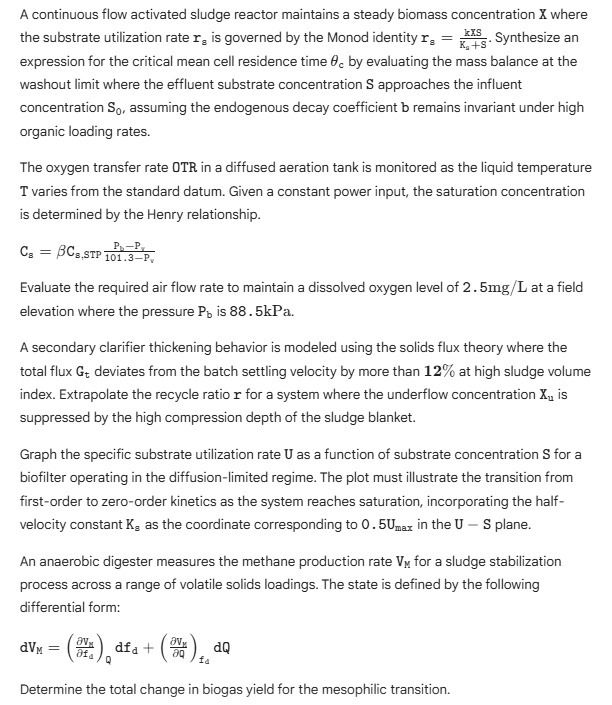 A continuous flow activated sludge reactor maintains a steady biomass concentration X where
the substrate utilization rate r, is governed by the Monod identity x, = 5%. Synthesize an
expression for the critical mean cell residence time f. by evaluating the mass balance at the
washout limit where the effluent substrate concentration § approaches the influent
concentration S,, assuming the endogenous decay coefficient b remains invariant under high
organic loading rates.
The oxygen transfer rate OTR in a diffused aeration tank is monitored as the liquid temperature.
T varies from the standard datum. Given a constant power input, the saturation concentration
is determined by the Henry relationship.
Co = Blase ioisty:
Evaluate the required air flow rate to maintain a dissolved oxygen level of 2. 5mg/L at a field
elevation where the pressure Py is 88. 5kPa.
A secondary clarifier thickening behavior is modeled using the solids flux theory where the
total flux G, deviates from the batch settling velocity by more than 127% at high sludge volume
index. Extrapolate the recycle ratio r for a system where the underflow concentration X, is
suppressed by the high compression depth of the sludge blanket.
Graph the specific substrate utilization rate U as a function of substrate concentration S for a
biofilter operating in the diffusion-limited regime. The plot must illustrate the transition from
first-order to zero-order kinetics as the system reaches saturation, incorporating the half-
velocity constant K, as the coordinate corresponding to 0 . 5Uges in the U — § plane.
An anaerobic digester measures the methane production rate Vy for a sludge stabilization
process across a range of volatile solids loadings. The state is defined by the following
differential form:
av = (3) ata+ (%) a
) «
Determine the total change in biogas yield for the mesophilic transition.
A continuous flow activated sludge reactor maintains a steady biomass concentration X where
the substrate utilization rate r, is governed by the Monod identity x, = 5%. Synthesize an
expression for the critical mean cell residence time f. by evaluating the mass balance at the
washout limit where the effluent substrate concentration § approaches the influent
concentration S,, assuming the endogenous decay coefficient b remains invariant under high
organic loading rates.
The oxygen transfer rate OTR in a diffused aeration tank is monitored as the liquid temperature.
T varies from the standard datum. Given a constant power input, the saturation concentration
is determined by the Henry relationship.
Co = Blase ioisty:
Evaluate the required air flow rate to maintain a dissolved oxygen level of 2. 5mg/L at a field
elevation where the pressure Py is 88. 5kPa.
A secondary clarifier thickening behavior is modeled using the solids flux theory where the
total flux G, deviates from the batch settling velocity by more than 127% at high sludge volume
index. Extrapolate the recycle ratio r for a system where the underflow concentration X, is
suppressed by the high compression depth of the sludge blanket.
Graph the specific substrate utilization rate U as a function of substrate concentration S for a
biofilter operating in the diffusion-limited regime. The plot must illustrate the transition from
first-order to zero-order kinetics as the system reaches saturation, incorporating the half-
velocity constant K, as the coordinate corresponding to 0 . 5Uges in the U — § plane.
An anaerobic digester measures the methane production rate Vy for a sludge stabilization
process across a range of volatile solids loadings. The state is defined by the following
differential form:
av = (3) ata+ (%) a
) «
Determine the total change in biogas yield for the mesophilic transition.
Asked by: Francis
Created at: 2026-01-13 12:23:22
Final Answer:
📢 Instructions:
- Ask anything relatd to above question only.
- For new Question goto :