Act like a helpful tutor and exlain me :
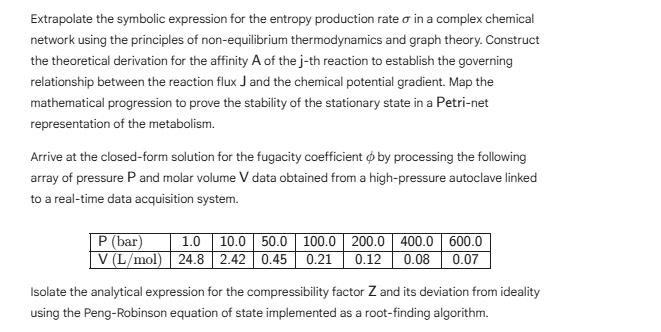
Give step-by-step solution with explanation and final answer:Extrapolate the symbolic expression for the entropy production rate a ina comple chemical
netwrk sing th princes of non-equibrium thermodynamics an grah theory. Const
the theoretical derivation for the affinity A of the j-th reaction to establish the governing
relationship between the reaction flux J and the chemical potential gradient. Map the.
mathematical progression to prove the stability of the stationary state in a Petri-net
representation the metabolism
rive tthe closed-form slutionfor the fugacity coeficient by processing the following
array of pressure P and molar volume V data obtained from a high-pressure autoclave linked
10a resk-tine data scion system.
Pb) [10 [1001500] 1000] 2000] 4000 6000
V (Lfmol
Isolate the analytical expression for the compressibility factor Z and its deviation from ideality
sing the Peng-Robinson sation of state implemented a oo fding algr
Question:
Act like a helpful tutor and exlain me :
Give step-by-step solution with explanation and final answer:Extrapolate the symbolic expression for the entropy production rate a ina comple chemical
netwrk sing th princes of non-equibrium thermodynamics an grah theory. Const
the theoretical derivation for the affinity A of the j-th reaction to establish the governing
relationship between the reaction flux J and the chemical potential gradient. Map the.
mathematical progression to prove the stability of the stationary state in a Petri-net
representation the metabolism
rive tthe closed-form slutionfor the fugacity coeficient by processing the following
array of pressure P and molar volume V data obtained from a high-pressure autoclave linked
10a resk-tine data scion system.
Pb) [10 [1001500] 1000] 2000] 4000 6000
V (Lfmol
Isolate the analytical expression for the compressibility factor Z and its deviation from ideality
sing the Peng-Robinson sation of state implemented a oo fding algr
This is AI generated Response.
Asked by: singaluri krishna kumari
Created at: 2025-12-24 19:55:48
Final Answer:
RenderedRaw Text
Did you like this answer?
Let's break down the solution into **three parts** as per your request: **entropy production rate**, **fugacity coefficient calculation from data**, and **Peng-Robinson compressibility factor**.
---
# 1. Entropy Production Rate in a Complex Network
## **A. Symbolic Expression for Entropy Production Rate (σ)**
In non-equilibrium thermodynamics, the entropy production rate for a set of chemical reactions is:
\[
\sigma = \sum_j J_j A_j
\]
where:
- \( J_j \): Flux of the j-th reaction (rate of progress)
- \( A_j \): Affinity (thermodynamic driving force) of the j-th reaction
## **B. Affinity and Flux Relationship**
The **affinity** for the j-th reaction is given by:
\[
A_j = -\sum_i \nu_{ij} \mu_i
\]
- \( \nu_{ij} \): Stoichiometric coefficient of species \( i \) in reaction \( j \)
- \( \mu_i \): Chemical potential of species \( i \)
**Flux** relates to the chemical potential gradient via Onsager's relation:
\[
J_j = \sum_k L_{jk} A_k
\]
where \( L_{jk} \) are Onsager coefficients (positive-definite).
## **C. Stability in Petri-net Representation**
For a stationary state (\( J_j = \) or \( dN/dt = \)), small perturbations from equilibrium will relax back if the entropy production is non-negative (\( \sigma \geq \)), demonstrating stability.
---
# 2. **Closed-Form Solution for Fugacity Coefficient (\(\phi\)) from Data**
## **A. Fugacity Coefficient Definition**
\[
\phi = \frac{f}{P}
\]
For a real gas:
\[
\ln \phi = \int_{}^{P} \frac{Z-1}{P} dP
\]
where \( Z \) is the compressibility factor:
\[
Z = \frac{PV}{RT}
\]
## **B. Data Table**
| P (bar) | 1. | 10. | 50. | 100. | 200. | 400. | 600. |
|---------|-----|------|------|-------|-------|-------|-------|
| V (L/mol)|24.8| 2.42 | .45 | .21 | .12 | .08 | .07 |
Assume \( T \) and \( R \) are known.
## **C. Step-by-Step Calculation**
1. **Calculate Z for each data point:**
\[
Z = \frac{PV}{RT}
\]
For each P, V pair, calculate \( Z \).
2. **Numerically integrate \(\frac{Z-1}{P}\) over the pressure range using the trapezoidal rule:**
\[
\ln \phi \approx \sum_{i=1}^{n-1} \frac{1}{2} (Z_{i+1} - 1 + Z_i - 1) \frac{P_{i+1} - P_i}{P_{i+1} + P_i}
\]
(You may need to interpolate/extrapolate for better accuracy.)
3. **Exponentiate to get \(\phi\):**
\[
\phi = \exp(\ln \phi)
\]
---
# 3. **Peng–Robinson EOS and Compressibility Factor Z**
## **A. Peng–Robinson EOS**
\[
P = \frac{RT}{V_m - b} - \frac{a}{V_m^2 + 2bV_m - b^2}
\]
- \( a, b \): EOS parameters (depend on critical properties and acentric factor)
- \( V_m \): Molar volume
## **B. Analytical Expression for Z**
\[
Z = \frac{PV_m}{RT}
\]
The Peng–Robinson EOS can be rearranged into a **cubic equation in \( Z \):**
\[
Z^3 + c_2 Z^2 + c_1 Z + c_ =
\]
where \( c_2, c_1, c_ \) are functions of \( a, b, P, T \).
The deviation from ideality is:
\[
Z_{\text{deviation}} = Z - 1
\]
## **C. Root-Finding Algorithm**
Use the **Newton-Raphson method** or **cardano's method** to solve the cubic equation for \( Z \):
1. Substitute \( V_m = \frac{ZRT}{P} \) into the PR EOS.
2. Rearrange to standard cubic form.
3. Solve for real roots; choose the physically meaningful \( Z \) (usually the smallest positive root for liquids, largest for vapor).
---
# **Summary Table**
| Step | Task | Expression | Explanation |
|------|------|------------|-------------|
| 1 | Entropy Production | \( \sigma = \sum_j J_j A_j \) | Sum over all reactions |
| 2 | Affinity | \( A_j = -\sum_i \nu_{ij} \mu_i \) | Stoichiometry and potentials |
| 3 | Fugacity Coefficient | \( \ln \phi = \int_^P \frac{Z-1}{P} dP \) | Integrate using data |
| 4 | Compressibility Factor | \( Z = \frac{PV}{RT} \) | For each data point |
| 5 | PR EOS | \( P = \frac{RT}{V_m-b} - \frac{a}{V_m^2+2bV_m-b^2} \) | Cubic in \( Z \) |
---
### **If you provide values for \( R \) and \( T \), I can demonstrate the calculations explicitly for the data table. Let me know if you'd like to see that!**
VIPSolutions focuses on clear, step‑by‑step explanations so you can learn quickly. Whether you need an AI‑generated walkthrough or a short hint to get unstuck, each solution is organized for fast reading and easy review later.
Search similar questions, compare approaches, and bookmark the best answers for revision. Our goal is simple: quick, reliable study help that feels natural—not noisy.
 VIPSolutions
 Extrapolate the symbolic expression for the entropy production rate a ina comple chemical
netwrk sing th princes of non-equibrium thermodynamics an grah theory. Const
the theoretical derivation for the affinity A of the j-th reaction to establish the governing
relationship between the reaction flux J and the chemical potential gradient. Map the.
mathematical progression to prove the stability of the stationary state in a Petri-net
representation the metabolism
rive tthe closed-form slutionfor the fugacity coeficient by processing the following
array of pressure P and molar volume V data obtained from a high-pressure autoclave linked
10a resk-tine data scion system.
Pb) [10 [1001500] 1000] 2000] 4000 6000
V (Lfmol
Isolate the analytical expression for the compressibility factor Z and its deviation from ideality
sing the Peng-Robinson sation of state implemented a oo fding algr
Extrapolate the symbolic expression for the entropy production rate a ina comple chemical
netwrk sing th princes of non-equibrium thermodynamics an grah theory. Const
the theoretical derivation for the affinity A of the j-th reaction to establish the governing
relationship between the reaction flux J and the chemical potential gradient. Map the.
mathematical progression to prove the stability of the stationary state in a Petri-net
representation the metabolism
rive tthe closed-form slutionfor the fugacity coeficient by processing the following
array of pressure P and molar volume V data obtained from a high-pressure autoclave linked
10a resk-tine data scion system.
Pb) [10 [1001500] 1000] 2000] 4000 6000
V (Lfmol
Isolate the analytical expression for the compressibility factor Z and its deviation from ideality
sing the Peng-Robinson sation of state implemented a oo fding algr