 VIPSolutions
Act like a helpful tutor and exlain me : Give step-by-step solution with explanation and final answer: provide detailed answer for each sub partEB Question 1 i You are appointed as a 2.13.1 Engineer responsible for, amongst other things, surface fs: infrastructure, winders, conveyor belts and pumping system. Your shaft is equipped Pp i with a Double drum winder for both men and material and a double drum BMR rock x winder . 3 4 ~ ltis reported to you that a material car fell down the shaft. J i © 1.1 What are the possible causes of objects falling down the shaft? i - IC ) E a 2What are the key things to do immediately after receiving the report? i). i result of this incident, you need to do shaft exam. W Leencucing shaft exam and ints
Question:
Act like a helpful tutor and exlain me :
Give step-by-step solution with explanation and final answer:
provide detailed answer for each sub part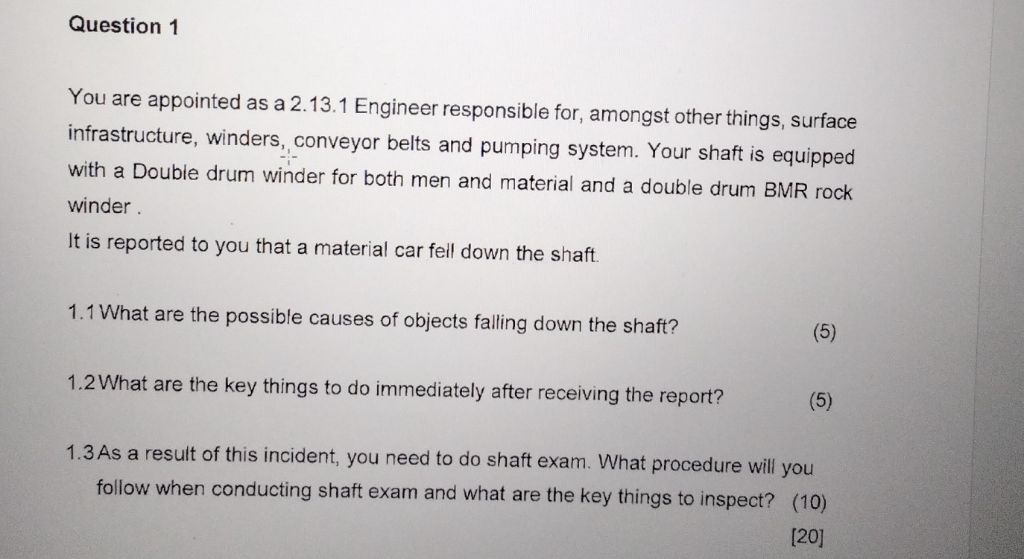 EB
Question 1 i
You are appointed as a 2.13.1 Engineer responsible for, amongst other things, surface fs:
infrastructure, winders, conveyor belts and pumping system. Your shaft is equipped Pp i
with a Double drum winder for both men and material and a double drum BMR rock x
winder . 3 4
~ ltis reported to you that a material car fell down the shaft. J i
© 1.1 What are the possible causes of objects falling down the shaft? i - IC )
E a
2What are the key things to do immediately after receiving the report?
i). i
result of this incident, you need to do shaft exam. W
Leencucing shaft exam and ints
EB
Question 1 i
You are appointed as a 2.13.1 Engineer responsible for, amongst other things, surface fs:
infrastructure, winders, conveyor belts and pumping system. Your shaft is equipped Pp i
with a Double drum winder for both men and material and a double drum BMR rock x
winder . 3 4
~ ltis reported to you that a material car fell down the shaft. J i
© 1.1 What are the possible causes of objects falling down the shaft? i - IC )
E a
2What are the key things to do immediately after receiving the report?
i). i
result of this incident, you need to do shaft exam. W
Leencucing shaft exam and ints
This is AI generated Response.
Asked by: manish kumar
Created at: 2025-09-17 09:35:08
Asked by: manish kumar
Created at: 2025-09-17 09:35:08
Final Answer:
Rendered
Raw Text
Did you like this answer?
Let’s break down each sub-question and provide detailed, step-by-step answers.
---
### **Question 1.1**
**What are the possible causes of objects falling down the shaft?** (5 marks)
#### **Step-by-Step Explanation:**
1. **Equipment Failure:**
- Failure of shaft conveyance attachments (like slings, chains, or ropes).
- Mechanical failure in the winder/drum system or brakes.
2. **Human Error:**
- Improperly secured material car or loose attachments.
- Inadequate loading or overloading of the car.
3. **Structural Issues:**
- Deterioration or damage to shaft guides, buntons, or station platforms.
- Loose debris or tools left on the shaft bank or platforms.
4. **Procedural Non-compliance:**
- Not following standard operating procedures (SOPs) during loading/unloading.
- Skipping pre-use checks or safety inspections.
5. **External Factors:**
- Vibration from blasting or adjacent activities causing items to dislodge.
- Environmental factors (e.g., severe weather affecting above-ground structures).
#### **Summary Table:**
| Cause | Description |
|---------------------------|---------------------------------------------|
| Equipment Failure | Faulty ropes, slings, brakes |
| Human Error | Improper securing, overloading |
| Structural Issues | Damaged guides, loose debris/tools |
| Procedural Non-compliance | Ignoring SOPs, missing inspections |
| External Factors | Vibrations, weather |
---
### **Question 1.2**
**What are the key things to do immediately after receiving the report?** (5 marks)
#### **Step-by-Step Actions:**
1. **Stop Operations:**
- Immediately halt all shaft operations to prevent further incidents or injury.
2. **Secure the Area:**
- Ensure no unauthorized personnel enter the shaft area.
- Post warning signs and inform all relevant staff.
3. **Assess for Injuries or Damage:**
- Check if anyone was hurt or if equipment/infrastructure was damaged.
- Provide first aid or call for emergency response if necessary.
4. **Preserve Evidence:**
- Do not disturb the scene unless necessary for safety.
- Document the scene with photographs and notes.
5. **Notify Relevant Authorities:**
- Report the incident to mine management, safety officer, and regulatory bodies as per protocol.
#### **Summary Table:**
| Step | Action |
|-------------------|---------------------------------------------------|
| Stop Operations | Halt all activities in the shaft |
| Secure the Area | Restrict access and inform staff |
| Assess for Injuries/Damage | Check for injuries and equipment damage |
| Preserve Evidence | Document and avoid disturbing the scene |
| Notify Authorities| Inform management and regulatory bodies |
---
### **Question 1.3**
**Conducting a Shaft Exam - Procedure and Key Inspection Points** (10 marks)
#### **Step-by-Step Procedure:**
1. **Preparation:**
- Obtain necessary permits and inform all relevant personnel.
- Gather appropriate PPE and inspection tools (flashlights, cameras, checklists).
2. **Communication:**
- Notify control room and shaft operator about the exam.
- Ensure two-way communication devices are functional.
3. **Shaft Lock-out:**
- Lock out/tag out the winder to prevent accidental operation during inspection.
4. **Visual Inspection from Top:**
- Inspect the shaft collar, headgear, and bank area for loose objects or debris.
5. **Descent and Detailed Inspection:**
- Safely descend the shaft (using authorized conveyance if required).
- Inspect guides, buntons, shaft walls for damage, misalignment, or foreign objects.
- Check shaft stations, platforms, and compartments.
6. **Check Safety Devices:**
- Inspect safety catches, arrestors, and interlocks for functionality.
7. **Assess Winder and Conveyance:**
- Examine ropes, drum, attachments, and braking systems.
8. **Examine Shaft Services:**
- Inspect cables, pipes, and other services for secure attachment and integrity.
9. **Record Findings:**
- Document all observations, take photographs, and note any defects.
10. **Report and Follow-up:**
- Prepare a formal report.
- Recommend and initiate corrective actions before resuming operations.
#### **Key Things to Inspect:**
- Shaft guides, buntons, and walls for physical integrity.
- Platforms and stations for loose objects or damage.
- Winder ropes, attachments, and drum condition.
- Shaft services (pipes, cables) for secure mounting.
- Condition and operation of safety devices.
- Evidence of previous impacts or collisions.
- Cleanliness and removal of debris from shaft bottom and compartments.
- Functionality of communication and emergency systems.
---
## **Final Summary**
### **1.1 Possible Causes**
- Equipment failure, human error, structural issues, procedural non-compliance, external factors.
### **1.2 Immediate Actions**
- Stop operations, secure area, assess for injuries/damage, preserve evidence, notify authorities.
### **1.3 Shaft Exam Procedure**
- Prepare, communicate, lock out system, inspect from top to bottom, check safety devices, examine winder/conveyance, inspect shaft services, record findings, report and follow up.
### **Key Inspection Points**
- Guides, buntons, shaft walls, winder ropes, platforms, safety devices, shaft services, evidence of impact, cleanliness, emergency systems.
---
**If you need any further clarification on any step, let me know!**
📢 Instructions:
- Ask anything relatd to above question only.
- For new Question goto :