Act like a helpful tutor and exlain me :
Give step-by-step solution with explanation and final answer:
explain in detailQuestions (100 Marks)
Question 1 (12 marks)
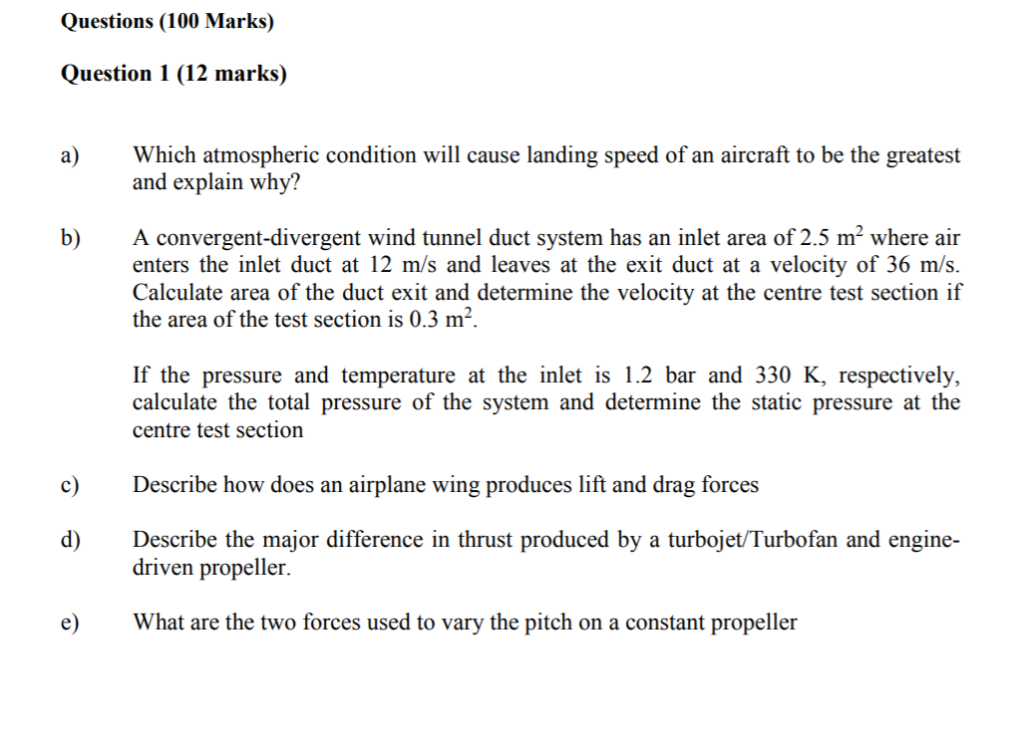
a) Which atmospheric condition will cause landing speed of an aircraft to be the greatest
and explain why?
b) A convergent-divergent wind tunnel duct system has an inlet area of 2.5 m? where air
enters the inlet duct at 12 m/s and leaves at the exit duct at a velocity of 36 m/s.
Calculate area of the duct exit and determine the velocity at the centre test section if
the area of the test section is 0.3 m2.
If the pressure and temperature at the inlet is 1.2 bar and 330 K, respectively,
calculate the total pressure of the system and determine the static pressure at the
centre test section
c) Describe how does an airplane wing produces lift and drag forces
d) Describe the major difference in thrust produced by a turbojet/Turbofan and engine-
driven propeller.
e) What are the two forces used to vary the pitch on a constant propeller
Question:
Act like a helpful tutor and exlain me :
Give step-by-step solution with explanation and final answer:
explain in detailQuestions (100 Marks)
Question 1 (12 marks)
a) Which atmospheric condition will cause landing speed of an aircraft to be the greatest
and explain why?
b) A convergent-divergent wind tunnel duct system has an inlet area of 2.5 m? where air
enters the inlet duct at 12 m/s and leaves at the exit duct at a velocity of 36 m/s.
Calculate area of the duct exit and determine the velocity at the centre test section if
the area of the test section is 0.3 m2.
If the pressure and temperature at the inlet is 1.2 bar and 330 K, respectively,
calculate the total pressure of the system and determine the static pressure at the
centre test section
c) Describe how does an airplane wing produces lift and drag forces
d) Describe the major difference in thrust produced by a turbojet/Turbofan and engine-
driven propeller.
e) What are the two forces used to vary the pitch on a constant propeller
This is AI generated Response.
Asked by: manish kumar
Created at: 2025-09-19 22:50:01
Final Answer:
RenderedRaw Text
Did you like this answer?
Let's break down and solve each part step by step.
---
# **Question 1 Solutions**
---
## **a) Atmospheric Condition Affecting Landing Speed**
**Question:**
Which atmospheric condition will cause landing speed of an aircraft to be the greatest and explain why?
**Step-by-step Explanation:**
1. **Lift Equation**: The lift force \( L \) must equal the weight \( W \) of the aircraft at landing:
\[
L = C_L \frac{1}{2} \rho V^2 S
\]
where \( C_L \) = lift coefficient, \( \rho \) = air density, \( V \) = speed, \( S \) = wing area.
2. **Solving for Speed**:
\[
V = \sqrt{ \frac{2W}{C_L \rho S} }
\]
The landing speed \( V \) increases as air density \( \rho \) decreases.
3. **Atmospheric Conditions Affecting Density**:
- **High Altitude**: Lower air density
- **High Temperature**: Lower air density
- **Low Pressure**: Lower air density
- **High Humidity**: Slightly lower air density
4. **Conclusion**:
**The greatest landing speed occurs in hot, high-altitude, low-pressure, and humid conditions** because these conditions reduce air density, requiring a higher speed to generate the same lift.
**Final Answer:**
**Low air density conditions (high altitude, high temperature, low pressure, high humidity) cause the greatest landing speed because the aircraft must move faster to generate sufficient lift in thinner air.**
---
## **b) Wind Tunnel Duct System Calculations**
### **Given Data:**
- Inlet area (\(A_1\)) = 2.5 m²
- Inlet velocity (\(V_1\)) = 12 m/s
- Test section area (\(A_2\)) = 0.3 m²
- Exit velocity (\(V_3\)) = 36 m/s
#### **Step 1: Find Area of Duct Exit \((A_3)\)**
**Mass continuity:**
\[
\dot{m}_1 = \dot{m}_2 = \dot{m}_3
\]
\[
\rho A_1 V_1 = \rho A_2 V_2 = \rho A_3 V_3
\]
Assuming incompressible flow (since speeds are much less than the speed of sound), we can ignore density changes.
\[
A_1 V_1 = A_2 V_2 = A_3 V_3
\]
#### **Step 2: Find Velocity at Centre Test Section (\(V_2\))**
\[
A_1 V_1 = A_2 V_2
\]
\[
V_2 = \frac{A_1 V_1}{A_2} = \frac{2.5 \times 12}{0.3} = \frac{30}{0.3} = 100 \text{ m/s}
\]
#### **Step 3: Find Area of Duct Exit (\(A_3\))**
\[
A_1 V_1 = A_3 V_3
\]
\[
A_3 = \frac{A_1 V_1}{V_3} = \frac{2.5 \times 12}{36} = \frac{30}{36} = 0.833 \text{ m}^2
\]
---
### **Step 4: Calculate Total Pressure at Inlet**
Given:
- Pressure (\(P_1\)) = 1.2 bar = 120,000 Pa
- Temperature (\(T_1\)) = 330 K
- \(V_1 = 12\) m/s
**Total pressure:**
\[
P_{0_1} = P_1 + \frac{1}{2} \rho V_1^2
\]
First, calculate air density (\(\rho\)) using ideal gas law:
\[
P = \rho R T \implies \rho = \frac{P}{R T}
\]
Where \(R = 287 \text{ J/kg K}\):
\[
\rho = \frac{120,000}{287 \times 330} \approx \frac{120,000}{94,710} \approx 1.267 \text{ kg/m}^3
\]
\[
P_{0_1} = 120,000 + 0.5 \times 1.267 \times (12)^2 = 120,000 + 0.5 \times 1.267 \times 144
\]
\[
= 120,000 + 0.6335 \times 144 = 120,000 + 91.224 = 120,091.22 \text{ Pa}
\]
---
### **Step 5: Static Pressure at Centre Test Section (\(P_2\)), assuming isentropic**
\[
P_{0_1} = P_{0_2} \implies P_{0_1} = P_2 + \frac{1}{2} \rho V_2^2
\]
\[
P_2 = P_{0_1} - \frac{1}{2} \rho V_2^2
\]
\[
P_2 = 120,091.22 - 0.5 \times 1.267 \times (100)^2
\]
\[
= 120,091.22 - 0.5 \times 1.267 \times 10,000
\]
\[
= 120,091.22 - 6,335 = 113,756.22 \text{ Pa}
\]
---
### **Summary of Answers for (b):**
- **Area of duct exit (\(A_3\)):** 0.833 m²
- **Velocity at test section (\(V_2\)):** 100 m/s
- **Total pressure at inlet:** 120,091 Pa
- **Static pressure at test section:** 113,756 Pa
---
## **c) Airplane Wing Lift and Drag Forces**
**Explanation:**
- **Lift:** Created due to the wing's shape (airfoil) and angle of attack. Air moves faster over the curved upper surface, creating lower pressure above than below (Bernoulli’s principle and Newton’s third law), resulting in upward lift.
- **Drag:** Resistance to motion through air. Caused by skin friction and pressure difference between front and back of the wing.
---
## **d) Turbofan/ Turbojet vs. Engine-Driven Propeller Thrust**
**Major Difference:**
- **Turbojet/Turbofan:** Produce thrust by accelerating a large mass of air through a jet engine, with a significant portion of thrust from the exhaust jet.
- **Propeller:** Produces thrust by accelerating air with spinning blades, typically at lower speeds, using a piston or turboprop engine.
---
## **e) Forces Used to Vary Pitch on a Constant Propeller**
**Two Forces:**
1. **Centrifugal Force:** Acts outward on the blades due to rotation.
2. **Oil Pressure or Counterweights (Governor Mechanism):** Used in variable pitch propellers to adjust blade angle by hydraulic or mechanical means.
---
# **Summary Table**
| Sub-question | Final Answer |
|--------------|--------------|
| a | Greatest landing speed: Low air density (high altitude, high temperature, low pressure, humid) |
| b | \(A_3 = 0.833\, m^2\), \(V_2 = 100\, m/s\), \(P_{0_1} = 120,091\, Pa\), \(P_2 = 113,756\, Pa\) |
| c | Wing produces lift by pressure difference (faster air above), drag by resistance |
| d | Turbojet/Turbofan: Jet exhaust thrust; Propeller: Spinning blades thrust |
| e | Centrifugal force and oil pressure/counterweights |
---
Let me know if you need further breakdown on any part!
VIPSolutions focuses on clear, step‑by‑step explanations so you can learn quickly. Whether you need an AI‑generated walkthrough or a short hint to get unstuck, each solution is organized for fast reading and easy review later.
Search similar questions, compare approaches, and bookmark the best answers for revision. Our goal is simple: quick, reliable study help that feels natural—not noisy.
 VIPSolutions
 Questions (100 Marks)
Question 1 (12 marks)
a) Which atmospheric condition will cause landing speed of an aircraft to be the greatest
and explain why?
b) A convergent-divergent wind tunnel duct system has an inlet area of 2.5 m? where air
enters the inlet duct at 12 m/s and leaves at the exit duct at a velocity of 36 m/s.
Calculate area of the duct exit and determine the velocity at the centre test section if
the area of the test section is 0.3 m2.
If the pressure and temperature at the inlet is 1.2 bar and 330 K, respectively,
calculate the total pressure of the system and determine the static pressure at the
centre test section
c) Describe how does an airplane wing produces lift and drag forces
d) Describe the major difference in thrust produced by a turbojet/Turbofan and engine-
driven propeller.
e) What are the two forces used to vary the pitch on a constant propeller
Questions (100 Marks)
Question 1 (12 marks)
a) Which atmospheric condition will cause landing speed of an aircraft to be the greatest
and explain why?
b) A convergent-divergent wind tunnel duct system has an inlet area of 2.5 m? where air
enters the inlet duct at 12 m/s and leaves at the exit duct at a velocity of 36 m/s.
Calculate area of the duct exit and determine the velocity at the centre test section if
the area of the test section is 0.3 m2.
If the pressure and temperature at the inlet is 1.2 bar and 330 K, respectively,
calculate the total pressure of the system and determine the static pressure at the
centre test section
c) Describe how does an airplane wing produces lift and drag forces
d) Describe the major difference in thrust produced by a turbojet/Turbofan and engine-
driven propeller.
e) What are the two forces used to vary the pitch on a constant propeller