 VIPSolutions
Act like a helpful tutor and exlain me : Give step-by-step solution with explanation and final answer: explain in detail1. A composite beam is constructed from three ours bled together as shown in Fig 1 The Jom diameter of the bolts slected as 10mm ninitial SQN 2mm” design of the beam. The allowable shear stress Sn SIN) for each bolt is 5. Assume that there is no gap a Ry | brid | betwee bls ad the boss, [20 pts] Ns | pe @ Determine the maximum spacing Snax of | RN x a tm ill ge ore QR J” torn V applied to the cross section of the composite a 3 beam. [10 pts] L Ep (b) Suggest two possible design concepts to 4 Sin double the spacing between bolts with proper equations. [10 pis] Fig. 1
Question:
Act like a helpful tutor and exlain me :
Give step-by-step solution with explanation and final answer:
explain in detail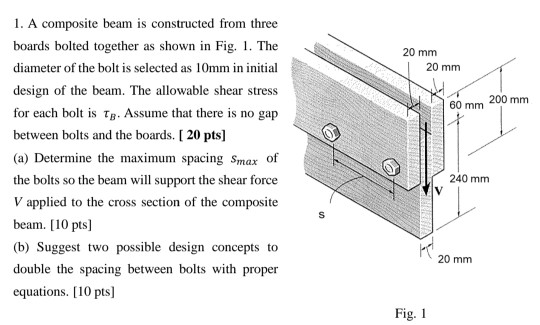 1. A composite beam is constructed from three
ours bled together as shown in Fig 1 The Jom
diameter of the bolts slected as 10mm ninitial SQN 2mm”
design of the beam. The allowable shear stress Sn SIN)
for each bolt is 5. Assume that there is no gap a Ry | brid |
betwee bls ad the boss, [20 pts] Ns | pe
@ Determine the maximum spacing Snax of | RN x a
tm ill ge ore QR J” torn
V applied to the cross section of the composite a 3
beam. [10 pts] L Ep
(b) Suggest two possible design concepts to 4 Sin
double the spacing between bolts with proper
equations. [10 pis]
Fig. 1
1. A composite beam is constructed from three
ours bled together as shown in Fig 1 The Jom
diameter of the bolts slected as 10mm ninitial SQN 2mm”
design of the beam. The allowable shear stress Sn SIN)
for each bolt is 5. Assume that there is no gap a Ry | brid |
betwee bls ad the boss, [20 pts] Ns | pe
@ Determine the maximum spacing Snax of | RN x a
tm ill ge ore QR J” torn
V applied to the cross section of the composite a 3
beam. [10 pts] L Ep
(b) Suggest two possible design concepts to 4 Sin
double the spacing between bolts with proper
equations. [10 pis]
Fig. 1
This is AI generated Response.
Asked by: manish kumar
Created at: 2025-09-20 10:29:15
Asked by: manish kumar
Created at: 2025-09-20 10:29:15
Final Answer:
Rendered
Raw Text
Did you like this answer?
Let's solve the problem **step-by-step**:
---
# 1. Understanding the Problem
- **Composite beam:** 3 boards, bolted together.
- **Bolt diameter:** 10 mm.
- **Allowable shear stress per bolt:** \( \tau_B \)
- **Shear force applied:** \( V \)
- **Spacing between bolts:** \( s \)
- **Goal:**
(a) Find the maximum spacing \( s_{max} \) so that bolts can safely transfer the shear force \( V \).
(b) Suggest ways to double the bolt spacing, using equations.
---
## (a) **Determine Maximum Bolt Spacing \( s_{max} \)**
### **Step 1: Shear Flow Calculation**
The **shear flow** \( q \) (force per unit length transferred between boards) is:
\[
q = \frac{VQ}{I}
\]
Where:
- \( V \) = Shear force on beam
- \( Q \) = First moment of area about neutral axis for the portion above (or below) the bolt line
- \( I \) = Second moment of area (moment of inertia) of the entire cross section
---
### **Step 2: Shear Force per Bolt**
- Shear force per bolt = \( q \cdot s \) (where \( s \) = spacing between bolts)
---
### **Step 3: Shear Strength of One Bolt**
- **Shear area of one bolt:**
\( A_{bolt} = \frac{\pi}{4} d^2 \)
(For \( d = 10\, \text{mm} \))
- **Maximum allowable shear force per bolt:**
\( F_{bolt,max} = \tau_B \cdot A_{bolt} \)
---
### **Step 4: Equate Bolt Capacity to Shear Flow**
Set maximum force per bolt equal to the force resisted by shear flow over spacing \( s \):
\[
q \cdot s_{max} = F_{bolt,max}
\]
\[
s_{max} = \frac{F_{bolt,max}}{q}
\]
---
### **Step 5: Final Expression for \( s_{max} \)**
Substitute values:
\[
s_{max} = \frac{\tau_B \cdot A_{bolt}}{q}
\]
\[
s_{max} = \frac{\tau_B \cdot \frac{\pi}{4}d^2}{\frac{VQ}{I}}
\]
\[
s_{max} = \frac{\tau_B \cdot \frac{\pi}{4}d^2 \cdot I}{VQ}
\]
---
### **Summary Formula**
\[
\boxed{
s_{max} = \frac{\tau_B \cdot \frac{\pi}{4}d^2 \cdot I}{VQ}
}
\]
**Where:**
- \( \tau_B \) = Allowable shear stress in bolt
- \( d \) = Bolt diameter
- \( I \) = Moment of inertia of full cross section
- \( Q \) = First moment of area of section above or below bolt line
- \( V \) = Applied shear force
---
## (b) **Suggest Two Ways to Double Bolt Spacing**
To **double the bolt spacing** (\( 2s_{max} \)), you must either:
1. **Increase the bolt's shear capacity**
2. **Decrease the required shear flow**
### **Option 1: Increase Bolt Shear Capacity**
- Increase \( d \) (bolt diameter): \( A_{bolt} \propto d^2 \)
- Use bolts with higher allowable shear stress (\( \tau_B \))
**Equation:**
\[
s_{max,new} = \frac{\tau_{B,new} \cdot \frac{\pi}{4}d_{new}^2 \cdot I}{VQ}
\]
To **double** \( s_{max} \):
\[
\frac{\tau_{B,new} \cdot d_{new}^2}{\tau_B \cdot d^2} = 2
\]
So, either double \( \tau_B \), or increase \( d \) by \( \sqrt{2} \) times.
---
### **Option 2: Reduce Shear Flow \( q \)**
- Reduce applied shear force \( V \) (not practical in design)
- Increase \( Q \) or \( I \) by redesigning the cross-section (e.g., make the beam deeper or wider)
- **Split the shear force among more interface layers** (e.g., use more boards, so each interface carries less force)
**Equation:**
\[
q = \frac{VQ}{I}
\]
If you can **reduce \( q \) by half**, spacing \( s \) can double.
---
## **Final Answers**
### **(a) Maximum Bolt Spacing**
\[
\boxed{
s_{max} = \frac{\tau_B \cdot \frac{\pi}{4}d^2 \cdot I}{VQ}
}
\]
### **(b) Two Design Concepts to Double Bolt Spacing**
1. **Use larger or stronger bolts:** Increase \( d \) or \( \tau_B \) so that \( A_{bolt} \) or allowable force per bolt doubles.
2. **Reduce interface shear flow:** Increase \( I \) or reduce \( Q \) (change cross-section), or split the force among more interfaces.
---
If you want to see a **numerical example**, let me know!
📢 Instructions:
- Ask anything relatd to above question only.
- For new Question goto :