Act like a helpful tutor and exlain me :
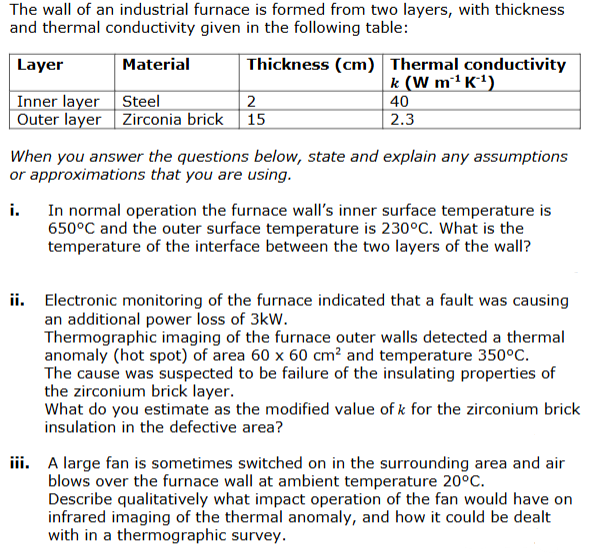
Give step-by-step solution with explanation and final answer:The wall of an industrial furnace is formed from two layers, with thickness
and thermal conductivity given in the following table:
Fa lO ei id
k(W mK?
Outer layer | Zirconia brick | 15 2.3
When you answer the questions below, state and explain any assumptions
or approximations that you are using.
i. In normal operation the furnace wall’s inner surface temperature is
650°C and the outer surface temperature is 230°C. What is the
temperature of the interface between the two layers of the wall?
ii. Electronic monitoring of the furnace indicated that a fault was causing
an additional power loss of 3kW.
Thermographic imaging of the furnace outer walls detected a thermal
anomaly (hot spot) of area 60 x 60 cm? and temperature 350°C.
The cause was suspected to be failure of the insulating properties of
the zirconium brick layer.
What do you estimate as the modified value of k for the zirconium brick
insulation in the defective area?
iii. A large fan is sometimes switched on in the surrounding area and air
blows over the furnace wall at ambient temperature 20°C.
Describe qualitatively what impact operation of the fan would have on
infrared imaging of the thermal anomaly, and how it could be dealt
with in a thermographic survey.
Question:
Act like a helpful tutor and exlain me :
Give step-by-step solution with explanation and final answer:The wall of an industrial furnace is formed from two layers, with thickness
and thermal conductivity given in the following table:
Fa lO ei id
k(W mK?
Outer layer | Zirconia brick | 15 2.3
When you answer the questions below, state and explain any assumptions
or approximations that you are using.
i. In normal operation the furnace wall’s inner surface temperature is
650°C and the outer surface temperature is 230°C. What is the
temperature of the interface between the two layers of the wall?
ii. Electronic monitoring of the furnace indicated that a fault was causing
an additional power loss of 3kW.
Thermographic imaging of the furnace outer walls detected a thermal
anomaly (hot spot) of area 60 x 60 cm? and temperature 350°C.
The cause was suspected to be failure of the insulating properties of
the zirconium brick layer.
What do you estimate as the modified value of k for the zirconium brick
insulation in the defective area?
iii. A large fan is sometimes switched on in the surrounding area and air
blows over the furnace wall at ambient temperature 20°C.
Describe qualitatively what impact operation of the fan would have on
infrared imaging of the thermal anomaly, and how it could be dealt
with in a thermographic survey.
This is AI generated Response.
Asked by: manish kumar
Created at: 2025-10-01 11:33:31
Final Answer:
RenderedRaw Text
Did you like this answer?
Let's solve each question step by step.
---
# **i. Find the interface temperature between the two layers**
**Given:**
- **Inner layer (Steel):**
Thickness, \( L_1 = 2\, \text{cm} = .02\, \text{m} \)
Thermal conductivity, \( k_1 = 40\, \text{W/mK} \)
- **Outer layer (Zirconia brick):**
Thickness, \( L_2 = 15\, \text{cm} = .15\, \text{m} \)
Thermal conductivity, \( k_2 = 2.3\, \text{W/mK} \)
- **Temperatures:**
Inner surface: \( T_1 = 650^\circ\text{C} \)
Outer surface: \( T_3 = 230^\circ\text{C} \)
Let \( T_2 \) be the interface temperature (between the two layers).
## **Assumptions:**
- 1D steady-state conduction.
- No heat loss to surroundings except through the wall.
- Perfect contact at the interface.
## **Step 1: Write the heat flow equation (steady-state, series layers)**
\[
q = \frac{T_1 - T_3}{\left(\frac{L_1}{k_1} + \frac{L_2}{k_2}\right)}
\]
At steady state, the heat flux through both layers is the same.
\[
q = \frac{T_1 - T_2}{L_1/k_1} = \frac{T_2 - T_3}{L_2/k_2}
\]
## **Step 2: Express \(T_2\) in terms of knowns**
Let \( R_1 = L_1/k_1 \), \( R_2 = L_2/k_2 \):
\[
\frac{T_1 - T_2}{R_1} = \frac{T_2 - T_3}{R_2}
\]
Cross-multiplied:
\[
(T_1 - T_2)R_2 = (T_2 - T_3)R_1
\]
\[
T_1 R_2 - T_2 R_2 = T_2 R_1 - T_3 R_1
\]
\[
T_1 R_2 + T_3 R_1 = T_2 (R_1 + R_2)
\]
\[
T_2 = \frac{T_1 R_2 + T_3 R_1}{R_1 + R_2}
\]
## **Step 3: Calculate \( R_1 \) and \( R_2 \)**
\[
R_1 = \frac{.02}{40} = .0005\, \text{m}^2\text{K/W}
\]
\[
R_2 = \frac{.15}{2.3} \approx .0652\, \text{m}^2\text{K/W}
\]
## **Step 4: Substitute and solve for \( T_2 \)**
\[
T_2 = \frac{650 \times .0652 + 230 \times .0005}{.0005 + .0652}
\]
\[
T_2 = \frac{42.38 + .115}{.0657}
\]
\[
T_2 = \frac{42.495}{.0657} \approx 646.8^\circ\text{C}
\]
**Final answer for (i):**
> **The interface temperature between the steel and zirconia brick layers is approximately \( \boxed{647^\circ\text{C}} \).**
---
# **ii. Estimate the modified \( k \) value for defective zirconia insulation**
**Given:**
- Additional power loss: \( Q = 3\,\text{kW} = 300\,\text{W} \)
- Hot spot area: \( A = 60 \times 60 = 360\,\text{cm}^2 = .36\,\text{m}^2 \)
- Temperature drop across zirconia:
Inner temp at interface: Use \( T_2 \approx 647^\circ\text{C} \) (from part i)
Outer temp at hot spot: \( T_3' = 350^\circ\text{C} \)
**Assume only the zirconia layer is defective and responsible for the extra heat loss.**
## **Step 1: Write heat flow equation for the hot spot**
\[
Q = \frac{k' A (T_2 - T_3')}{L_2}
\]
Where \( k' \) is the defective (higher) thermal conductivity.
## **Step 2: Rearrange to solve for \( k' \)**
\[
k' = \frac{Q L_2}{A (T_2 - T_3')}
\]
## **Step 3: Substitute known values**
- \( Q = 300\,\text{W} \)
- \( L_2 = .15\,\text{m} \)
- \( A = .36\,\text{m}^2 \)
- \( T_2 = 647^\circ\text{C} \)
- \( T_3' = 350^\circ\text{C} \)
\[
k' = \frac{300 \times .15}{.36 \times (647 - 350)}
\]
\[
k' = \frac{450}{.36 \times 297}
\]
\[
k' = \frac{450}{106.92}
\]
\[
k' \approx 4.21\,\text{W/mK}
\]
**Final answer for (ii):**
> **The estimated modified thermal conductivity (\( k' \)) of the zirconia brick in the defective area is \( \boxed{4.2\,\text{W/mK}} \).**
---
# **iii. Effect of the fan on the thermal anomaly in IR imaging**
**Qualitative Explanation:**
- When the fan is on, cool air at \( 20^\circ\text{C} \) blows over the outer wall.
- This increases the convective heat transfer coefficient (\( h \)) at the outer surface.
- Greater cooling means the outer surface loses heat more rapidly, so its temperature drops.
- **Impact:** The temperature of the "hot spot" as seen by a thermal camera will appear lower than when the fan is off, even though the actual heat flow (fault) may still be present.
- **Problem:** The thermal anomaly (hot spot) might become less visible or less pronounced in the IR survey, potentially masking the defect.
- **Recommendation:** For accurate thermographic surveys, the fan should be off or its effect should be accounted for, as increased air movement alters surface temperatures and could lead to underestimating the severity of insulation failure.
**Summary for (iii):**
> **Operation of the fan would cool the wall surface, reducing the apparent temperature of the thermal anomaly in the thermographic survey. This could mask the presence of the defect and lead to underestimation of its severity. Surveys are best done with the fan off or with the effect of air movement accounted for.**
---
## **Summary Table**
| Part | Final Answer |
|------|--------------|
| (i) | Interface temperature \( T_2 \approx \boxed{647^\circ\text{C}} \) |
| (ii) | Defective zirconia \( k' \approx \boxed{4.2\,\text{W/mK}} \) |
| (iii)| Fan cools surface, reducing apparent anomaly in IR survey; may mask defect. |
Let me know if you want any step explained in more detail!
VIPSolutions focuses on clear, step‑by‑step explanations so you can learn quickly. Whether you need an AI‑generated walkthrough or a short hint to get unstuck, each solution is organized for fast reading and easy review later.
Search similar questions, compare approaches, and bookmark the best answers for revision. Our goal is simple: quick, reliable study help that feels natural—not noisy.
 VIPSolutions
 The wall of an industrial furnace is formed from two layers, with thickness
and thermal conductivity given in the following table:
Fa lO ei id
k(W mK?
Outer layer | Zirconia brick | 15 2.3
When you answer the questions below, state and explain any assumptions
or approximations that you are using.
i. In normal operation the furnace wall’s inner surface temperature is
650°C and the outer surface temperature is 230°C. What is the
temperature of the interface between the two layers of the wall?
ii. Electronic monitoring of the furnace indicated that a fault was causing
an additional power loss of 3kW.
Thermographic imaging of the furnace outer walls detected a thermal
anomaly (hot spot) of area 60 x 60 cm? and temperature 350°C.
The cause was suspected to be failure of the insulating properties of
the zirconium brick layer.
What do you estimate as the modified value of k for the zirconium brick
insulation in the defective area?
iii. A large fan is sometimes switched on in the surrounding area and air
blows over the furnace wall at ambient temperature 20°C.
Describe qualitatively what impact operation of the fan would have on
infrared imaging of the thermal anomaly, and how it could be dealt
with in a thermographic survey.
The wall of an industrial furnace is formed from two layers, with thickness
and thermal conductivity given in the following table:
Fa lO ei id
k(W mK?
Outer layer | Zirconia brick | 15 2.3
When you answer the questions below, state and explain any assumptions
or approximations that you are using.
i. In normal operation the furnace wall’s inner surface temperature is
650°C and the outer surface temperature is 230°C. What is the
temperature of the interface between the two layers of the wall?
ii. Electronic monitoring of the furnace indicated that a fault was causing
an additional power loss of 3kW.
Thermographic imaging of the furnace outer walls detected a thermal
anomaly (hot spot) of area 60 x 60 cm? and temperature 350°C.
The cause was suspected to be failure of the insulating properties of
the zirconium brick layer.
What do you estimate as the modified value of k for the zirconium brick
insulation in the defective area?
iii. A large fan is sometimes switched on in the surrounding area and air
blows over the furnace wall at ambient temperature 20°C.
Describe qualitatively what impact operation of the fan would have on
infrared imaging of the thermal anomaly, and how it could be dealt
with in a thermographic survey.