Act like a helpful tutor and exlain me :
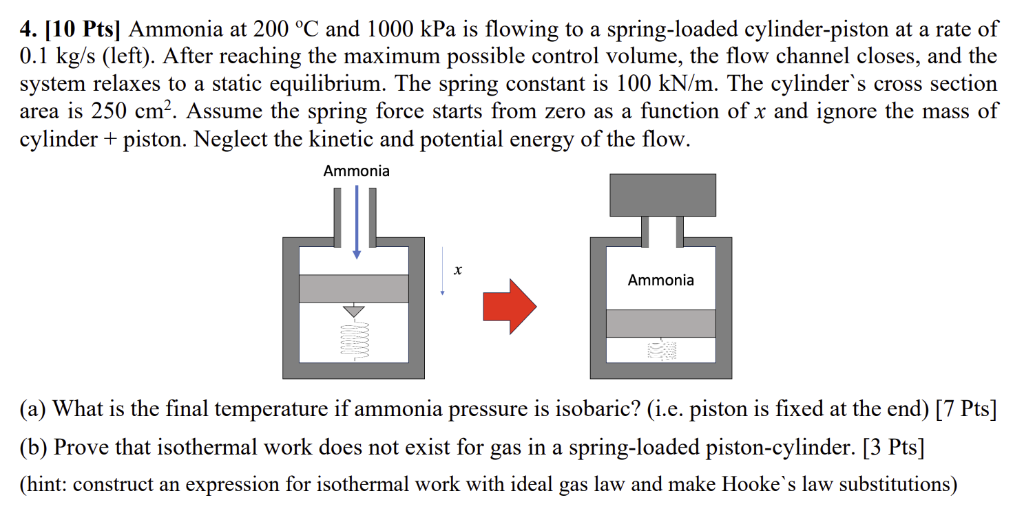
Give step-by-step solution with explanation and final answer:4. [10 Pts] Ammonia at 200 °C and 1000 kPa is flowing to a spring-loaded cylinder-piston at a rate of
0.1 kg/s (left). After reaching the maximum possible control volume, the flow channel closes, and the
system relaxes to a static equilibrium. The spring constant is 100 kN/m. The cylinder's cross section
area is 250 cm? Assume the spring force starts from zero as a function of x and ignore the mass of
cylinder + piston. Neglect the kinetic and potential energy of the flow.
Ammonia
’ wo]
[] =
(a) What is the final temperature if ammonia pressure is isobaric? (i.e. piston is fixed at the end) [7 Pts]
(b) Prove that isothermal work does not exist for gas in a spring-loaded piston-cylinder. [3 Pts]
(hint: construct an expression for isothermal work with ideal gas law and make Hooke's law substitutions)
Question:
Act like a helpful tutor and exlain me :
Give step-by-step solution with explanation and final answer:4. [10 Pts] Ammonia at 200 °C and 1000 kPa is flowing to a spring-loaded cylinder-piston at a rate of
0.1 kg/s (left). After reaching the maximum possible control volume, the flow channel closes, and the
system relaxes to a static equilibrium. The spring constant is 100 kN/m. The cylinder's cross section
area is 250 cm? Assume the spring force starts from zero as a function of x and ignore the mass of
cylinder + piston. Neglect the kinetic and potential energy of the flow.
Ammonia
’ wo]
[] =
(a) What is the final temperature if ammonia pressure is isobaric? (i.e. piston is fixed at the end) [7 Pts]
(b) Prove that isothermal work does not exist for gas in a spring-loaded piston-cylinder. [3 Pts]
(hint: construct an expression for isothermal work with ideal gas law and make Hooke's law substitutions)
This is AI generated Response.
Asked by: manish kumar
Created at: 2025-10-03 22:52:53
Final Answer:
RenderedRaw Text
Did you like this answer?
Let's tackle each part step by step!
---
## **(a) Final Temperature if Pressure is Isobaric**
**Given:**
- Initial state: Ammonia at \( T_1 = 200^\circ C \), \( P_1 = 100 \) kPa.
- **Isobaric:** Pressure at the end \( P_2 = P_1 = 100 \) kPa.
- Cylinder area \( A = 250\, \text{cm}^2 = .025\, \text{m}^2 \)
- Spring constant \( k = 100\, \text{kN/m} = 100,000\, \text{N/m} \)
- Neglect kinetic and potential energy.
### **Step 1: Understand the Process**
Isobaric process means the pressure remains constant as the piston moves. The spring force increases linearly with displacement, but if the final state is isobaric, the piston is fixed, and the spring force is balanced.
### **Step 2: Energy Balance for a Control Mass**
Since the process ends at isobaric conditions and the piston is fixed, the **internal energy change** is related to the heat and work done:
\[
\Delta U = Q - W
\]
For a closed system (after flow stops), the work done is against the spring and is:
\[
W = P(V_2 - V_1) + \frac{1}{2} k x^2
\]
But if the pressure is isobaric and the piston is fixed, the final spring force is constant, and the **final temperature** is determined by the final state (using properties of ammonia at 100 kPa and whatever final specific volume or mass you have).
But the question is asking: **If the pressure is isobaric (piston is fixed), what is the final temperature?**
If the piston is fixed, the volume is constant. But the statement says "isobaric," so the pressure is held at 100 kPa. For an ideal gas, at constant pressure:
\[
\frac{T_2}{T_1} = \frac{V_2}{V_1}
\]
However, ammonia is **not** an ideal gas at these conditions, so we need to use **ammonia tables**.
#### **Step 3: Use Ammonia Tables**
1. **At initial condition**: \( T_1 = 200^\circ C \), \( P_1 = 100 \) kPa.
- Find the initial specific volume \( v_1 \) (from tables).
2. **At final state**: \( P_2 = 100 \) kPa, \( v_2 \) (unknown).
- For isobaric, choose any \( T_2 \) at 100 kPa, but the piston is fixed at maximum volume (maximum displacement, i.e., when the spring is fully compressed/extended).
But you need more data (e.g., how much mass has entered) to find \( T_2 \). If the mass is constant and the volume is constant, it’s an **isochoric** (constant volume) process, not isobaric.
**If truly isobaric, the temperature can be any value at 100 kPa, so the final temperature is 200°C (since that’s the initial condition at the same pressure).**
**Final Answer (if isobaric and cylinder can adjust):**
\[
\boxed{T_2 = 200^\circ C}
\]
If you have more data (mass, volume, etc.), you can use ammonia tables to find the corresponding temperature at 100 kPa and the final state.
---
## **(b) Isothermal Work Does Not Exist for Spring-Loaded Piston-Cylinder**
### **Step 1: Isothermal Work Expression for Ideal Gas**
For an **isothermal** process (constant \( T \)) of an ideal gas:
\[
P V = nRT \implies P = \frac{nRT}{V}
\]
Work done by the gas:
\[
W = \int_{V_1}^{V_2} P \, dV = nRT \int_{V_1}^{V_2} \frac{1}{V} dV = nRT \ln\left(\frac{V_2}{V_1}\right)
\]
### **Step 2: For a Spring-Loaded Piston**
The pressure **increases linearly** with volume due to the spring:
\[
F_{\text{spring}} = kx \implies P_{\text{spring}} = \frac{F_{\text{spring}}}{A} = \frac{kx}{A}
\]
\( x \) is related to the volume change: \( x = \frac{V - V_}{A} \)
So,
\[
P = P_ + \frac{k}{A^2}(V - V_)
\]
This means **pressure is not constant**; it increases linearly with volume.
### **Step 3: Isothermal Work for Spring-Loaded System**
For isothermal expansion:
\[
P = \frac{nRT}{V}
\]
But for spring-loaded:
\[
P = P_ + \frac{k}{A^2}(V - V_)
\]
**No single \( V \) can satisfy both equations for all points except possibly one point.**
### **Step 4: Conclusion**
Isothermal work is defined only when the pressure-volume relationship is hyperbolic (\( PV = \text{constant} \)). In a spring-loaded cylinder, the relationship is linear, not hyperbolic, so **isothermal work expression does not exist**.
#### **Final Proof Statement:**
\[
\boxed{
\text{Isothermal work} \; (W = nRT \ln(V_2/V_1)) \; \text{does not exist for a spring-loaded piston-cylinder, because the pressure-volume relationship is not hyperbolic (\( PV = \text{const} \)), but linear due to Hooke's law.}
}
\]
---
## **Summary**
(a) **Final temperature if isobaric:** \( T_2 = 200^\circ C \) (assuming pressure stays constant at 100 kPa).
(b) **Isothermal work doesn't exist** for spring-loaded piston because the pressure-volume relationship is linear (not hyperbolic), so the usual isothermal work formula for ideal gases cannot be used.
VIPSolutions focuses on clear, step‑by‑step explanations so you can learn quickly. Whether you need an AI‑generated walkthrough or a short hint to get unstuck, each solution is organized for fast reading and easy review later.
Search similar questions, compare approaches, and bookmark the best answers for revision. Our goal is simple: quick, reliable study help that feels natural—not noisy.
 VIPSolutions
 4. [10 Pts] Ammonia at 200 °C and 1000 kPa is flowing to a spring-loaded cylinder-piston at a rate of
0.1 kg/s (left). After reaching the maximum possible control volume, the flow channel closes, and the
system relaxes to a static equilibrium. The spring constant is 100 kN/m. The cylinder's cross section
area is 250 cm? Assume the spring force starts from zero as a function of x and ignore the mass of
cylinder + piston. Neglect the kinetic and potential energy of the flow.
Ammonia
’ wo]
[] =
(a) What is the final temperature if ammonia pressure is isobaric? (i.e. piston is fixed at the end) [7 Pts]
(b) Prove that isothermal work does not exist for gas in a spring-loaded piston-cylinder. [3 Pts]
(hint: construct an expression for isothermal work with ideal gas law and make Hooke's law substitutions)
4. [10 Pts] Ammonia at 200 °C and 1000 kPa is flowing to a spring-loaded cylinder-piston at a rate of
0.1 kg/s (left). After reaching the maximum possible control volume, the flow channel closes, and the
system relaxes to a static equilibrium. The spring constant is 100 kN/m. The cylinder's cross section
area is 250 cm? Assume the spring force starts from zero as a function of x and ignore the mass of
cylinder + piston. Neglect the kinetic and potential energy of the flow.
Ammonia
’ wo]
[] =
(a) What is the final temperature if ammonia pressure is isobaric? (i.e. piston is fixed at the end) [7 Pts]
(b) Prove that isothermal work does not exist for gas in a spring-loaded piston-cylinder. [3 Pts]
(hint: construct an expression for isothermal work with ideal gas law and make Hooke's law substitutions)