Act like a helpful tutor and exlain me :
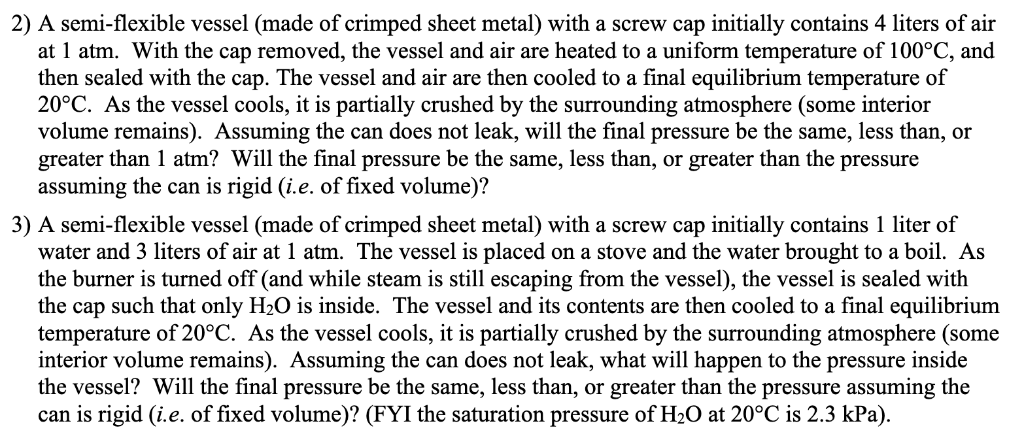
Give step-by-step solution with explanation and final answer:Only solve question ( 2 ) completely2) A semi-flexible vessel (made of crimped sheet metal) with a screw cap initially contains 4 liters of air
at 1 atm. With the cap removed, the vessel and air are heated to a uniform temperature of 100°C, and
then sealed with the cap. The vessel and air are then cooled to a final equilibrium temperature of
20°C. As the vessel cools, it is partially crushed by the surrounding atmosphere (some interior
volume remains). Assuming the can does not leak, will the final pressure be the same, less than, or
greater than 1 atm? Will the final pressure be the same, less than, or greater than the pressure
assuming the can is rigid (i.e. of fixed volume)?
3) A semi-flexible vessel (made of crimped sheet metal) with a screw cap initially contains 1 liter of
water and 3 liters of air at 1 atm. The vessel is placed on a stove and the water brought to a boil. As
the burner is turned off (and while steam is still escaping from the vessel), the vessel is sealed with
the cap such that only H>O is inside. The vessel and its contents are then cooled to a final equilibrium
temperature of 20°C. As the vessel cools, it is partially crushed by the surrounding atmosphere (some
interior volume remains). Assuming the can does not leak, what will happen to the pressure inside
the vessel? Will the final pressure be the same, less than, or greater than the pressure assuming the
can is rigid (i.e. of fixed volume)? (FYI the saturation pressure of H>O at 20°C is 2.3 kPa).
Question:
Act like a helpful tutor and exlain me :
Give step-by-step solution with explanation and final answer:Only solve question ( 2 ) completely2) A semi-flexible vessel (made of crimped sheet metal) with a screw cap initially contains 4 liters of air
at 1 atm. With the cap removed, the vessel and air are heated to a uniform temperature of 100°C, and
then sealed with the cap. The vessel and air are then cooled to a final equilibrium temperature of
20°C. As the vessel cools, it is partially crushed by the surrounding atmosphere (some interior
volume remains). Assuming the can does not leak, will the final pressure be the same, less than, or
greater than 1 atm? Will the final pressure be the same, less than, or greater than the pressure
assuming the can is rigid (i.e. of fixed volume)?
3) A semi-flexible vessel (made of crimped sheet metal) with a screw cap initially contains 1 liter of
water and 3 liters of air at 1 atm. The vessel is placed on a stove and the water brought to a boil. As
the burner is turned off (and while steam is still escaping from the vessel), the vessel is sealed with
the cap such that only H>O is inside. The vessel and its contents are then cooled to a final equilibrium
temperature of 20°C. As the vessel cools, it is partially crushed by the surrounding atmosphere (some
interior volume remains). Assuming the can does not leak, what will happen to the pressure inside
the vessel? Will the final pressure be the same, less than, or greater than the pressure assuming the
can is rigid (i.e. of fixed volume)? (FYI the saturation pressure of H>O at 20°C is 2.3 kPa).
This is AI generated Response.
Asked by: manish kumar
Created at: 2025-10-04 09:13:33
Final Answer:
RenderedRaw Text
Did you like this answer?
Let's **solve question (2) with step-by-step explanation**:
---
## **Question (2) Restated**
A semi-flexible vessel (4 L air at 1 atm) is heated to 100°C with the cap off, then sealed and cooled to 20°C. The vessel is partially crushed (volume decreases but not to zero) as it cools, equalizing some pressure with the atmosphere.
**Will the final pressure inside be the same, less than, or greater than 1 atm? Also, compare this to the case of a rigid (fixed-volume) can.**
---
## **Step 1: Initial Conditions**
- Initial volume \( V_1 = 4 \) L
- Initial pressure \( P_1 = 1 \) atm
- Initial temperature \( T_1 = 100^\circ \text{C} = 373 \) K (after heating and just before sealing)
When the vessel is open and heated to 100°C, the air inside is at **atmospheric pressure** (1 atm), but at 100°C.
**The cap is then sealed at this condition:**
- \( P_{\text{seal}} = 1 \) atm
- \( T_{\text{seal}} = 373 \) K
- \( V_{\text{seal}} = V_1 \)
---
## **Step 2: Cooling with a Semi-Flexible Vessel**
- Final temperature: \( T_2 = 20^\circ \text{C} = 293 \) K
- The vessel is *semi-flexible*: as the air cools and its pressure drops below 1 atm, the vessel is partially crushed by the outside atmosphere, reducing its volume until the pressure inside matches the outside.
### **Key Point:**
The vessel cannot maintain a pressure below atmospheric pressure (1 atm), because the external pressure will crush it until the pressures are equal!
---
### **What happens as it cools?**
- The air inside **wants** to reach a lower pressure (by the ideal gas law), but
- The vessel collapses until \( P_{\text{inside}} = P_{\text{outside}} = 1 \) atm.
---
## **Step 3: Final Pressure in the Semi-Flexible Vessel**
**The final pressure, assuming the can does not leak, will be:**
\[
\boxed{1 \text{ atm}}
\]
because the vessel will be crushed by the atmosphere until the pressure inside matches the outside pressure.
---
## **Step 4: Comparison with the Rigid Vessel**
### **Rigid Vessel (Fixed Volume):**
Apply the **ideal gas law** (\( PV = nRT \)), with the number of moles \( n \) fixed.
Let’s use ratios:
\[
\frac{P_2}{P_1} = \frac{T_2}{T_1}
\]
\[
P_2 = P_1 \times \frac{T_2}{T_1}
\]
\[
P_2 = 1 \text{ atm} \times \frac{293\text{ K}}{373\text{ K}} = .785 \text{ atm}
\]
So, for a **rigid can**, the final pressure would be **less than 1 atm** (specifically about .79 atm).
---
## **Step 5: Summary Table**
| Case | Final Pressure |
|-----------------------|----------------------------|
| **Semi-flexible can** | **1 atm** |
| **Rigid can** | **.79 atm (less than 1)** |
---
## **Final Answers**
- **Semi-flexible can:** Final pressure is **the same as** the external pressure (1 atm).
- **Rigid can:** Final pressure is **less than** 1 atm.
- **Comparison:** The final pressure in the semi-flexible can is **greater than** the pressure in the rigid can.
---
### **Conceptual Explanation**
- **Semi-flexible:** The can collapses until the pressure inside rises to match the atmosphere, so the final pressure can't go below 1 atm.
- **Rigid:** The volume can't change, so the pressure drops as the temperature drops.
---
### **Final Boxed Answers**
1. **Final pressure in the semi-flexible can:** **Same as 1 atm**
2. **Compared to rigid can:** **Greater than the pressure in the rigid can (which is .79 atm)**
---
Let me know if you'd like a diagram or further clarification!
VIPSolutions focuses on clear, step‑by‑step explanations so you can learn quickly. Whether you need an AI‑generated walkthrough or a short hint to get unstuck, each solution is organized for fast reading and easy review later.
Search similar questions, compare approaches, and bookmark the best answers for revision. Our goal is simple: quick, reliable study help that feels natural—not noisy.
 VIPSolutions
 2) A semi-flexible vessel (made of crimped sheet metal) with a screw cap initially contains 4 liters of air
at 1 atm. With the cap removed, the vessel and air are heated to a uniform temperature of 100°C, and
then sealed with the cap. The vessel and air are then cooled to a final equilibrium temperature of
20°C. As the vessel cools, it is partially crushed by the surrounding atmosphere (some interior
volume remains). Assuming the can does not leak, will the final pressure be the same, less than, or
greater than 1 atm? Will the final pressure be the same, less than, or greater than the pressure
assuming the can is rigid (i.e. of fixed volume)?
3) A semi-flexible vessel (made of crimped sheet metal) with a screw cap initially contains 1 liter of
water and 3 liters of air at 1 atm. The vessel is placed on a stove and the water brought to a boil. As
the burner is turned off (and while steam is still escaping from the vessel), the vessel is sealed with
the cap such that only H>O is inside. The vessel and its contents are then cooled to a final equilibrium
temperature of 20°C. As the vessel cools, it is partially crushed by the surrounding atmosphere (some
interior volume remains). Assuming the can does not leak, what will happen to the pressure inside
the vessel? Will the final pressure be the same, less than, or greater than the pressure assuming the
can is rigid (i.e. of fixed volume)? (FYI the saturation pressure of H>O at 20°C is 2.3 kPa).
2) A semi-flexible vessel (made of crimped sheet metal) with a screw cap initially contains 4 liters of air
at 1 atm. With the cap removed, the vessel and air are heated to a uniform temperature of 100°C, and
then sealed with the cap. The vessel and air are then cooled to a final equilibrium temperature of
20°C. As the vessel cools, it is partially crushed by the surrounding atmosphere (some interior
volume remains). Assuming the can does not leak, will the final pressure be the same, less than, or
greater than 1 atm? Will the final pressure be the same, less than, or greater than the pressure
assuming the can is rigid (i.e. of fixed volume)?
3) A semi-flexible vessel (made of crimped sheet metal) with a screw cap initially contains 1 liter of
water and 3 liters of air at 1 atm. The vessel is placed on a stove and the water brought to a boil. As
the burner is turned off (and while steam is still escaping from the vessel), the vessel is sealed with
the cap such that only H>O is inside. The vessel and its contents are then cooled to a final equilibrium
temperature of 20°C. As the vessel cools, it is partially crushed by the surrounding atmosphere (some
interior volume remains). Assuming the can does not leak, what will happen to the pressure inside
the vessel? Will the final pressure be the same, less than, or greater than the pressure assuming the
can is rigid (i.e. of fixed volume)? (FYI the saturation pressure of H>O at 20°C is 2.3 kPa).