 VIPSolutions
Act like a helpful tutor and exlain me : Give step-by-step solution with explanation and final answer:In the given figure, the pipe entrance is sharp-edged. The elevation at the entrance is Az = 31.00 m . If the flow rate is 0.004 m® /s , what power in W, is extracted by the turbine? The water is expelled to the atmosphere after exiting the globe valve. For water at 20 °C, take p = 998 kg/m” and pu = 0.001 kg/m:s . For cast iron, take & ~ 0.26 mm . The minor loss coefficients are Entrance: K = 0.5; 5-cm(~ 2") open globe valve: K ~ 6.9. Take 7 = 2 . AVA Open globe = Turbine valve Water Cast iron: L=125m,D=5cm The power extracted by the turbine is[ JW.
Question:
Act like a helpful tutor and exlain me :
Give step-by-step solution with explanation and final answer: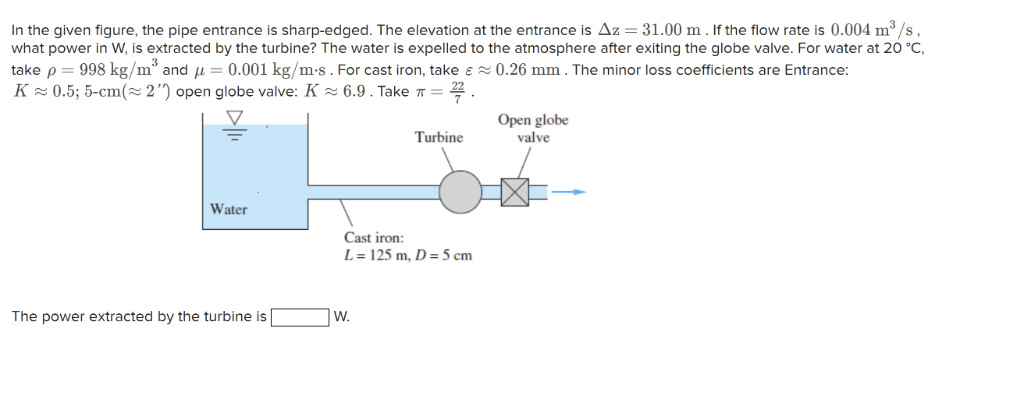 In the given figure, the pipe entrance is sharp-edged. The elevation at the entrance is Az = 31.00 m . If the flow rate is 0.004 m® /s ,
what power in W, is extracted by the turbine? The water is expelled to the atmosphere after exiting the globe valve. For water at 20 °C,
take p = 998 kg/m” and pu = 0.001 kg/m:s . For cast iron, take & ~ 0.26 mm . The minor loss coefficients are Entrance:
K = 0.5; 5-cm(~ 2") open globe valve: K ~ 6.9. Take 7 = 2 .
AVA Open globe
= Turbine valve
Water
Cast iron:
L=125m,D=5cm
The power extracted by the turbine is[ JW.
In the given figure, the pipe entrance is sharp-edged. The elevation at the entrance is Az = 31.00 m . If the flow rate is 0.004 m® /s ,
what power in W, is extracted by the turbine? The water is expelled to the atmosphere after exiting the globe valve. For water at 20 °C,
take p = 998 kg/m” and pu = 0.001 kg/m:s . For cast iron, take & ~ 0.26 mm . The minor loss coefficients are Entrance:
K = 0.5; 5-cm(~ 2") open globe valve: K ~ 6.9. Take 7 = 2 .
AVA Open globe
= Turbine valve
Water
Cast iron:
L=125m,D=5cm
The power extracted by the turbine is[ JW.
This is AI generated Response.
Asked by: manish kumar
Created at: 2025-10-04 09:33:40
Asked by: manish kumar
Created at: 2025-10-04 09:33:40
Final Answer:
Rendered
Raw Text
Did you like this answer?
Let's solve the problem step by step:
---
## **Step 1: List the Given Data**
- **Elevation difference:** \( \Delta z = 31.00\, \mathrm{m} \)
- **Flow rate:** \( Q = .004\, \mathrm{m}^3/\mathrm{s} \)
- **Density:** \( \rho = 998\, \mathrm{kg}/\mathrm{m}^3 \)
- **Dynamic viscosity:** \( \mu = .001\, \mathrm{kg}/(\mathrm{m}\cdot\mathrm{s}) \)
- **Pipe length:** \( L = 125\, \mathrm{m} \)
- **Pipe diameter:** \( D = .05\, \mathrm{m} \)
- **Pipe roughness (cast iron):** \( \epsilon = .26\, \mathrm{mm} = .00026\, \mathrm{m} \)
- **Minor loss coefficients:**
- Entrance: \( K_{\text{ent}} = .5 \)
- Globe valve: \( K_{\text{valve}} = 6.9 \)
- **Take \( \pi = \frac{22}{7} \)**
- **Atmospheric discharge**
---
## **Step 2: Find the Velocity in the Pipe**
\[ Q = A \cdot v \implies v = \frac{Q}{A} \]
\[ A = \frac{\pi D^2}{4} = \frac{22}{7} \times \frac{(.05)^2}{4} = .001963\, \mathrm{m}^2 \]
\[ v = \frac{.004}{.001963} \approx 2.039\, \mathrm{m/s} \]
---
## **Step 3: Calculate Reynolds Number**
\[ \text{Re} = \frac{\rho v D}{\mu} = \frac{998 \times 2.039 \times .05}{.001} = 101,870 \]
This is turbulent flow.
---
## **Step 4: Find Relative Roughness**
\[ \frac{\epsilon}{D} = \frac{.00026}{.05} = .0052 \]
---
## **Step 5: Estimate Friction Factor (\( f \))**
Use the **Swamee-Jain equation** for turbulent flow:
\[
f = .25 \left[ \log_{10} \left( \frac{\epsilon}{3.7D} + \frac{5.74}{\text{Re}^{.9}} \right) \right]^{-2}
\]
Calculate:
- \( \frac{\epsilon}{3.7D} = \frac{.00026}{3.7 \times .05} = .001405 \)
- \( \frac{5.74}{\text{Re}^{.9}} = \frac{5.74}{(101870)^{.9}} \approx .000104 \)
Sum: \( .001405 + .000104 = .001509 \)
\[
f = .25 \left[ \log_{10} (.001509) \right]^{-2}
\]
\[
\log_{10}(.001509) \approx -2.821
\]
\[
f = .25 \left[ -2.821 \right]^{-2} = .25 \times (1/7.96) \approx .0314
\]
---
## **Step 6: Head Losses**
### **a) Entrance Loss**
\[
h_{\text{ent}} = K_{\text{ent}} \frac{v^2}{2g} = .5 \frac{(2.039)^2}{2 \times 9.81} \approx .106\, \mathrm{m}
\]
### **b) Globe Valve Loss**
\[
h_{\text{valve}} = K_{\text{valve}} \frac{v^2}{2g} = 6.9 \frac{(2.039)^2}{2 \times 9.81} \approx 1.46\, \mathrm{m}
\]
### **c) Pipe Friction Loss**
\[
h_{\text{f}} = f \frac{L}{D} \frac{v^2}{2g}
\]
\[
\frac{L}{D} = \frac{125}{.05} = 250
\]
\[
h_{\text{f}} = .0314 \times 250 \times \frac{(2.039)^2}{2 \times 9.81}
\]
\[
= 78.5 \times \frac{4.16}{19.62} = 78.5 \times .212 = 16.64\, \mathrm{m}
\]
---
## **Step 7: Total Head Loss**
\[
h_{\text{loss,tot}} = h_{\text{ent}} + h_{\text{f}} + h_{\text{valve}} = .106 + 16.64 + 1.46 = 18.206\, \mathrm{m}
\]
---
## **Step 8: Apply the Energy Equation (Bernoulli’s with Turbine and Losses)**
From the surface (1) to the outlet (2):
\[
z_1 + \frac{P_1}{\gamma} = z_2 + \frac{P_2}{\gamma} + h_{\text{loss}} + \frac{W_{\text{turbine}}}{\gamma}
\]
At both points, velocity is negligible except in the pipe, and both are open to atmosphere, so pressures cancel out. \( z_1 - z_2 = \Delta z \).
\[
\Delta z = h_{\text{loss}} + \frac{W_{\text{turbine}}}{\gamma}
\]
\[
W_{\text{turbine}} = \gamma (\Delta z - h_{\text{loss}})
\]
Where \( \gamma = \rho g \).
---
## **Step 9: Calculate the Power Extracted**
\[
P_{\text{turbine}} = \dot{m}g(\Delta z - h_{\text{loss}})
\]
Where \( \dot{m} = \rho Q \):
\[
P_{\text{turbine}} = \rho Q g (\Delta z - h_{\text{loss}})
\]
\[
= 998 \times .004 \times 9.81 \times (31 - 18.206)
\]
\[
= 998 \times .004 \times 9.81 \times 12.794
\]
\[
= 3.992 \times 9.81 \times 12.794
\]
\[
= 39.15 \times 12.794
\]
\[
\approx 501\, \text{W}
\]
---
## **Final Answer**
\[
\boxed{501\, \text{W}}
\]
---
**The power extracted by the turbine is approximately \( \mathbf{501\, W} \).**
📢 Instructions:
- Ask anything relatd to above question only.
- For new Question goto :