 VIPSolutions
Act like a helpful tutor and exlain me : Give step-by-step solution with explanation and final answer:Select all the statements that are true regarding the flowchart shown below. Mixture of three components in an ether solution. 0 I. 0 HN Benzolc Acid Ethyl 4-aminobenzoate 9-Fluorenone Add 3M NaOH Ether Layer Aqueous Layer YAdd 6M HCI Add 3M HCI Ether Layer Aqueous Layer re 6M NaOH (J A will contain a solution of ethyl 4-aminobenzoate and 9-fluorenone. [JF will contain dissolved 9-fluorenone. ("J E will contain dissolved benzoic acid salt. [) D will contain dissolved 9-fluorenone. (JA will contain a solution of benzoic acid and 9-fluorenone.
Question:
Act like a helpful tutor and exlain me :
Give step-by-step solution with explanation and final answer: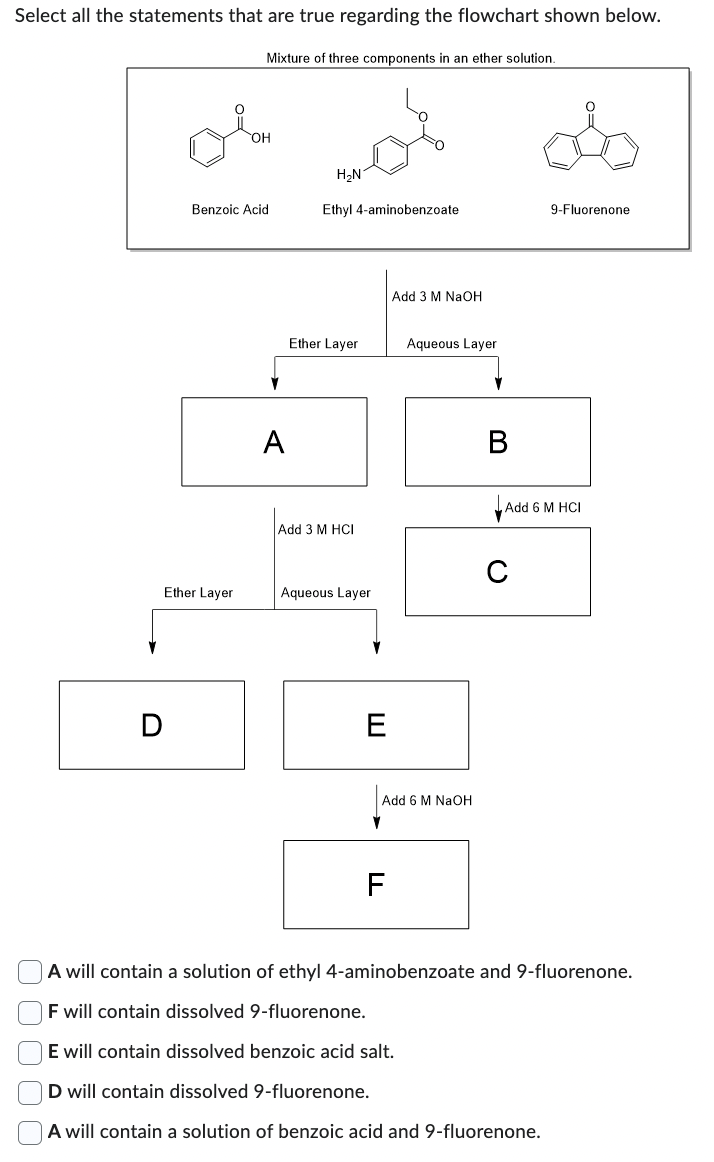 Select all the statements that are true regarding the flowchart shown below.
Mixture of three components in an ether solution.
0 I. 0
HN
Benzolc Acid Ethyl 4-aminobenzoate 9-Fluorenone
Add 3M NaOH
Ether Layer Aqueous Layer
YAdd 6M HCI
Add 3M HCI
Ether Layer Aqueous Layer
re 6M NaOH
(J A will contain a solution of ethyl 4-aminobenzoate and 9-fluorenone.
[JF will contain dissolved 9-fluorenone.
("J E will contain dissolved benzoic acid salt.
[) D will contain dissolved 9-fluorenone.
(JA will contain a solution of benzoic acid and 9-fluorenone.
Select all the statements that are true regarding the flowchart shown below.
Mixture of three components in an ether solution.
0 I. 0
HN
Benzolc Acid Ethyl 4-aminobenzoate 9-Fluorenone
Add 3M NaOH
Ether Layer Aqueous Layer
YAdd 6M HCI
Add 3M HCI
Ether Layer Aqueous Layer
re 6M NaOH
(J A will contain a solution of ethyl 4-aminobenzoate and 9-fluorenone.
[JF will contain dissolved 9-fluorenone.
("J E will contain dissolved benzoic acid salt.
[) D will contain dissolved 9-fluorenone.
(JA will contain a solution of benzoic acid and 9-fluorenone.
This is AI generated Response.
Asked by: Edu
Created at: 2025-10-05 00:16:21
Asked by: Edu
Created at: 2025-10-05 00:16:21
Final Answer:
Rendered
Raw Text
Did you like this answer?
Let's analyze the flowchart step by step:
---
## Step 1: Mixture in Ether Solution
- The mixture contains **benzoic acid**, **ethyl 4-aminobenzoate**, and **9-fluorenone** in ether.
---
## Step 2: Add 3 M NaOH
- **Benzoic acid** (acidic) reacts with NaOH to form its **sodium salt**, which is **water-soluble** and thus moves to the **aqueous layer (B)**.
- **Ethyl 4-aminobenzoate** (an ester with an amine group, but the amine is not basic enough to react here) and **9-fluorenone** (neutral ketone) remain in the **ether layer (A)**.
---
### After NaOH Addition:
- **A (Ether Layer):** Contains **ethyl 4-aminobenzoate** and **9-fluorenone**.
- **B (Aqueous Layer):** Contains **benzoic acid salt** (sodium benzoate).
---
## Step 3: Add 3 M HCl to B
- **B**: Adding HCl to sodium benzoate **re-precipitates benzoic acid** (since it becomes insoluble in water).
- The precipitated benzoic acid can be separated (likely in E), while the aqueous layer is separated.
---
## Step 4: Add 6 M HCl to A
- **A**: Adding strong acid (HCl) will **not affect ethyl 4-aminobenzoate** (as the amine is not basic enough to react in ether) and **9-fluorenone** (neutral) remains.
- Likely, this step is to check if anything moves to aqueous (amine salt formation at very high acid concentration), but here, both likely stay in ether.
---
## Step 5: Add 6 M NaOH to E
- **E**: After precipitating benzoic acid, if any remains, adding NaOH would dissolve it as sodium benzoate.
---
## Step 6: Understand Each Statement
### Statement Analysis:
1. **A will contain a solution of ethyl 4-aminobenzoate and 9-fluorenone.**
- **TRUE**. Both are neutral/weakly basic and stay in ether after NaOH extraction.
2. **F will contain dissolved 9-fluorenone.**
- **FALSE**. F is from E (aqueous benzoic acid salt), so it will not contain 9-fluorenone.
3. **E will contain dissolved benzoic acid salt.**
- **TRUE**. E is the aqueous layer after HCl addition to B, so it contains sodium benzoate (benzoic acid salt).
4. **D will contain dissolved 9-fluorenone.**
- **TRUE**. D is from the ether layer after HCl addition to A, which still contains 9-fluorenone.
5. **A will contain a solution of benzoic acid and 9-fluorenone.**
- **FALSE**. Benzoic acid is extracted into aqueous layer (B) after NaOH addition.
---
## **Final Answers:**
- [x] **A will contain a solution of ethyl 4-aminobenzoate and 9-fluorenone.**
- [ ] F will contain dissolved 9-fluorenone.
- [x] **E will contain dissolved benzoic acid salt.**
- [x] **D will contain dissolved 9-fluorenone.**
- [ ] A will contain a solution of benzoic acid and 9-fluorenone.
---
### **Summary Table**
| Statement | True/False | Reasoning |
|-----------|:----------:|-----------|
| A will contain a solution of ethyl 4-aminobenzoate and 9-fluorenone. | ✅ | Both are neutral/weakly basic, stay in ether. |
| F will contain dissolved 9-fluorenone. | ❌ | F is from aqueous phase after benzoic acid salt. |
| E will contain dissolved benzoic acid salt. | ✅ | E is the aqueous layer after precipitating benzoic acid. |
| D will contain dissolved 9-fluorenone. | ✅ | D is from ether layer after HCl addition, still contains 9-fluorenone. |
| A will contain a solution of benzoic acid and 9-fluorenone. | ❌ | Benzoic acid is extracted as salt into aqueous layer. |
📢 Instructions:
- Ask anything relatd to above question only.
- For new Question goto :