 VIPSolutions
Act like a helpful tutor and exlain me : Give step-by-step solution with explanation and final answer:3. Arocket is flying horizontally in the sky. At time instant t, the mass of the rocket is M; the velocity of the rocket is U'relative to the ground; the exhaust gas is coming out of rocket nozzle at a speed of Vo and mass flow rate is sir. Assuming the air resistance force on the rocket is a constant value of D and the rocket is accelerating at a. Please derive the expression of a. (Please choose C.V. properly and. explain why) Ua Dm Ao, Vo, m, P1 (gage pressure) D
Question:
Act like a helpful tutor and exlain me :
Give step-by-step solution with explanation and final answer: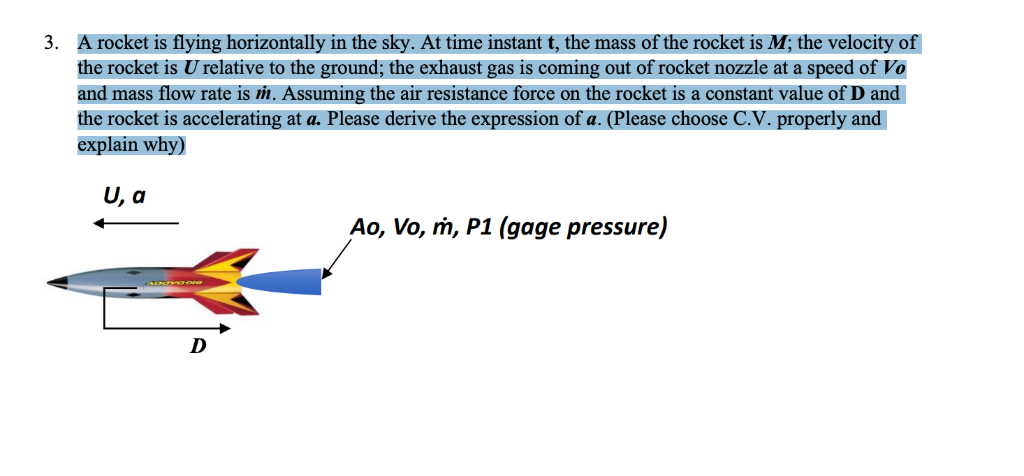 3. Arocket is flying horizontally in the sky. At time instant t, the mass of the rocket is M; the velocity of
the rocket is U'relative to the ground; the exhaust gas is coming out of rocket nozzle at a speed of Vo
and mass flow rate is sir. Assuming the air resistance force on the rocket is a constant value of D and
the rocket is accelerating at a. Please derive the expression of a. (Please choose C.V. properly and.
explain why)
Ua
Dm Ao, Vo, m, P1 (gage pressure)
D
3. Arocket is flying horizontally in the sky. At time instant t, the mass of the rocket is M; the velocity of
the rocket is U'relative to the ground; the exhaust gas is coming out of rocket nozzle at a speed of Vo
and mass flow rate is sir. Assuming the air resistance force on the rocket is a constant value of D and
the rocket is accelerating at a. Please derive the expression of a. (Please choose C.V. properly and.
explain why)
Ua
Dm Ao, Vo, m, P1 (gage pressure)
D
This is AI generated Response.
Asked by: manish kumar
Created at: 2025-10-05 22:28:25
Asked by: manish kumar
Created at: 2025-10-05 22:28:25
Final Answer:
Rendered
Raw Text
Did you like this answer?
# Step-by-Step Solution
## Problem Restatement
We have a rocket flying **horizontally**:
- At time \( t \), **mass** = \( M \)
- **Velocity** = \( U \) (relative to ground)
- **Exhaust gas** comes out at speed \( V_ \) (relative to rocket, i.e., nozzle frame)
- **Mass flow rate** of exhaust = \( \dot{m} \)
- **Air resistance** = \( D \) (constant)
- **Rocket acceleration** = \( a \)
- **Find:** Derive an expression for \( a \) (rocket's acceleration)
We are told to **choose control volume properly** and explain.
---
## Step 1: Choose Control Volume (C.V.)
Choose the **rocket** as the control volume.
- It is a **non-deforming, moving C.V.** (the mass changes, but you track the rocket itself, not the surrounding air).
- We use the **momentum balance** for a moving, variable-mass system.
---
## Step 2: Apply Linear Momentum Equation (Rocket Equation)
General momentum equation for control volume (CV):
\[
\sum F_{\text{ext}} = \frac{d}{dt}(M U) - \dot{m}_{\text{out}} (U_{\text{out,rel}}) + \dot{m}_{\text{in}} (U_{\text{in,rel}})
\]
Here, mass only **leaves** (no mass enters):
- \( U \): velocity of rocket (CV) relative to ground
- Exhaust leaves at \( V_ \) **relative to rocket**, so relative to ground:
\( U_{\text{exhaust, ground}} = U - V_ \)
(If rocket moves at \( U \), and exhaust is ejected backward at \( V_ \) relative to rocket, its ground speed is \( U - V_ \))
So, mass leaves at rate \( \dot{m} \) with velocity \( U - V_ \) (relative to ground).
---
## Step 3: Write the Momentum Balance
\[
\sum F_{\text{ext}} = \frac{d}{dt}(MU) = M \frac{dU}{dt} + U \frac{dM}{dt}
\]
The external forces are:
- Drag \( -D \) (opposes motion)
- Thrust from exhaust (already accounted for by momentum flux)
- (No gravity in horizontal motion)
Now, account for **momentum flux**:
\[
\text{Net outflow:} \quad -\dot{m}(U_{\text{exhaust, ground}}) = -\dot{m}(U - V_)
\]
(The negative sign because mass is leaving the rocket.)
So,
\[
\sum F_{\text{ext}} = M \frac{dU}{dt} + U \frac{dM}{dt} = -D - \dot{m}(U - V_)
\]
---
## Step 4: Express Mass Change
The mass of the rocket **decreases**:
\[
\frac{dM}{dt} = -\dot{m}
\]
---
## Step 5: Substitute and Simplify
Plug in \( \frac{dM}{dt} = -\dot{m} \):
\[
M \frac{dU}{dt} + U (-\dot{m}) = -D - \dot{m}(U - V_)
\]
\[
M \frac{dU}{dt} - U \dot{m} = -D - \dot{m} U + \dot{m} V_
\]
\[
M \frac{dU}{dt} - U \dot{m} + U \dot{m} = -D + \dot{m} V_
\]
\[
M \frac{dU}{dt} = -D + \dot{m} V_
\]
---
## Step 6: Solve for Acceleration \( a \)
\[
M a = \dot{m} V_ - D
\]
\[
\boxed{
a = \frac{\dot{m} V_ - D}{M}
}
\]
---
## Step 7: **Explanation of Terms**
- \( \dot{m} V_ \): **Thrust** (momentum per time from exhaust)
- \( D \): **Drag** (air resistance)
- \( M \): **Instantaneous mass** of rocket
---
## **Final Answer**
\[
\boxed{
a = \frac{\dot{m} V_ - D}{M}
}
\]
- **Control volume:** Rocket itself (moving CV, mass is leaving through exhaust)
- **Why:** The momentum flux due to exhaust and the external drag are the only forces acting horizontally.
- **Acceleration** is the net force (thrust minus drag) divided by the current rocket mass.
📢 Instructions:
- Ask anything relatd to above question only.
- For new Question goto :