 VIPSolutions
Act like a helpful tutor and exlain me : Give step-by-step solution with explanation and final answer:Questions 4: (12 points) A medium drive fit is required for the below shaft and 2” cylinder, they are both steel with Sy = 100 kpsi, E = 30 35 Mpsi, and a coefficient of friction of 0.7. a a) Find the max and min allowable diameters for both the hole and shaft. b) Find the min and max torque that can be transmitted. ¢) If you need to incorporate these parts into a larger analysis, which dimensions would you use for each part and why?
Question:
Act like a helpful tutor and exlain me :
Give step-by-step solution with explanation and final answer: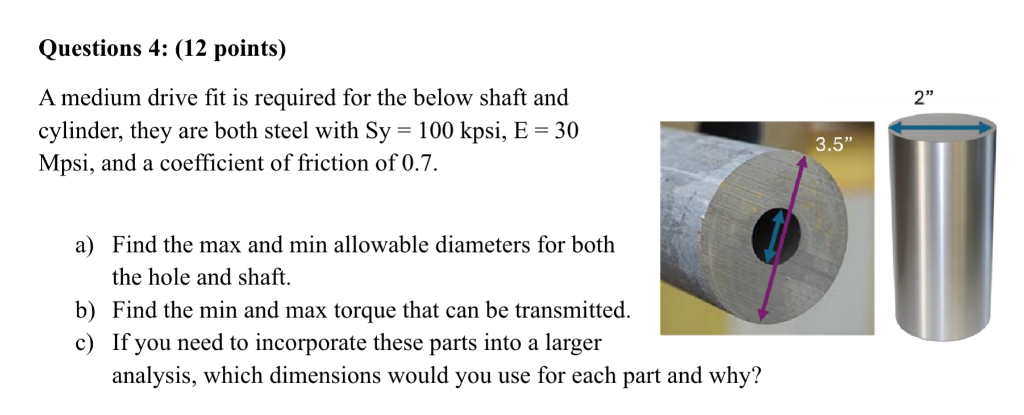 Questions 4: (12 points)
A medium drive fit is required for the below shaft and 2”
cylinder, they are both steel with Sy = 100 kpsi, E = 30 35
Mpsi, and a coefficient of friction of 0.7. a
a) Find the max and min allowable diameters for both
the hole and shaft.
b) Find the min and max torque that can be transmitted.
¢) If you need to incorporate these parts into a larger
analysis, which dimensions would you use for each part and why?
Questions 4: (12 points)
A medium drive fit is required for the below shaft and 2”
cylinder, they are both steel with Sy = 100 kpsi, E = 30 35
Mpsi, and a coefficient of friction of 0.7. a
a) Find the max and min allowable diameters for both
the hole and shaft.
b) Find the min and max torque that can be transmitted.
¢) If you need to incorporate these parts into a larger
analysis, which dimensions would you use for each part and why?
This is AI generated Response.
Asked by: manish kumar
Created at: 2025-10-07 08:33:37
Asked by: manish kumar
Created at: 2025-10-07 08:33:37
Final Answer:
Rendered
Raw Text
Did you like this answer?
Let's solve the questions step-by-step:
---
## **Given Data**
- **Material:** Steel
- **Yield Strength (\( S_y \))** = 100 ksi = 100,000 psi
- **Modulus of Elasticity (\( E \))** = 30 Mpsi = 30,000,000 psi
- **Coefficient of friction (\( \mu \))** = .7
- **Outer diameter of cylinder (\( D_{out} \))** = 3.5 in
- **Inner diameter (hole/shaft) (\( D_{in} \))** = 2. in
---
## **a) Find the max and min allowable diameters for both the hole and shaft.**
### **Medium Drive Fit Tolerances (Reference)**
A "medium drive fit" typically has a **shaft slightly larger** than the hole, with an **interference fit** (shaft is .001"–.002" larger per inch of diameter).
#### **Interference Calculation**
- Interference per inch: **.001" – .002"**
- For 2" diameter:
- **Min interference:** \( .001 \times 2 = .002" \)
- **Max interference:** \( .002 \times 2 = .004" \)
#### **Hole and Shaft Dimensions**
- **Nominal size:** 2.000"
- **Hole diameter range:** 2.000" to 1.998" (lower for interference)
- **Shaft diameter range:** 2.002" to 2.004" (higher for interference)
##### **Summary Table**
| Part | Min Diameter (in) | Max Diameter (in) |
|--------|-------------------|-------------------|
| Hole | 1.998 | 2.000 |
| Shaft | 2.002 | 2.004 |
---
## **b) Find the min and max torque that can be transmitted.**
### **Interference Fit and Torque Transmission**
The maximum torque (\( T \)) transmitted by the interference fit (friction fit) is:
\[
T = \mu \cdot F_N \cdot r
\]
where:
- \( \mu \) = coefficient of friction = .7
- \( F_N \) = normal force (from interference)
- \( r \) = shaft radius = 1 in
#### **Calculate the Normal Force (\( F_N \))**
- **Contact pressure (\( p \))** from interference:
\[
p = \frac{\delta \cdot E}{D}
\]
Where \( \delta \) = interference, \( E \) = modulus, \( D \) = diameter.
- **Force on interface:**
\[
F_N = p \cdot A = p \cdot (\pi D L)
\]
Assume length \( L \) (not given, so keep as \( L \)).
#### **Max Pressure (Yield Limit)**
- Max allowable pressure: Don't exceed yield strength.
- Set \( p_{max} = S_y = 100,000 \) psi (conservative).
#### **Calculate \( F_{N,max} \):**
\[
F_{N,max} = S_y \cdot \pi D L
\]
\[
T_{max} = \mu \cdot F_{N,max} \cdot r = .7 \cdot S_y \cdot \pi D L \cdot r
\]
Plug in values:
\[
T_{max} = .7 \cdot 100{,}000 \cdot \pi \cdot 2 \cdot L \cdot 1
\]
\[
T_{max} = .7 \cdot 100{,}000 \cdot 2\pi L
\]
\[
T_{max} = .7 \cdot 200{,}000 \cdot \pi L
\]
\[
T_{max} = 140{,}000 \pi L \quad \text{(in-lbf, as a function of length \( L \))}
\]
#### **Min Torque (min interference):**
For minimum interference (\( \delta_{min} = .002" \)):
\[
p_{min} = \frac{\delta_{min} \cdot E}{D}
= \frac{.002 \times 30,000,000}{2}
= 30,000 \text{ psi}
\]
\[
F_{N,min} = 30,000 \cdot \pi \cdot 2 \cdot L = 60,000 \pi L
\]
\[
T_{min} = .7 \cdot 60,000 \cdot \pi L = 42,000 \pi L \quad \text{(in-lbf)}
\]
##### **Final Answers (in terms of L):**
\[
\boxed{
T_{min} = 42,000 \pi L \quad \text{in-lbf}
}
\]
\[
\boxed{
T_{max} = 140,000 \pi L \quad \text{in-lbf}
}
\]
Where \( L \) = length of the fit (in inches).
---
## **c) If you need to incorporate these parts into a larger analysis, which dimensions would you use for each part and why?**
### **Answer/Explanation:**
- **For the shaft:** Use the **minimum allowable diameter** (2.002") for strength and fit calculations, as it is the most conservative for stress and deflection analysis.
- **For the hole:** Use the **maximum allowable diameter** (2.000") for assembly and tolerance stack-up, as it represents the loosest fit.
- **For interference fit calculations:** Use **both extremes** (max and min) to analyze the range of possible fits, ensuring reliability for worst-case scenarios.
- **For stress/strain analysis:** Use the **smaller shaft diameter** (to ensure safety against yield).
**Why?**
Using the extremes ensures you consider the worst-case for both assembly and performance (ensuring the parts always fit and transmit the required torque without slipping or yielding).
---
## **Summary Table**
| Parameter | Value/Range |
|-----------------------|-------------------------|
| **Hole Diameter** | 1.998" – 2.000" |
| **Shaft Diameter** | 2.002" – 2.004" |
| **Min Torque** | \( 42,000 \pi L \) in-lbf|
| **Max Torque** | \( 140,000 \pi L \) in-lbf|
| **Use for Analysis** | Min shaft, max hole diam|
---
**If you have a value for length \( L \), plug it in to get the actual torque values! Let me know if you'd like to see worked examples with a specific length.**
📢 Instructions:
- Ask anything relatd to above question only.
- For new Question goto :