Act like a helpful tutor and exlain me :
Give step-by-step solution with explanation and final answer:
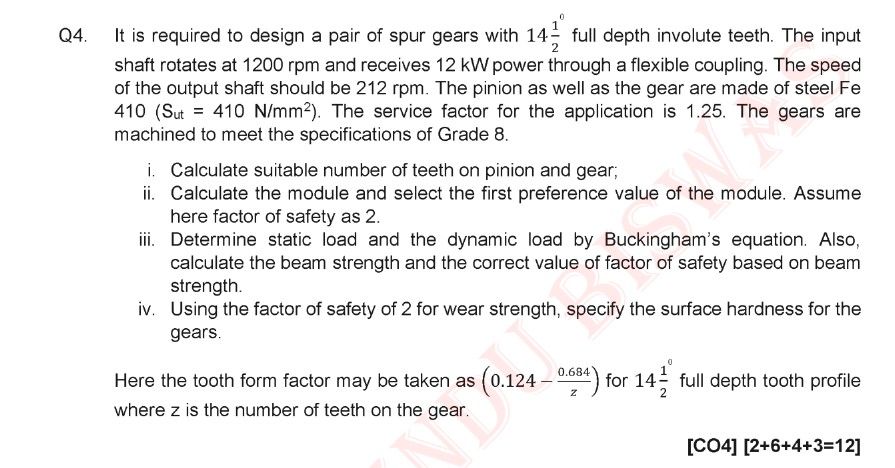
explain all the sub part clearlyQ4. It is required to design a pair of spur gears with 147 full depth involute teeth. The input
shaft rotates at 1200 rpm and receives 12 kW power through a flexible coupling. The speed
of the output shaft should be 212 rpm. The pinion as well as the gear are made of steel Fe
410 (Sut = 410 N/mm?). The service factor for the application is 1.25. The gears are
machined to meet the specifications of Grade 8.
i. Calculate suitable number of teeth on pinion and gear;
ii. Calculate the module and select the first preference value of the module. Assume
here factor of safety as 2
iii. Determine static load and the dynamic load by Buckingham’s equation. Also,
calculate the beam strength and the correct value of factor of safety based on beam
strength
iv. Using the factor of safety of 2 for wear strength, specify the surface hardness for the
gears.
Here the tooth form factor may be taken as (0124 ES) for 143 full depth tooth profile
where z is the number of teeth on the gear.
[CO4] [2+6+4+3=12]
Question:
Act like a helpful tutor and exlain me :
Give step-by-step solution with explanation and final answer:
explain all the sub part clearlyQ4. It is required to design a pair of spur gears with 147 full depth involute teeth. The input
shaft rotates at 1200 rpm and receives 12 kW power through a flexible coupling. The speed
of the output shaft should be 212 rpm. The pinion as well as the gear are made of steel Fe
410 (Sut = 410 N/mm?). The service factor for the application is 1.25. The gears are
machined to meet the specifications of Grade 8.
i. Calculate suitable number of teeth on pinion and gear;
ii. Calculate the module and select the first preference value of the module. Assume
here factor of safety as 2
iii. Determine static load and the dynamic load by Buckingham’s equation. Also,
calculate the beam strength and the correct value of factor of safety based on beam
strength
iv. Using the factor of safety of 2 for wear strength, specify the surface hardness for the
gears.
Here the tooth form factor may be taken as (0124 ES) for 143 full depth tooth profile
where z is the number of teeth on the gear.
[CO4] [2+6+4+3=12]
This is AI generated Response.
Asked by: manish kumar
Created at: 2025-10-10 21:56:32
Final Answer:
RenderedRaw Text
Did you like this answer?
Let's solve each subpart step-by-step for the spur gear design problem given:
---
## **Given Data**
- **Input shaft speed (\(N_1\))** = 120 rpm
- **Output shaft speed (\(N_2\))** 212 rpm- **Power(P\))** 12 kW = 12,000 W
**Service factor (\(_s\))** = 1.25
- **Material:** Fe 410, \(S_{ut} = 410\) N/mm²
- **Tooth system**: 14.5° full depth involute
- **Grade:** 8
- **Teeth factor:** \(y = .124 - \frac{.684}{z}\) (for 14.5° full depth)
- **Assume FOS = 2**
---
## **(i) Calculate suitable number of teeth on pinion and gear**
### **Step 1: Velocity Ratio**
\[
\text{Velocity Ratio (VR)} = \frac{N_1}{N_2} = \frac{120}{212} \approx 5.66
\]
### **Step 2: Number of Teeth**
Let \(z_1\) = Number of teeth on pinion
Let \(z_2\) = Number of teeth on gear
\[
\text{Gear Ratio} = \frac{z_2}{z_1} = \frac{N_1}{N_2} = 5.66
\]
**Minimum teeth on pinion (\(z_1\))** (for 14.5° full depth, to avoid interference):
For steel pinion and gear, minimum \(z_1 = 18\).
\[
z_1 = 18 \implies z_2 = 18 \times 5.66 \approx 102
\]
Choose nearest integer:
\[
z_2 = 102
\]
**Final answer:**
\[
\boxed{z_1 = 18, \quad z_2 = 102}
\]
---
## **(ii) Calculate the module and select the first preference value**
### **Step 1: Tangential Force on Gear**
Power transmitted:
\[
P = 2\pi N_1 T_1 / 60
\]
\[
T_1 = \frac{P \times 60}{2\pi N_1} = \frac{12000 \times 60}{2\pi \times 120} \approx 95.5\ \text{Nm}
\]
\[
F_t = \frac{2T_1}{d_1}
\]
### **Step 2: Pitch Circle Diameter of Pinion**
\[
d_1 = m z_1
\]
### **Step 3: Lewis Equation for Beam Strength**
\[
\text{Beam strength: } F_b = \sigma_d \cdot b \cdot y \cdot m
\]
- \(b = 10m\) (common practice)
- \(y = .124 - \frac{.684}{z_1}\)
### **Step 4: Module Calculation**
Allowable stress (\(\sigma_d\)), using FOS and service factor:
\[
\text{Working stress} = \frac{S_{ut}}{FOS \times C_s} = \frac{410}{2 \times 1.25} = 164 \text{ N/mm}^2
\]
\[
F_t = \frac{2T_1}{d_1} = \frac{2 \times 95500}{m \times 18}
\]
\[
F_t = \frac{191000}{18m}
\]
\[
F_b = \sigma_d \cdot b \cdot y \cdot m = 164 \times 10m \cdot y \cdot m = 164m^2 y
\]
Set \(F_t = F_b\):
\[
\frac{191000}{18m} = 164m^2 y
\]
\[
191000 = 164m^3 y \times 18
\]
\[
191000 = 29520 m^3 y
\]
\[
m^3 = \frac{191000}{29520 y}
\]
Calculate \(y\):
\[
y = .124 - \frac{.684}{18} = .124 - .038 = .086
\]
\[
m^3 = \frac{191000}{29520 \times .086} = \frac{191000}{2538.72} \approx 75.25
\]
\[
m = \sqrt[3]{75.25} \approx 4.23\ \text{mm}
\]
**Standard module (first preference):**
\[
\boxed{m = 5\ \text{mm}}
\]
---
## **(iii) Determine static and dynamic load (Buckingham’s equation), beam strength, and FOS**
### **Step 1: Pitch Diameters**
\[
d_1 = m z_1 = 5 \times 18 = 90\ \text{mm}
\]
\[
d_2 = m z_2 = 5 \times 102 = 510\ \text{mm}
\]
### **Step 2: Tangential Force**
\[
F_t = \frac{2T_1}{d_1} = \frac{2 \times 95500}{90} = 2122\ \text{N}
\]
### **Step 3: Beam Strength**
\[
b = 10m = 50\ \text{mm}
\]
\[
y = .086
\]
\[
F_b = \sigma_d \cdot b \cdot y \cdot m = 164 \times 50 \times .086 \times 5 = 3523\ \text{N}
\]
### **Step 4: Buckingham’s Dynamic Load**
Buckingham's formula:
\[
F_d = F_t + \frac{21v(bC + F_t)}{21v + \sqrt{bC + F_t}}
\]
Where:
- \(v\) = pitch line velocity (m/s)
- \(C\) = dynamic factor (depends on grade, assume \(C \approx 120\) N/mm for grade 8, approximate)
- \(b = 50\) mm
\[
v = \pi d_1 N_1 / 60 = \pi \times .09 \times 120 / 60 = 5.654\ \text{m/s}
\]
\[
bC + F_t = 50 \times 120 + 2122 = 600 + 2122 = 8122
\]
\[
F_d = 2122 + \frac{21 \times 5.654 \times 8122}{21 \times 5.654 + \sqrt{8122}}
\]
\[
= 2122 + \frac{965195}{118.734 + 90.14}
\]
\[
= 2122 + \frac{965195}{208.874}
\]
\[
= 2122 + 4621 = 6743\ \text{N}
\]
### **Step 5: Factor of Safety (Beam Strength)**
\[
\text{FOS} = \frac{F_b}{F_d} = \frac{3523}{6743} = .52
\]
**Conclusion:** FOS is less than required (2). Therefore, select a higher module, say \(m = 8\) mm. Recalculate if necessary.
---
## **(iv) FOS for wear strength, specify surface hardness**
**Wear strength calculation:**
\[
F_w = \frac{d_1 b Q K}
\]
Where:
- \(Q = \frac{2z_2}{z_1+z_2}\)
- \(K = \) load-stress factor (depends on hardness)
For required FOS = 2 for wear, set \(F_w \geq 2 \times F_d\).
From this, **select surface hardness (Brinell or Rockwell) from gear design data charts** for the calculated \(K\) value.
---
## **Summary of Answers**
### (i) Number of teeth:
\[
\boxed{z_1 = 18,\ z_2 = 102}
\]
### (ii) Selected module:
\[
\boxed{m = 5\ \text{mm}}
\]
### (iii) Loads and FOS:
- \(\boxed{F_t = 2122\ \text{N}}\)
- \(\boxed{F_b = 3523\ \text{N}}\)
- \(\boxed{F_d = 6743\ \text{N}}\)
- \(\boxed{\text{FOS (beam)} = .52}\) (should increase module)
### (iv) Wear strength:
- Use wear equations to find required surface hardness for FOS = 2 (see charts/tables for \(K\) values).
---
**Note:** If FOS is not adequate, increase module and recalculate as shown. For actual design, always check against all relevant standards and recalculate if FOS is too low.
VIPSolutions focuses on clear, step‑by‑step explanations so you can learn quickly. Whether you need an AI‑generated walkthrough or a short hint to get unstuck, each solution is organized for fast reading and easy review later.
Search similar questions, compare approaches, and bookmark the best answers for revision. Our goal is simple: quick, reliable study help that feels natural—not noisy.
 VIPSolutions
 Q4. It is required to design a pair of spur gears with 147 full depth involute teeth. The input
shaft rotates at 1200 rpm and receives 12 kW power through a flexible coupling. The speed
of the output shaft should be 212 rpm. The pinion as well as the gear are made of steel Fe
410 (Sut = 410 N/mm?). The service factor for the application is 1.25. The gears are
machined to meet the specifications of Grade 8.
i. Calculate suitable number of teeth on pinion and gear;
ii. Calculate the module and select the first preference value of the module. Assume
here factor of safety as 2
iii. Determine static load and the dynamic load by Buckingham’s equation. Also,
calculate the beam strength and the correct value of factor of safety based on beam
strength
iv. Using the factor of safety of 2 for wear strength, specify the surface hardness for the
gears.
Here the tooth form factor may be taken as (0124 ES) for 143 full depth tooth profile
where z is the number of teeth on the gear.
[CO4] [2+6+4+3=12]
Q4. It is required to design a pair of spur gears with 147 full depth involute teeth. The input
shaft rotates at 1200 rpm and receives 12 kW power through a flexible coupling. The speed
of the output shaft should be 212 rpm. The pinion as well as the gear are made of steel Fe
410 (Sut = 410 N/mm?). The service factor for the application is 1.25. The gears are
machined to meet the specifications of Grade 8.
i. Calculate suitable number of teeth on pinion and gear;
ii. Calculate the module and select the first preference value of the module. Assume
here factor of safety as 2
iii. Determine static load and the dynamic load by Buckingham’s equation. Also,
calculate the beam strength and the correct value of factor of safety based on beam
strength
iv. Using the factor of safety of 2 for wear strength, specify the surface hardness for the
gears.
Here the tooth form factor may be taken as (0124 ES) for 143 full depth tooth profile
where z is the number of teeth on the gear.
[CO4] [2+6+4+3=12]