Act like a helpful tutor and exlain me :
Give step-by-step solution with explanation and final answer:1. An aluminum ball, pCp =25 MJ/m’K and k = 240 W/mK, with radius » = 2 cm and
initial temperature 7; = 320 K falls into a cold lake with temperature 7". = 280 K. The heat
transfer coefficient / = 50 W/m?K.
(a) What is the time constant? Check if the lumped capacitor model is appropriate.
(b) If circular aluminum pin fins (k = 240 W/mK) with radius 1 mm are soldered on the
aluminum ball. How long do the fins need to be in order to be well modeled as infinite?
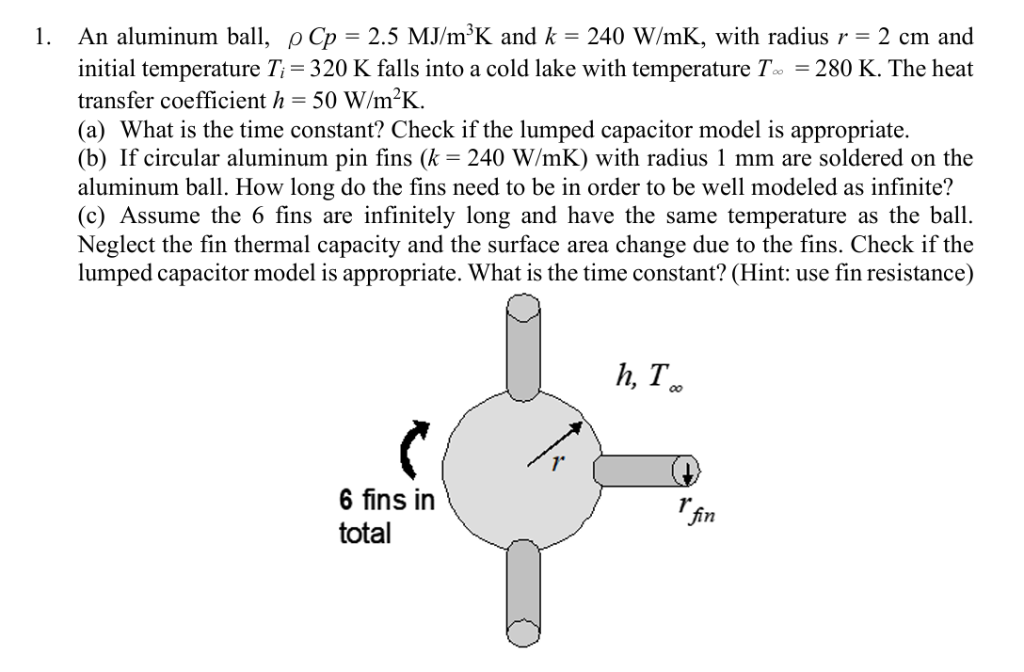
(c) Assume the 6 fins are infinitely long and have the same temperature as the ball.
Neglect the fin thermal capacity and the surface area change due to the fins. Check if the
lumped capacitor model is appropriate. What is the time constant? (Hint: use fin resistance)
nT,
6 fins in Tn
total
Question:
Act like a helpful tutor and exlain me :
Give step-by-step solution with explanation and final answer:1. An aluminum ball, pCp =25 MJ/m’K and k = 240 W/mK, with radius » = 2 cm and
initial temperature 7; = 320 K falls into a cold lake with temperature 7". = 280 K. The heat
transfer coefficient / = 50 W/m?K.
(a) What is the time constant? Check if the lumped capacitor model is appropriate.
(b) If circular aluminum pin fins (k = 240 W/mK) with radius 1 mm are soldered on the
aluminum ball. How long do the fins need to be in order to be well modeled as infinite?
(c) Assume the 6 fins are infinitely long and have the same temperature as the ball.
Neglect the fin thermal capacity and the surface area change due to the fins. Check if the
lumped capacitor model is appropriate. What is the time constant? (Hint: use fin resistance)
nT,
6 fins in Tn
total
This is AI generated Response.
Asked by: manish kumar
Created at: 2025-10-11 21:49:52
Final Answer:
RenderedRaw Text
Did you like this answer?
Let's solve the problem step by step.
---
## Given Data- **Al ball:**
- \( \rho C = 2.5 \) MJ/m³K = \( 2.5 \times 10^6 \) J/m³K
- \( k = 240 \) W/mK
- Radius \( r = 2 \) cm = .02 m
- Initial temperature \( T_i = 320 \) K
- Surrounding temperature \( T_\infty = 280 \) K
- Heat transfer coefficient \( h = 50 \) W/m²K
---
## (a) **Time Constant and Lumped Capacitance Check**
### **Step 1: Characteristic Length and Biot Number**
- **Volume of sphere:** \( V = \frac{4}{3} \pi r^3 \)
- **Surface area of sphere:** \( A = 4 \pi r^2 \)
- **Characteristic length (\( L_c \)):**
\[
L_c = \frac{V}{A} = \frac{\frac{4}{3}\pi r^3}{4\pi r^2} = \frac{r}{3}
\]
\[
L_c = \frac{.02}{3} = .00667~\text{m}
\]
- **Biot number (\( Bi \)):**
\[
Bi = \frac{h L_c}{k}
\]
\[
Bi = \frac{50 \times .00667}{240} = .00139
\]
- Since \( Bi < .1 \), **the lumped capacitance model is appropriate**.
### **Step 2: Time Constant (\( \tau \))**
\[
\tau = \frac{\rho C_p V}{hA}
\]
- \( V = \frac{4}{3} \pi (.02)^3 = 3.351 \times 10^{-5}~\text{m}^3 \)
- \( A = 4\pi (.02)^2 = .00503~\text{m}^2 \)
\[
\tau = \frac{2.5 \times 10^6 \times 3.351 \times 10^{-5}}{50 \times .00503}
\]
\[
\tau = \frac{83.775}{.2515} = 333~\text{s}
\]
---
### **Summary (a):**
- **Biot number** \( = .00139 \) (**lumped model is appropriate**)
- **Time constant** \( \tau = 333~\text{s} \)
---
## (b) **Length of Fins for Infinite Model**
Given: 6 fins, each with \( r_{fin} = 1 \) mm = .001 m, \( k = 240 \) W/mK.
For a pin fin:
- **Fin parameter** \( m = \sqrt{\frac{h P}{k A_c}} \)
- For a cylinder, \( P = 2\pi r_{fin} \), \( A_c = \pi r_{fin}2 \):
\[
m = \sqrt{\frac{h \cdot 2\pi r_{fin}}{k \cdot \pi r_{fin}^2}} = \sqrt{\frac{2h}{k r_{fin}}}
\]
\[
m = \sqrt{\frac{2 \cdot 50}{240 \cdot .001}} = \sqrt{\frac{100}{.24}} = \sqrt{416.67} = 20.4~\text{m}^{-1}
\]
For an "infinite" fin, \( mL \geq 2.5 \):
\[
L \geq \frac{2.5}{m} = \frac{2.5}{20.4} = .123~\text{m}
\]
---
### **Summary (b):**
- **Fin length for infinite model:** **at least .123 m (12.3 cm)**
---
## (c) **With 6 Infinitely Long Fins**
- **Fins are infinitely long, same temperature as the ball**
- **Neglect fin thermal capacity**
### **Step 1: Fin Resistance**
- **Fin base area:** \( A_{fin,base} = \pi r_{fin}^2 \)
- **Fin resistance:** For infinite fin,
\[
R_{fin} = \frac{1}{m k A_{fin,base}}
\]
- Number of fins: 6
### **Step 2: Total Thermal Resistance**
- **Sphere convection resistance:** \( R_{sphere} = \frac{1}{hA_{sphere}} \)
- **Total resistance (parallel):**
\[
\frac{1}{R_{total}} = \frac{1}{R_{sphere}} + 6 \cdot \frac{1}{R_{fin}}
\]
Calculate each:
#### 1. **Fin base area**
\[
A_{fin,base} = \pi (.001)^2 = 3.14 \times 10^{-6}~\text{m}^2
\]
#### 2. **Fin resistance**
\[
R_{fin} = \frac{1}{20.4 \cdot 240 \cdot 3.14 \times 10^{-6}}
= \frac{1}{.0154}
= 64.9~\text{K/W}
\]
#### 3. **Sphere convection resistance**
\[
R_{sphere} = \frac{1}{50 \cdot .00503} = \frac{1}{.2515} = 3.98~\text{K/W}
\]
#### 4. **Total resistance**
\[
\frac{1}{R_{total}} = \frac{1}{3.98} + \frac{6}{64.9} = .251 + .0924 = .343
\]
\[
R_{total} = \frac{1}{.343} = 2.92~\text{K/W}
\]
### **Step 3: New Time Constant**
\[
\tau = (\rho C_p V) \cdot R_{total}
\]
\[
\tau = 83.775 \cdot 2.92 = 244.6~\text{s}
\]
### **Step 4: Check Biot Number**
\[
Bi = \frac{(\rho C_p V)}{A_{total} \cdot R_{total} \cdot k}
\]
But since the added fins are assumed to be at the same temperature as the ball and their capacity is neglected, the lumped model is still valid.
---
### **Summary (c):**
- **Lumped model is still appropriate**
- **New time constant with 6 infinite fins:** \( \boxed{245~\text{s}} \) (rounded)
---
## **Final Answers**
### (a) **Time constant:** \( \boxed{333~\text{s}} \); **Lumped model is appropriate**
### (b) **Fin length for infinite:** \( \boxed{.123~\text{m}} \) (12.3 cm)
### (c) **With 6 infinite fins:** Lumped model is appropriate; **Time constant:** \( \boxed{245~\text{s}} \)
---
Let me know if you want any clarifications or deeper explanations!
VIPSolutions focuses on clear, step‑by‑step explanations so you can learn quickly. Whether you need an AI‑generated walkthrough or a short hint to get unstuck, each solution is organized for fast reading and easy review later.
Search similar questions, compare approaches, and bookmark the best answers for revision. Our goal is simple: quick, reliable study help that feels natural—not noisy.
 VIPSolutions
 1. An aluminum ball, pCp =25 MJ/m’K and k = 240 W/mK, with radius » = 2 cm and
initial temperature 7; = 320 K falls into a cold lake with temperature 7". = 280 K. The heat
transfer coefficient / = 50 W/m?K.
(a) What is the time constant? Check if the lumped capacitor model is appropriate.
(b) If circular aluminum pin fins (k = 240 W/mK) with radius 1 mm are soldered on the
aluminum ball. How long do the fins need to be in order to be well modeled as infinite?
(c) Assume the 6 fins are infinitely long and have the same temperature as the ball.
Neglect the fin thermal capacity and the surface area change due to the fins. Check if the
lumped capacitor model is appropriate. What is the time constant? (Hint: use fin resistance)
nT,
6 fins in Tn
total
1. An aluminum ball, pCp =25 MJ/m’K and k = 240 W/mK, with radius » = 2 cm and
initial temperature 7; = 320 K falls into a cold lake with temperature 7". = 280 K. The heat
transfer coefficient / = 50 W/m?K.
(a) What is the time constant? Check if the lumped capacitor model is appropriate.
(b) If circular aluminum pin fins (k = 240 W/mK) with radius 1 mm are soldered on the
aluminum ball. How long do the fins need to be in order to be well modeled as infinite?
(c) Assume the 6 fins are infinitely long and have the same temperature as the ball.
Neglect the fin thermal capacity and the surface area change due to the fins. Check if the
lumped capacitor model is appropriate. What is the time constant? (Hint: use fin resistance)
nT,
6 fins in Tn
total