 VIPSolutions
Act like a helpful tutor and exlain me : Give step-by-step solution with explanation and final answer:explain completeley ,. You have access to use FDM, VPP, and LPBF 3-D printers to fabricate any engineering parts. (a) Which methods do you consider fabricating polymer and polymer matrix composite parts? Justify your answer. (b) Which methods do you consider fabricating bulk ceramic parts? Justify your answer. (c) Which methods do you consider fabricating metallic parts? Justify your answer.
Question:
Act like a helpful tutor and exlain me :
Give step-by-step solution with explanation and final answer:explain completeley ,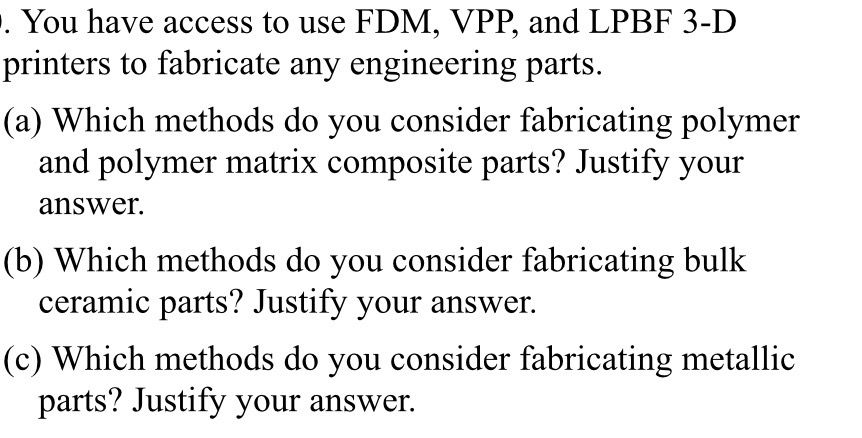 . You have access to use FDM, VPP, and LPBF 3-D
printers to fabricate any engineering parts.
(a) Which methods do you consider fabricating polymer
and polymer matrix composite parts? Justify your
answer.
(b) Which methods do you consider fabricating bulk
ceramic parts? Justify your answer.
(c) Which methods do you consider fabricating metallic
parts? Justify your answer.
. You have access to use FDM, VPP, and LPBF 3-D
printers to fabricate any engineering parts.
(a) Which methods do you consider fabricating polymer
and polymer matrix composite parts? Justify your
answer.
(b) Which methods do you consider fabricating bulk
ceramic parts? Justify your answer.
(c) Which methods do you consider fabricating metallic
parts? Justify your answer.
This is AI generated Response.
Asked by: manish kumar
Created at: 2025-10-22 01:09:46
Asked by: manish kumar
Created at: 2025-10-22 01:09:46
Final Answer:
Rendered
Raw Text
Did you like this answer?
Certainly! Here's a detailed, step-by-step explanation for each part of the question:
---
## **Question Summary:**
You have access to advanced 3D fabrication methods (FDM, VPP, LPBF) for creating different types of engineering parts. The question asks which methods are suitable for fabricating:
- (a) Polymer and polymer matrix composite parts
- (b) Bulk ceramic parts
- (c) Metallic parts
---
## **Understanding the Manufacturing Methods:**
### **1. FDM (Fused Deposition Modeling)**
- **Material:** Thermoplastic polymers
- **Process:** Melts and extrudes thermoplastic filament layer by layer
- **Applications:** Prototyping, polymer parts, and some composites
### **2. VPP (Vat Photopolymerization)**
- **Material:** Photopolymer resins
- **Process:** Uses light (e.g., UV) to cure liquid resin layer by layer
- **Applications:** High-detail polymer parts, dental, jewelry
### **3. LPBF (Laser Powder Bed Fusion)**
- **Material:** Metal powders
- **Process:** Uses a laser to selectively melt metal powder layer by layer
- **Applications:** Metal parts, aerospace, medical implants
---
## **Part (a): Fabricating Polymer and Polymer Matrix Composite Parts**
### **Method Consideration:**
- **FDM:** Suitable for thermoplastic polymers; can include composite filaments (e.g., carbon fiber reinforced thermoplastics)
- **VPP:** Suitable for high-detail polymer parts, but limited by the resin type
- **LPBF:** Not suitable for polymers
### **Conclusion:**
- **Methods to consider:** **FDM and VPP**
### **Justification:**
- **FDM** is widely used for polymer parts and can incorporate composite materials within thermoplastic filaments.
- **VPP** produces detailed polymer parts but is less common for composites; still relevant for pure polymer parts.
---
## **Part (b): Fabricating Bulk Ceramic Parts**
### **Method Consideration:**
- **FDM:** Not suitable for ceramics directly
- **VPP:** Not suitable for ceramics
- **LPBF:** Not typical for ceramics in powder bed fusion, but some advanced processes are emerging
### **Most Suitable Method:**
- **None of these methods are ideal** for bulk ceramic parts directly. Ceramic parts are often made via **ceramic additive manufacturing methods** like Binder Jetting or Slip Casting, or via traditional sintering processes.
### **However,** if limited to the provided methods, **none are suitable** for bulk ceramics.
### **Conclusion:**
**None of the listed methods** are optimal for fabricating bulk ceramic parts.
---
## **Part (c): Fabricating Metallic Parts**
### **Method Consideration:**
- **LPBF:** The most suitable, as it is specifically designed for metal powders.
- **FDM:** Not suitable for metals.
- **VPP:** Not suitable for metals.
### **Conclusion:**
- **Method to consider:** **LPBF**
### **Justification:**
- LPBF uses laser to selectively melt metal powders, making it ideal for metallic parts.
---
# **Summary of Answers:**
| Part | Suitable Methods | Explanation |
|---------|----------------------|--------------|
| (a) Polymer and polymer matrix composite parts | **FDM, VPP** | FDM can print thermoplastic and composites; VPP produces detailed polymer parts |
| (b) Bulk ceramic parts | **None of these methods** | These methods are not suitable; ceramics require other processes |
| (c) Metallic parts | **LPBF** | LPBF is specifically designed for metal additive manufacturing |
---
## **Final notes:**
- Always choose the process aligned with material properties and part requirements.
- For ceramics, consider specialized ceramic additive manufacturing techniques.
- For composites, FDM is versatile with composite filaments; VPP can produce detailed parts but less so for composites.
---
If you need more detailed explanations on each process or alternative methods, feel free to ask!
📢 Instructions:
- Ask anything relatd to above question only.
- For new Question goto :