Act like a helpful tutor and exlain me :
Give step-by-step solution with explanation and final answer:Question 2
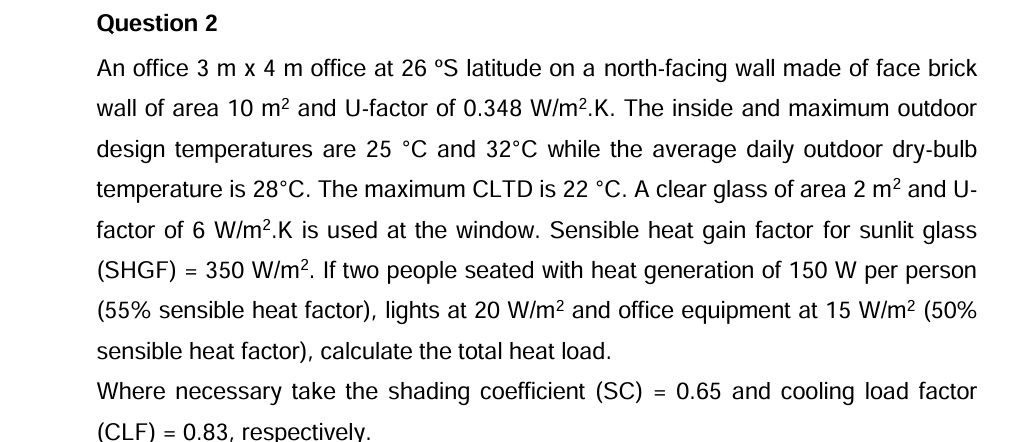
An office 3 m x 4 m office at 26 °S latitude on a north-facing wall made of face brick
wall of area 10 m? and U-factor of 0.348 W/m2.K. The inside and maximum outdoor
design temperatures are 25 °C and 32°C while the average daily outdoor dry-bulb
temperature is 28°C. The maximum CLTD is 22 °C. A clear glass of area 2 m? and U-
factor of 6 W/m2.K is used at the window. Sensible heat gain factor for sunlit glass
(SHGF) = 350 W/m2. If two people seated with heat generation of 150 W per person
(55% sensible heat factor), lights at 20 W/m? and office equipment at 15 W/m? (50%
sensible heat factor), calculate the total heat load.
Where necessary take the shading coefficient (SC) = 0.65 and cooling load factor
(CLF) = 0.83. respectively.
Question:
Act like a helpful tutor and exlain me :
Give step-by-step solution with explanation and final answer:Question 2
An office 3 m x 4 m office at 26 °S latitude on a north-facing wall made of face brick
wall of area 10 m? and U-factor of 0.348 W/m2.K. The inside and maximum outdoor
design temperatures are 25 °C and 32°C while the average daily outdoor dry-bulb
temperature is 28°C. The maximum CLTD is 22 °C. A clear glass of area 2 m? and U-
factor of 6 W/m2.K is used at the window. Sensible heat gain factor for sunlit glass
(SHGF) = 350 W/m2. If two people seated with heat generation of 150 W per person
(55% sensible heat factor), lights at 20 W/m? and office equipment at 15 W/m? (50%
sensible heat factor), calculate the total heat load.
Where necessary take the shading coefficient (SC) = 0.65 and cooling load factor
(CLF) = 0.83. respectively.
This is AI generated Response.
Asked by: manish kumar
Created at: 2025-10-22 12:57:40
Final Answer:
RenderedRaw Text
Did you like this answer?
Let's solve this step-by-step.
---
# Step 1: Understand the problem
We need to calculate the **total heat load** for the office, considering:
- **Heat gains** from people, lights, and equipment.
- **Heat transfer** through the wall and window, including conduction, convection, and solar heat gain.
---
# Step 2: Gather given data
| Parameter | Value |
| --- | --- |
| Office size | 3 m x 4 m |
| Wall area | 10 m² |
| Latitude | 26° S |
| U-factor (wall) | .348 W/m²·K |
| Wall area | 10 m² |
| Inside temperature | 25°C |
| Outdoor temperature | 32°C |
| Max outdoor temperature | 32°C |
| Average outdoor temperature | 28°C |
| Glass area | 2 m² |
| U-factor (glass) | 6 W/m²·K |
| SHGF | 350 W/m² |
| Number of people | 2 |
| Heat generated per person | 150 W |
| Lights | 20 W/m² |
| Office equipment | 15 W/m² |
| Shading coefficient (SC) | .65 |
| Cooling load factor (CLF) | .83 |
---
# Step 3: Calculate internal heat gains
### 3.1 Heat from people
\[
Q_{people} = 2 \times 150\,W = 300\,W
\]
### 3.2 Heat from lighting
\[
Q_{lights} = 20\,W/m^2 \times \text{area}
\]
\[
= 20\,W/m^2 \times (3\,m \times 4\,m) = 20 \times 12 = 240\,W
\]
### 3.3 Heat from office equipment
\[
Q_{equip} = 15\,W/m^2 \times 12\,m^2 = 15 \times 12 = 180\,W
\]
---
# Step 4: Calculate heat transfer through the wall
### 4.1 Temperature difference
\[
\Delta T_{wall} = T_{inside} - T_{outside} = 25°C - 32°C = -7°C
\]
(Heat flow will be outward because outside is hotter)
### 4.2 Heat conduction through wall
\[
Q_{wall} = U_{wall} \times A_{wall} \times |\Delta T_{wall}|
\]
\[
= .348\,W/m^2·K \times 10\,m^2 \times 7\,K = .348 \times 10 \times 7 = 24.36\,W
\]
(Note: Since the temperature difference is negative, heat flows outward, so this is heat gain/loss from the room. For cooling load, we consider heat entering the room, which is zero here because heat flows outward.)
---
### 4.3 Solar heat gain through the window
\[
Q_{solar} = SHGF \times A_{window} \times \text{SC}
\]
\[
= 350\,W/m^2 \times 2\,m^2 \times .65 = 350 \times 2 \times .65 = 455\,W
\]
---
# Step 5: Calculate heat transfer through the glass
### 5.1 Temperature difference across glass
\[
\Delta T_{glass} = T_{inside} - T_{outside} = -7°C
\]
### 5.2 Heat transfer via glass (conduction)
\[
Q_{glass} = U_{glass} \times A_{glass} \times |\Delta T_{glass}|
\]
\[
= 6\,W/m^2·K \times 2\,m^2 \times 7\,K = 6 \times 2 \times 7 = 84\,W
\]
---
# Step 6: Adjust for shading and cooling load factors
Since the heat gain through the glass is affected by shading coefficient:
\[
Q_{glass, adjusted} = Q_{glass} \times SC = 84 \times .65 = 54.6\,W
\]
---
# Step 7: Sum all heat gains
| Heat source | Power (W) |
| --- | --- |
| People | 300 |
| Lights | 240 |
| Equipment | 180 |
| Solar gain through glass (adjusted) | 54.6 |
| Heat gain through wall | (outward flow, so no gain) |
| Solar heat gain (SHGF) | 455 |
**Total internal + solar heat gains:**
\[
Q_{total} = 300 + 240 + 180 + 54.6 + 455 = 1,229.6\,W
\]
---
# **Final Step: Apply the cooling load factor**
The total heat load considering the cooling load factor:
\[
Q_{cooling} = Q_{total} \times CLF = 1,229.6 \times .83 \approx 1,020\,W
\]
---
# **Final Answer:**
\[
\boxed{
\text{Total heat load} \approx \mathbf{102\,W}
}
\]
This is the approximate cooling power required to maintain the indoor conditions considering all internal and external heat gains and losses.
---
Let me know if you'd like further clarification!
VIPSolutions focuses on clear, step‑by‑step explanations so you can learn quickly. Whether you need an AI‑generated walkthrough or a short hint to get unstuck, each solution is organized for fast reading and easy review later.
Search similar questions, compare approaches, and bookmark the best answers for revision. Our goal is simple: quick, reliable study help that feels natural—not noisy.
 VIPSolutions
 Question 2
An office 3 m x 4 m office at 26 °S latitude on a north-facing wall made of face brick
wall of area 10 m? and U-factor of 0.348 W/m2.K. The inside and maximum outdoor
design temperatures are 25 °C and 32°C while the average daily outdoor dry-bulb
temperature is 28°C. The maximum CLTD is 22 °C. A clear glass of area 2 m? and U-
factor of 6 W/m2.K is used at the window. Sensible heat gain factor for sunlit glass
(SHGF) = 350 W/m2. If two people seated with heat generation of 150 W per person
(55% sensible heat factor), lights at 20 W/m? and office equipment at 15 W/m? (50%
sensible heat factor), calculate the total heat load.
Where necessary take the shading coefficient (SC) = 0.65 and cooling load factor
(CLF) = 0.83. respectively.
Question 2
An office 3 m x 4 m office at 26 °S latitude on a north-facing wall made of face brick
wall of area 10 m? and U-factor of 0.348 W/m2.K. The inside and maximum outdoor
design temperatures are 25 °C and 32°C while the average daily outdoor dry-bulb
temperature is 28°C. The maximum CLTD is 22 °C. A clear glass of area 2 m? and U-
factor of 6 W/m2.K is used at the window. Sensible heat gain factor for sunlit glass
(SHGF) = 350 W/m2. If two people seated with heat generation of 150 W per person
(55% sensible heat factor), lights at 20 W/m? and office equipment at 15 W/m? (50%
sensible heat factor), calculate the total heat load.
Where necessary take the shading coefficient (SC) = 0.65 and cooling load factor
(CLF) = 0.83. respectively.