 VIPSolutions
Act like a helpful tutor and exlain me : I need ai free answer for cheggestar a girs Them ed es kd rr sd add hl eos oe i en ea Ce eT a Sheesh r= dre
Question:
Act like a helpful tutor and exlain me :
I need ai free answer for chegg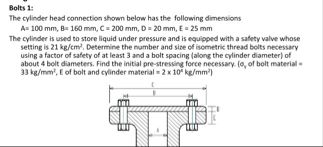 estar a girs
Them ed es kd rr sd add hl eos
oe i en ea
Ce eT
a
Sheesh
r=
dre
estar a girs
Them ed es kd rr sd add hl eos
oe i en ea
Ce eT
a
Sheesh
r=
dre
This is AI generated Response.
Asked by: John
Created at: 2025-10-15 18:16:54
Asked by: John
Created at: 2025-10-15 18:16:54
Final Answer:
Rendered
Raw Text
Did you like this answer?
Sure! Let's break down the problem step by step:
---
# **Problem Statement Recap**
We're given a cylinder head connection with the following parameters:
- **A = 100 mm**
- **B = 160 mm**
- **C = 200 mm**
- **D = 20 mm**
- **E = 25 mm**
- **Safety valve setting:** ≥ 21 kgf/cm² (convert to N/m² for SI)
- **Factor of safety:** at least **3**
- **Bolt spacing:** ~4 bolt diameters
- **Bolt material yield strength:** **33 kgf/mm²**
- **Cylinder material yield strength:** **2 x 10⁴ kgf/cm²**
Tasks:
1. **Calculate the number and size of isometric threaded bolts required.**
2. **Find the initial pre-stressing force necessary.**
---
# **Step 1: Calculate Maximum Force on Cylinder Head**
1. **Convert pressure to SI units:**
\( 21 \text{ kgf/cm}^2 = 21 \times 9.81 \times 10^4 \text{ N/m}^2 = 2.06 \times 10^6 \text{ N/m}^2 \) (rounded)
2. **Calculate area over which pressure acts (assume circular head, use diameter C):**
\[
\text{Area} = \frac{\pi}{4} \times (C)^2 = \frac{\pi}{4} \times (.2 \text{ m})^2 = .0314 \text{ m}^2
\]
3. **Total force on head:**
\[
F = \text{Pressure} \times \text{Area} = 2.06 \times 10^6 \times .0314 = 64,684 \text{ N}
\]
---
# **Step 2: Apply Factor of Safety**
\[
\text{Design force} = \text{Factor of Safety} \times \text{Force} = 3 \times 64,684 = 194,052 \text{ N}
\]
---
# **Step 3: Choose Bolt Size and Number**
- **Let d = bolt diameter**
- **Spacing = ~4d**
- **Bolts arranged in a circle (diameter B = 160 mm = .16 m)**
### **Bolt Strength Calculation**
- **Bolt material yield strength:** 33 kgf/mm²
- \( 33 \text{ kgf/mm}^2 = 33 \times 9.81 \text{ N/mm}^2 = 324 \text{ N/mm}^2 \)
- **Let the number of bolts = n**
\[
\text{Total force per bolt} = \frac{\text{Design force}}{n}
\]
\[
\text{Area per bolt} = \frac{\pi}{4} d^2
\]
\[
\text{Allowable force per bolt} = \text{Area per bolt} \times \text{Bolt yield strength}
\]
(Usually, you use a fraction of the yield strength, but since the safety factor is already applied, we use the yield here.)
Set:
\[
\frac{\text{Design force}}{n} = \frac{\pi}{4} d^2 \times 324
\]
Let's try **M20 bolts** (d = 20 mm):
\[
\text{Area per bolt} = \frac{\pi}{4} (20)^2 = 314 \text{ mm}^2
\]
\[
\text{Allowable force per bolt} = 314 \times 324 = 101,736 \text{ N}
\]
Number of bolts needed:
\[
n = \frac{194,052}{101,736} \approx 1.9
\]
So, **minimum 2 bolts** of 20 mm diameter could theoretically work, but let's check for more practical arrangements and spacing.
**Spacing (4d = 80 mm):**
- Circumference of bolt circle: \( \pi \times 160 = 503 \) mm
- Number of bolts with 80 mm spacing: \( \frac{503}{80} \approx 6.3 \)
So, **6 bolts of M20** is reasonable.
---
# **Step 4: Initial Pre-stressing Force**
Each bolt should be pre-stressed to at least the force it will carry:
\[
\text{Pre-stressing force per bolt} = \frac{\text{Design force}}{n} = \frac{194,052}{6} = 32,342 \text{ N}
\]
---
# **Step 5: Summary Table**
| Parameter | Value |
|-------------------|---------------------|
| Number of bolts | 6 |
| Bolt diameter | 20 mm (M20) |
| Bolt spacing | 80 mm (approx) |
| Pre-stressing force per bolt | 32,342 N |
---
# **Final Answers**
### 1. **Number & Size of Bolts**
- Use **6 bolts** of **20 mm diameter** (M20), spaced about **80 mm** apart on a 160 mm diameter circle.
### 2. **Initial Pre-stressing Force**
- **Each bolt should be pre-stressed to about 32,342 N.**
---
Let me know if you'd like to see **detailed calculations** for a different bolt size or another arrangement!
📢 Instructions:
- Ask anything relatd to above question only.
- For new Question goto :