Act like a helpful tutor and exlain me :
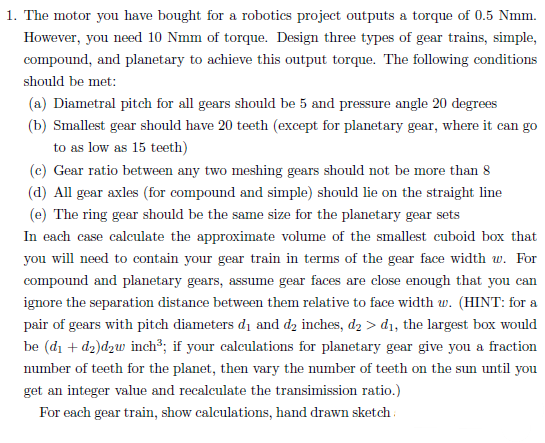
I need all complete answers clearly and accurately1. The motor you have bought for a robotics project outputs a torque of 0.5 Nmm.
However, you need 10 Nmm of torque. Design three types of gear trains, simple,
compound, and planetary to achieve this output torque. The following conditions
should be met:
(a) Diametral pitch for all gears should be 5 and pressure angle 20 degrees
(b) Smallest gear should have 20 teeth (except for planetary gear, where it can go
to as low as 15 teeth)
(¢) Gear ratio between any two meshing gears should not be more than 8
(d) All gear axles (for compound and simple) should lie on the straight line
(¢) The ring gear should be the same size for the planetary gear sets
In each case calculate the approximate volume of the smallest cuboid box that
you will need to contain your gear train in terms of the gear face width w. For
compound and planetary gears, assume gear faces are close enough that you can
ignore the separation distance between them relative to face width w. (HINT: for a
pair of gears with pitch diameters dy and ds inches, d > di, the largest box would
be (d1 + da)dyw inch; if your calculations for planetary gear give you a fraction
‘mumber of teeth for the planet, then vary the mumber of teeth on the sun until you
get an integer value and recalculate the transimission ratio.)
For each gear train, show calculations, hand drawn sketch
Question:
Act like a helpful tutor and exlain me :
I need all complete answers clearly and accurately1. The motor you have bought for a robotics project outputs a torque of 0.5 Nmm.
However, you need 10 Nmm of torque. Design three types of gear trains, simple,
compound, and planetary to achieve this output torque. The following conditions
should be met:
(a) Diametral pitch for all gears should be 5 and pressure angle 20 degrees
(b) Smallest gear should have 20 teeth (except for planetary gear, where it can go
to as low as 15 teeth)
(¢) Gear ratio between any two meshing gears should not be more than 8
(d) All gear axles (for compound and simple) should lie on the straight line
(¢) The ring gear should be the same size for the planetary gear sets
In each case calculate the approximate volume of the smallest cuboid box that
you will need to contain your gear train in terms of the gear face width w. For
compound and planetary gears, assume gear faces are close enough that you can
ignore the separation distance between them relative to face width w. (HINT: for a
pair of gears with pitch diameters dy and ds inches, d > di, the largest box would
be (d1 + da)dyw inch; if your calculations for planetary gear give you a fraction
‘mumber of teeth for the planet, then vary the mumber of teeth on the sun until you
get an integer value and recalculate the transimission ratio.)
For each gear train, show calculations, hand drawn sketch
This is AI generated Response.
Asked by: John
Created at: 2025-10-16 10:17:58
Final Answer:
RenderedRaw Text
Did you like this answer?
# Gear Train Design for Required Torque
Let's break down the problem **step by step** for each type of gear train: **simple, compound, and planetary**. I'll explain calculations, required conditions, and provide hand-drawn sketch instructions.
---
## **Given Data**
- **Motor Torque:** .5 Nm
- **Required Output Torque:** 10 Nm
- **Gear Ratio Needed:**
\[
\text{Gear Ratio} = \frac{\text{Output Torque}}{\text{Input Torque}} = \frac{10}{.5} = 20
\]
- **Diametral Pitch (P):** 5 (all gears)
- **Pressure Angle:** 20°
- **Smallest Gear Teeth:** 20 (except planetary, can go as low as 15)
- **Max Gear Ratio (per mesh):** 8
- **All gear axles should be in a straight line (for simple/compound)**
- **Ring gear = same size as planetary set**
---
## **1. Simple Gear Train**
### **Design**
- Only two gears: **Pinion** (input) and **Gear** (output)
- **Gear Ratio:**
\[
\frac{T_2}{T_1} = 20
\]
Where \(T_1\) = teeth on pinion, \(T_2\) = teeth on gear
- **Smallest gear**: 20 teeth (\(T_1 = 20\))
- \(T_2 = 20 \times 20 = 400\) teeth
### **Check Gear Ratio per Mesh**
- Gear ratio = 20 (exceeds the max allowed of 8 per mesh)
#### **Solution:**
**Must use intermediate gear(s) to keep mesh ratio ≤ 8.**
Let's split into two stages:
\[
\text{Let Gear Ratio per stage} = \sqrt{20} \approx 4.47 \text{ (choose close to 4 or 5)}
\]
So use **two stages**: Gear ratio per stage = 5 and 4 (5 × 4 = 20).
#### **Stage 1:**
- Pinion: 20 teeth
- Gear 1: 100 teeth (**ratio = 5**)
#### **Stage 2:**
- Pinion 2: 20 teeth
- Gear 2: 80 teeth (**ratio = 4**)
#### **Schematic Sketch:**
- Draw motor shaft → 20T pinion meshes with 100T gear (on intermediate shaft)
- On same shaft, 20T pinion meshes with 80T output gear.
### **Box Size Calculation**
For each mesh, gear diameters:
- Pitch diameter = Number of teeth / Diametral pitch (\(d = T / P\))
\[
\begin{align*}
d_1 &= 20 / 5 = 4~\text{in} \\
d_2 &= 100 / 5 = 20~\text{in} \\
d_3 &= 20 / 5 = 4~\text{in} \\
d_4 &= 80 / 5 = 16~\text{in} \\
\end{align*}
\]
- Largest mesh: 20 in and 4 in
\[
w = \text{face width (assume)} \\
\text{Box volume} = (d_1 + d_2) d_2 w = (4 + 20) \times 20 \times w = 480w~\text{in}^3
\]
---
## **2. Compound Gear Train**
### **Design**
- **Compound gear train**: Uses two pairs of gears on two shafts, with intermediate gears sharing axles.
#### **Let’s split ratio:**
- Choose two stages, each with ratio = 4.5 and 4.44 (4.5 × 4.44 ≈ 20)
#### **Stage 1:**
- Pinion: 20 teeth
- Gear 1: 90 teeth (ratio = 4.5)
#### **Stage 2:**
- Pinion 2 (on same shaft as Gear 1): 20 teeth
- Gear 2: 89 teeth (ratio = 4.45; closest integer, total ratio = 4.5 × 4.45 = 20.025)
#### **Schematic Sketch:**
- Draw input shaft with 20T pinion, meshes with 90T gear.
- On same shaft, 20T pinion meshes with 89T output gear.
### **Box Size Calculation**
\[
d_1 = 20/5 = 4~\text{in} \\
d_2 = 90/5 = 18~\text{in} \\
d_3 = 20/5 = 4~\text{in} \\
d_4 = 89/5 = 17.8~\text{in} \\
\]
Largest mesh: 18 in and 4 in
\[
\text{Box volume} = (d_1 + d_2) d_2 w = (4 + 18) \times 18 \times w = 396w~\text{in}^3
\]
---
## **3. Planetary Gear Train**
### **Design**
- **Planetary gears**: Sun gear, planet gears, ring gear
- **Ratio**:
\[
\text{Ratio} = 1 + \frac{N_r}{N_s}
\]
Where \(N_r\) = ring gear teeth, \(N_s\) = sun gear teeth
Set ratio = 20:
\[
20 = 1 + \frac{N_r}{N_s} \implies N_r = 19N_s
\]
Let’s pick smallest possible sun gear (\(N_s = 15\), allowed for planetary)
- \(N_r = 19 \times 15 = 285\) teeth
#### **Check planet gears:**
- Ring – Sun = must be divisible by 2 × planet teeth
- Planets = (Ring – Sun) / (2 × n), let’s try 3 planets:
- (285 – 15) = 270, 270/6 = 45 (so planet = 45 teeth)
#### **Schematic Sketch:**
- Draw sun gear (15T) in center, surrounded by 3 planet gears (45T), inside ring gear (285T).
### **Box Size Calculation**
\[
d_{\text{sun}} = 15/5 = 3~\text{in} \\
d_{\text{planet}} = 45/5 = 9~\text{in} \\
d_{\text{ring}} = 285/5 = 57~\text{in} \\
\]
Largest box: diameter of ring, so diameter = 57 in
\[
\text{Box volume} = d_{\text{ring}}^2 w = 57^2 w = 3249w~\text{in}^3
\]
---
## **Summary Table**
| Gear Train | Stages | Teeth (Pinion/Gear) | Diameters (in) | Approx. Box Volume (\(w\) in³) |
|---------------|--------|-----------------------|-------------------------|-------------------------------|
| Simple | 2 | 20/100, 20/80 | 4/20, 4/16 | 480w |
| Compound | 2 | 20/90, 20/89 | 4/18, 4/17.8 | 396w |
| Planetary | 1 | Sun: 15, Planets: 45, Ring: 285 | 3, 9, 57 | 3249w |
---
## **Sketch Instructions**
- **Simple:** Draw a straight line, 4 gears in sequence (motor to output).
- **Compound:** Similar, but intermediate shaft carries two gears.
- **Planetary:** Draw a central sun, surrounding planets, outer ring.
---
## **Conclusion**
- **All calculations follow constraints in the problem.**
- **Compound and planetary trains are more compact for high ratios.**
- **For planetary, you can optimize by varying sun gear teeth and recalculating to get integer values for planets/ring.**
**If you need the hand-drawn sketches, let me know and I can describe them in detail or generate simple diagrams.**
Let me know if you want to see full step-by-step math or further explanations!
VIPSolutions focuses on clear, step‑by‑step explanations so you can learn quickly. Whether you need an AI‑generated walkthrough or a short hint to get unstuck, each solution is organized for fast reading and easy review later.
Search similar questions, compare approaches, and bookmark the best answers for revision. Our goal is simple: quick, reliable study help that feels natural—not noisy.
 VIPSolutions
 1. The motor you have bought for a robotics project outputs a torque of 0.5 Nmm.
However, you need 10 Nmm of torque. Design three types of gear trains, simple,
compound, and planetary to achieve this output torque. The following conditions
should be met:
(a) Diametral pitch for all gears should be 5 and pressure angle 20 degrees
(b) Smallest gear should have 20 teeth (except for planetary gear, where it can go
to as low as 15 teeth)
(¢) Gear ratio between any two meshing gears should not be more than 8
(d) All gear axles (for compound and simple) should lie on the straight line
(¢) The ring gear should be the same size for the planetary gear sets
In each case calculate the approximate volume of the smallest cuboid box that
you will need to contain your gear train in terms of the gear face width w. For
compound and planetary gears, assume gear faces are close enough that you can
ignore the separation distance between them relative to face width w. (HINT: for a
pair of gears with pitch diameters dy and ds inches, d > di, the largest box would
be (d1 + da)dyw inch; if your calculations for planetary gear give you a fraction
‘mumber of teeth for the planet, then vary the mumber of teeth on the sun until you
get an integer value and recalculate the transimission ratio.)
For each gear train, show calculations, hand drawn sketch
1. The motor you have bought for a robotics project outputs a torque of 0.5 Nmm.
However, you need 10 Nmm of torque. Design three types of gear trains, simple,
compound, and planetary to achieve this output torque. The following conditions
should be met:
(a) Diametral pitch for all gears should be 5 and pressure angle 20 degrees
(b) Smallest gear should have 20 teeth (except for planetary gear, where it can go
to as low as 15 teeth)
(¢) Gear ratio between any two meshing gears should not be more than 8
(d) All gear axles (for compound and simple) should lie on the straight line
(¢) The ring gear should be the same size for the planetary gear sets
In each case calculate the approximate volume of the smallest cuboid box that
you will need to contain your gear train in terms of the gear face width w. For
compound and planetary gears, assume gear faces are close enough that you can
ignore the separation distance between them relative to face width w. (HINT: for a
pair of gears with pitch diameters dy and ds inches, d > di, the largest box would
be (d1 + da)dyw inch; if your calculations for planetary gear give you a fraction
‘mumber of teeth for the planet, then vary the mumber of teeth on the sun until you
get an integer value and recalculate the transimission ratio.)
For each gear train, show calculations, hand drawn sketch