Act like a helpful tutor and exlain me :
I need help going through these propagation
o
f
uncertainty problems step
b
y
step, and understanding how many significant figures
t
o
use for eachAddition and Subtraction: The absolute error is used.
Example:y=a+b-c s, = [si +si+sé square root of the sum of the squares (of the absolute error)
Problem: Based on the equation, values (a, b, c), and errors (ss, ss, sc) below, what is the final value (y) and propagated
error (s,).
a=50m 52=02m
b-222m s-007m
c=36m sc=0.1m
How would you write the final answer in the format value t error? How many significant figures should you use?
Rule: For the final answer, the number place of the absolute error is the position of the least significant figure.
What is the relative error? Write your answer as value + error? How many significant figures should you use?
What is the percent relative error? Write your answer as value t error? How many significant figures should you use?
Question:
Act like a helpful tutor and exlain me :
I need help going through these propagation
o
f
uncertainty problems step
b
y
step, and understanding how many significant figures
t
o
use for eachAddition and Subtraction: The absolute error is used.
Example:y=a+b-c s, = [si +si+sé square root of the sum of the squares (of the absolute error)
Problem: Based on the equation, values (a, b, c), and errors (ss, ss, sc) below, what is the final value (y) and propagated
error (s,).
a=50m 52=02m
b-222m s-007m
c=36m sc=0.1m
How would you write the final answer in the format value t error? How many significant figures should you use?
Rule: For the final answer, the number place of the absolute error is the position of the least significant figure.
What is the relative error? Write your answer as value + error? How many significant figures should you use?
What is the percent relative error? Write your answer as value t error? How many significant figures should you use?
This is AI generated Response.
Asked by: Alok Kumar
Created at: 2026-02-01 09:00:20
Final Answer:
RenderedRaw Text
Did you like this answer?
Absolutely! Let's walk through the problem **step by step** and discuss **significant figures** at each stage.
---
## 1. **Calculate the Value of y**
Given:
- \( a = 5. \, \text{m} \)
- \( b = 2.22 \, \text{m} \)
- \( c = 3.6 \, \text{m} \)
- Equation: \( y = a + b - c \)
So:
\[
y = 5. + 2.22 - 3.6 = 3.62 \, \text{m}
\]
**Significant Figures:**
For addition/subtraction, the answer must have the same number of decimal places as the value with the **least decimal places**.
- \( 5. \) (1 decimal)
- \( 2.22 \) (2 decimals)
- \( 3.6 \) (1 decimal)
So, round \( y \) to **1 decimal place**:
\[
y = 3.6 \, \text{m}
\]
---
## 2. **Calculate the Propagated Error (\( s_y \))**
The formula (root sum of squares):
\[
s_y = \sqrt{s_a^2 + s_b^2 + s_c^2}
\]
Where:
- \( s_a = .2 \, \text{m} \)
- \( s_b = .07 \, \text{m} \)
- \( s_c = .1 \, \text{m} \)
Plug in:
\[
s_y = \sqrt{(.2)^2 + (.07)^2 + (.1)^2}
\]
\[
s_y = \sqrt{.04 + .0049 + .01}
\]
\[
s_y = \sqrt{.0549}
\]
\[
s_y \approx .234 \, \text{m}
\]
**Significant Figures for Error:**
Errors should be reported with **1 significant figure** (sometimes 2 if the first digit is 1 or 2 for clarity), so:
\[
s_y \approx .2 \, \text{m}
\]
---
## 3. **Final Answer (Value ± Error)**
- Value: \( 3.6 \, \text{m} \)
- Error: \( .2 \, \text{m} \)
**Format:** \( y = 3.6 \pm .2 \, \text{m} \)
- The answer is rounded to the decimal place of the error (tenths place).
---
## 4. **Relative Error**
Relative error is:
\[
\text{Relative error} = \frac{s_y}{y}
\]
\[
\frac{.2}{3.6} \approx .056
\]
**Significant Figures:**
Relative errors are often given with **1 or 2 significant figures**:
\[
\text{Relative error} = .06 \pm .02
\]
But since the error is already 1 significant figure:
\[
\boxed{.06 \pm .02}
\]
---
## 5. **Percent Relative Error**
Percent relative error:
\[
\text{Percent relative error} = \left(\frac{s_y}{y}\right) \times 100\%
\]
\[
= .056 \times 100\% \approx 5.6\%
\]
**Significant Figures:**
Match the significant figures of the relative error:
\[
\boxed{6\%}
\]
---
## **Summary Table**
| Step | Value/Formula | Result | Significant Figures |
|-----------------------------|----------------------------------|-----------------------|-------------------------------|
| Final answer (value ± error)| \( 3.6 \pm .2 \) m | \( 3.6 \pm .2 \) m | 1 decimal (tenths place) |
| Relative error | \( .06 \pm .02 \) | \( .06 \) | 1–2 significant figures |
| Percent relative error | \( 6\% \) | \( 6\% \) | 1 significant figure |
---
## **Extra Notes on Significant Figures**
- **Addition/Subtraction:** Use the least number of decimal places from the inputs.
- **Error values:** Usually, 1 significant figure. If it starts with 1 or 2, you may use 2 significant figures.
- **Final answer:** The value should match the decimal place of the error.
Let me know if you want to see each step in more detail!
Question:
Final solutions summary not in table format
This is AI generated Response.
Asked by: Alok Kumar
Created at: 2026-02-01 09:03:23
Final Answer:
RenderedRaw Text
Did you like this answer?
## Final Solutions Summary
### 1. Final Value with Error
- **Value:** \( 3.6 \, \text{m} \)
- **Error:** \( \pm 0.2 \, \text{m} \)
- **Final Format:**
\[
y = 3.6 \pm 0.2 \, \text{m}
\]
### 2. Relative Error
- **Calculation:**
\[
\text{Relative Error} = \frac{0.2}{3.6} \approx 0.056
\]
- **Final Result:**
\[
0.06 \pm 0.02
\]
### 3. Percent Relative Error
- **Calculation:**
\[
\text{Percent Relative Error} = 0.056 \times 100\% \approx 5.6\%
\]
- **Final Result:**
\[
6\%
\]
---
### Significant Figures Summary
- **Final Value:** 1 decimal place (tenths)
- **Relative Error:** 1 significant figure
- **Percent Relative Error:** 1 significant figure
Feel free to ask if you need any further clarification!
VIPSolutions focuses on clear, step‑by‑step explanations so you can learn quickly. Whether you need an AI‑generated walkthrough or a short hint to get unstuck, each solution is organized for fast reading and easy review later.
Search similar questions, compare approaches, and bookmark the best answers for revision. Our goal is simple: quick, reliable study help that feels natural—not noisy.
 VIPSolutions
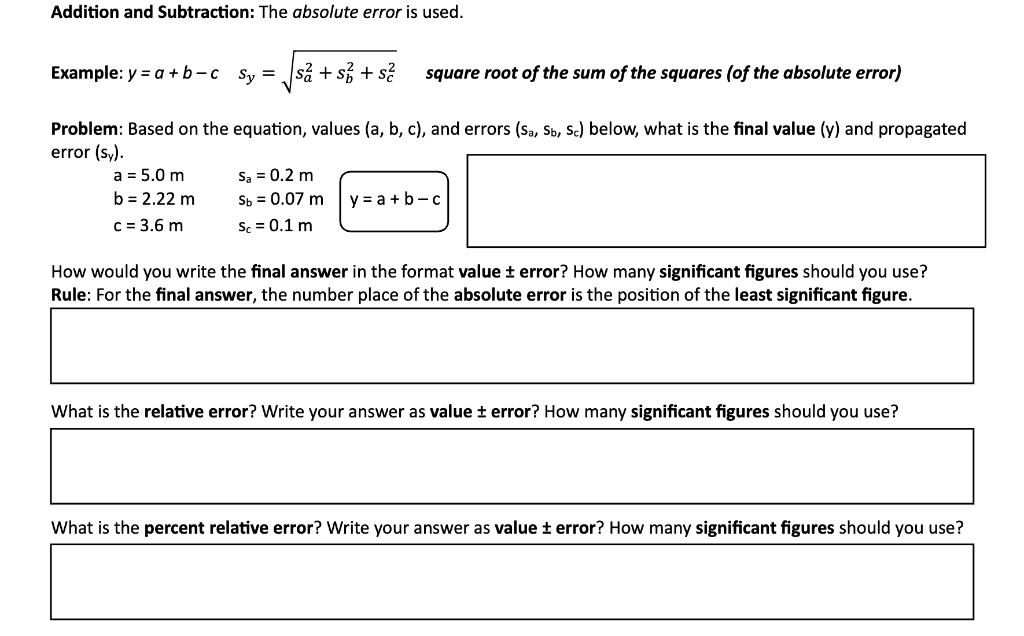 Addition and Subtraction: The absolute error is used.
Example:y=a+b-c s, = [si +si+sé square root of the sum of the squares (of the absolute error)
Problem: Based on the equation, values (a, b, c), and errors (ss, ss, sc) below, what is the final value (y) and propagated
error (s,).
a=50m 52=02m
b-222m s-007m
c=36m sc=0.1m
How would you write the final answer in the format value t error? How many significant figures should you use?
Rule: For the final answer, the number place of the absolute error is the position of the least significant figure.
What is the relative error? Write your answer as value + error? How many significant figures should you use?
What is the percent relative error? Write your answer as value t error? How many significant figures should you use?
Addition and Subtraction: The absolute error is used.
Example:y=a+b-c s, = [si +si+sé square root of the sum of the squares (of the absolute error)
Problem: Based on the equation, values (a, b, c), and errors (ss, ss, sc) below, what is the final value (y) and propagated
error (s,).
a=50m 52=02m
b-222m s-007m
c=36m sc=0.1m
How would you write the final answer in the format value t error? How many significant figures should you use?
Rule: For the final answer, the number place of the absolute error is the position of the least significant figure.
What is the relative error? Write your answer as value + error? How many significant figures should you use?
What is the percent relative error? Write your answer as value t error? How many significant figures should you use?