 VIPSolutions
Act like a helpful tutor and exlain me := me ge — COR IR ERC EES WH RO ICR TORN ERM TR SYSTEM § Fermented cucumber, is being preserved in brine with a concentration of %24 NaCl. The initial concentration of NaCl and moisture content (wet basis) of cucumber are % 5 and % 87, respectively. The convective mass transfer coefficient on the surface of the cucumber is high enough to cause a mass transfer Biot number (Big) greater than 100. The mass diffusivity of NaCl in cucumber is 17x10” m*/s. Calculate the salt concentration at the midpoint of the cucumber having an average diameter of 1.6 cm and a length of 8 cm after 1 h, Sh, 12h,48 h and 72 h. Plot the graph of NaCl concentration against time and determine the relationship between them. Consider the equilibrium distribution coefficient as 1.23 kg brine/kg cucumber since the concentration percentage of cucumber is kg NaCl per unit kg cucumber, while the brine concentration is kg NaCl per unit kg brine. Assuming that there is 20 liters of brine at the beginning in the brine tank containing S00 cucumbers, how much salt will the brine lose? Please, add your comments. Dan=2.4x10* ms (the diffusivity of NaCl in brine)
Question:
Act like a helpful tutor and exlain me :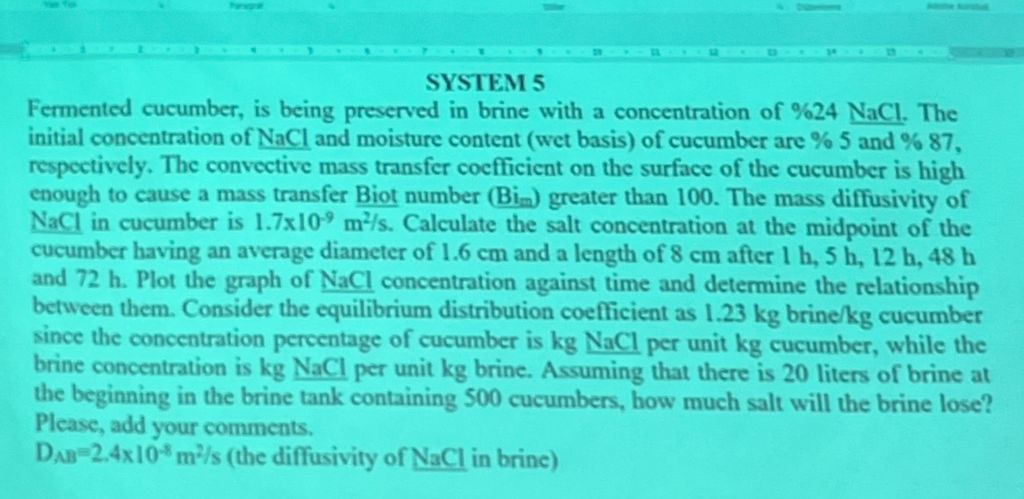 = me ge — COR IR ERC EES WH RO ICR TORN ERM TR
SYSTEM §
Fermented cucumber, is being preserved in brine with a concentration of %24 NaCl. The
initial concentration of NaCl and moisture content (wet basis) of cucumber are % 5 and % 87,
respectively. The convective mass transfer coefficient on the surface of the cucumber is high
enough to cause a mass transfer Biot number (Big) greater than 100. The mass diffusivity of
NaCl in cucumber is 17x10” m*/s. Calculate the salt concentration at the midpoint of the
cucumber having an average diameter of 1.6 cm and a length of 8 cm after 1 h, Sh, 12h,48 h
and 72 h. Plot the graph of NaCl concentration against time and determine the relationship
between them. Consider the equilibrium distribution coefficient as 1.23 kg brine/kg cucumber
since the concentration percentage of cucumber is kg NaCl per unit kg cucumber, while the
brine concentration is kg NaCl per unit kg brine. Assuming that there is 20 liters of brine at
the beginning in the brine tank containing S00 cucumbers, how much salt will the brine lose?
Please, add your comments.
Dan=2.4x10* ms (the diffusivity of NaCl in brine)
= me ge — COR IR ERC EES WH RO ICR TORN ERM TR
SYSTEM §
Fermented cucumber, is being preserved in brine with a concentration of %24 NaCl. The
initial concentration of NaCl and moisture content (wet basis) of cucumber are % 5 and % 87,
respectively. The convective mass transfer coefficient on the surface of the cucumber is high
enough to cause a mass transfer Biot number (Big) greater than 100. The mass diffusivity of
NaCl in cucumber is 17x10” m*/s. Calculate the salt concentration at the midpoint of the
cucumber having an average diameter of 1.6 cm and a length of 8 cm after 1 h, Sh, 12h,48 h
and 72 h. Plot the graph of NaCl concentration against time and determine the relationship
between them. Consider the equilibrium distribution coefficient as 1.23 kg brine/kg cucumber
since the concentration percentage of cucumber is kg NaCl per unit kg cucumber, while the
brine concentration is kg NaCl per unit kg brine. Assuming that there is 20 liters of brine at
the beginning in the brine tank containing S00 cucumbers, how much salt will the brine lose?
Please, add your comments.
Dan=2.4x10* ms (the diffusivity of NaCl in brine)
Asked by: vemuri swathi
Created at: 2025-12-24 13:52:15
Final Answer:
📢 Instructions:
- Ask anything relatd to above question only.
- For new Question goto :