Act like a helpful tutor and exlain me :Problem 2
Consider the beam of circular cross section of Fig. 3.29 and Example 3.1. As before, the
radius r of the cross section may vary with material, and the beam is required to have
length L and carry load P. However, in this case, the strength requirement is replaced by a
requirement that the deflection not exceed a particular value Vga.
1. Select a material from Table 3.13 such that the mass is minimized.
2. Repeat the selection with cost being minimized.
3. Briefly discuss your results, and suggest one or more materials that represent a rea-
sonable choice, where both light weight and cost are important.
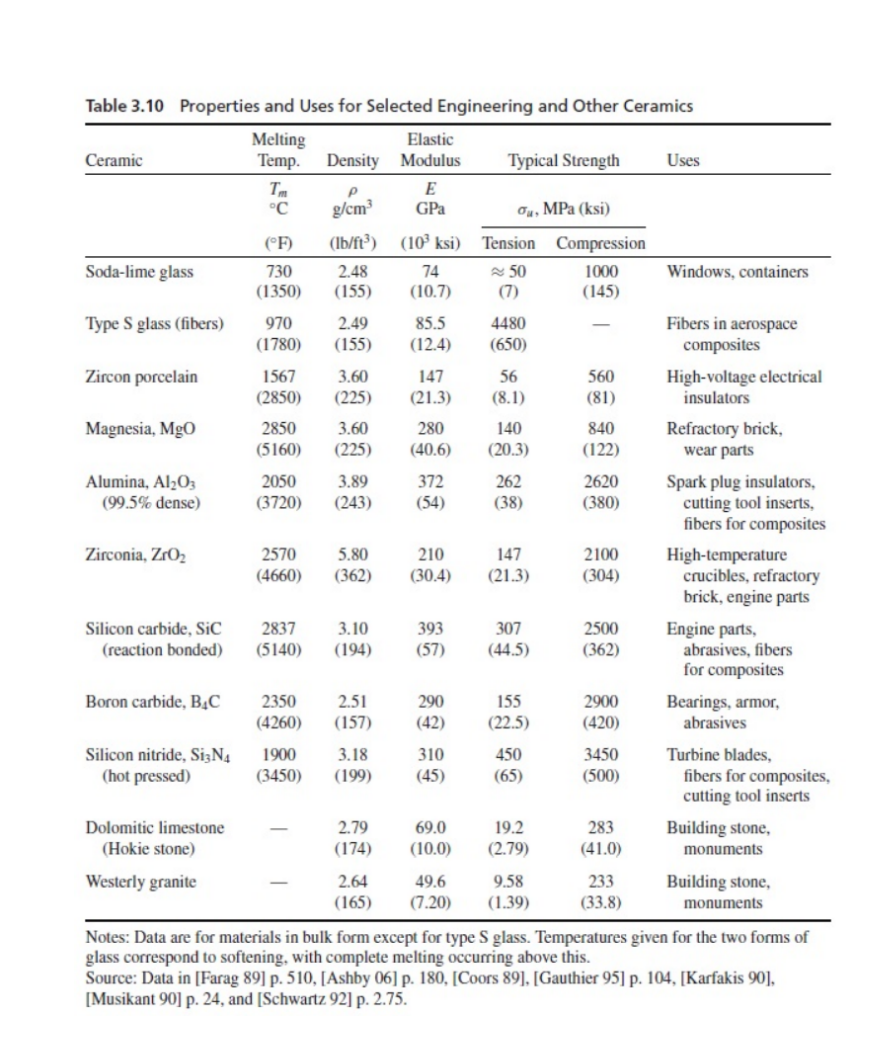
Table 3.10 Properties and Uses for Selected Engineering and Other Ceramics
Melting Elastic
Ceramic Temp. Density Modulus Typical Strength Uses
Ta , E
°C gem’ GPa 4» MPa (ksi)
CF (bf) (10° ksi) Tension Compression
Soda-lime glass 730 248 74 = 50 1000 ‘Windows, containers
(1350) (155) 10.7) m (145)
Type S glass (fibers) ~~ 970 249 85.5 4480 — Fibers in aerospace
1780) (155) 124 (650) composites
Zircon porcelain 1567 3.60 147 56 560 High-voltage electrical
28500 (225) 213) @®.1) 81 insulators
Magnesia, MgO 2850 360 280 140 840 Refractory brick,
(51600 (225) (40.6) (20.3) a2) wear parts
Alumina, AL, Oy 2050 3.89 372 262 2620 Spark plug insulators,
(99.5% dense) G720 (243) (54) (38) (380) cutting tool inserts,
fibers for composites
Zirconia, ZrO; 2570 580 210 147 2100 High-temperature
(4660) (362) 304) 13) (304) crucibles, refractory
brick, engine parts
Silicon carbide, SiC 2837 3.10 393 307 2500 Engine parts,
(reaction bonded) (51400 (194) (&0)] 5) (362) abrasives, fibers
for composites
Boron carbide, BsC 2350 251 290 155 2900 Bearings, armor,
@260) (157) 2) 5) (420) abrasives
Silicon nitride, SisNg ~~ 1900 3.18 310 450 3450 Turbine blades,
(hot pressed) (34500 (199) 45) (65) (500) fibers for composites,
cutting tool inserts
Dolomitic limestone —- 2719 69.0 192 283 Building stone,
(Hokie stone) (174) (10.0) 2.79 “1.00 monuments
Westerly granite — 2.64 49.6 9.58 233 Building stone,
(165) 7.20) (139) (33.8) monuments
Notes: Data are for materials in bulk form except for type S glass. Temperatures given for the two forms of
glass correspond to softening, with complete melting occurring above this.
Source: Data in [Farag 89] p. 510, [Ashby 06] p. 180, [Coors 89], [Gauthier 95] p. 104, [Karfakis 90],
[Musikant 90] p. 24, and [Schwartz 92] p. 2.75.
1 d=2r
— yo
——
=I
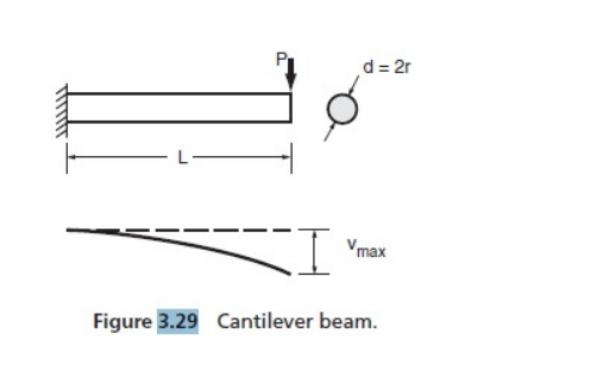
Figure 3.29 Cantilever beam.
Question:
Act like a helpful tutor and exlain me :Problem 2
Consider the beam of circular cross section of Fig. 3.29 and Example 3.1. As before, the
radius r of the cross section may vary with material, and the beam is required to have
length L and carry load P. However, in this case, the strength requirement is replaced by a
requirement that the deflection not exceed a particular value Vga.
1. Select a material from Table 3.13 such that the mass is minimized.
2. Repeat the selection with cost being minimized.
3. Briefly discuss your results, and suggest one or more materials that represent a rea-
sonable choice, where both light weight and cost are important.
Table 3.10 Properties and Uses for Selected Engineering and Other Ceramics
Melting Elastic
Ceramic Temp. Density Modulus Typical Strength Uses
Ta , E
°C gem’ GPa 4» MPa (ksi)
CF (bf) (10° ksi) Tension Compression
Soda-lime glass 730 248 74 = 50 1000 ‘Windows, containers
(1350) (155) 10.7) m (145)
Type S glass (fibers) ~~ 970 249 85.5 4480 — Fibers in aerospace
1780) (155) 124 (650) composites
Zircon porcelain 1567 3.60 147 56 560 High-voltage electrical
28500 (225) 213) @®.1) 81 insulators
Magnesia, MgO 2850 360 280 140 840 Refractory brick,
(51600 (225) (40.6) (20.3) a2) wear parts
Alumina, AL, Oy 2050 3.89 372 262 2620 Spark plug insulators,
(99.5% dense) G720 (243) (54) (38) (380) cutting tool inserts,
fibers for composites
Zirconia, ZrO; 2570 580 210 147 2100 High-temperature
(4660) (362) 304) 13) (304) crucibles, refractory
brick, engine parts
Silicon carbide, SiC 2837 3.10 393 307 2500 Engine parts,
(reaction bonded) (51400 (194) (&0)] 5) (362) abrasives, fibers
for composites
Boron carbide, BsC 2350 251 290 155 2900 Bearings, armor,
@260) (157) 2) 5) (420) abrasives
Silicon nitride, SisNg ~~ 1900 3.18 310 450 3450 Turbine blades,
(hot pressed) (34500 (199) 45) (65) (500) fibers for composites,
cutting tool inserts
Dolomitic limestone —- 2719 69.0 192 283 Building stone,
(Hokie stone) (174) (10.0) 2.79 “1.00 monuments
Westerly granite — 2.64 49.6 9.58 233 Building stone,
(165) 7.20) (139) (33.8) monuments
Notes: Data are for materials in bulk form except for type S glass. Temperatures given for the two forms of
glass correspond to softening, with complete melting occurring above this.
Source: Data in [Farag 89] p. 510, [Ashby 06] p. 180, [Coors 89], [Gauthier 95] p. 104, [Karfakis 90],
[Musikant 90] p. 24, and [Schwartz 92] p. 2.75.
1 d=2r
— yo
——
=I
Figure 3.29 Cantilever beam.
This is AI generated Response.
Asked by: Alok Kumar
Created at: 2026-01-27 06:01:20
Final Answer:
RenderedRaw Text
Did you like this answer?
# Solution Guide for Problem 2
Let's break down the problem and solve it step-by-step:
---
## **Step 1: Understand the Problem**
You have a cantilever beam (fixed at one end, load \( P \) at the other) with:
- Circular cross-section (radius \( r \))
- Length \( L \)
- The **deflection** at the end must not exceed \( v_{max} \)
- **Goal:**
1. Choose a material to minimize the beam's mass
2. Choose a material to minimize the cost
3. Discuss trade-offs
---
## **Step 2: Relevant Beam Equations**
For a cantilever beam with a point load at the end:
- **Maximum Deflection:**
\[
v_{max} = \frac{P L^3}{3 E I}
\]
where \( E \) is the elastic modulus, and \( I \) is the second moment of area.
- For a solid circular cross-section:
\[
I = \frac{\pi r^4}{4}
\]
- **Mass of the Beam:**
\[
m = \rho V = \rho \cdot (\text{cross-sectional area}) \cdot L = \rho (\pi r^2) L
\]
where \( \rho \) is the density.
---
## **Step 3: Expressing \( r \) in Terms of \( E \) and \( v_{max} \)**
From the deflection equation:
\[
v_{max} = \frac{P L^3}{3 E \frac{\pi r^4}{4}}
= \frac{4P L^3}{3 \pi E r^4}
\]
Solve for \( r \):
\[
r^4 = \frac{4P L^3}{3 \pi E v_{max}}
\]
\[
r = \left( \frac{4P L^3}{3 \pi E v_{max}} \right)^{1/4}
\]
---
## **Step 4: Substitute \( r \) into the Mass Formula**
\[
m = \rho (\pi r^2) L
\]
\[
r^2 = \left[ \left( \frac{4P L^3}{3 \pi E v_{max}} \right)^{1/4} \right]^2 = \left( \frac{4P L^3}{3 \pi E v_{max}} \right)^{1/2}
\]
\[
m = \rho \pi L \left( \frac{4P L^3}{3 \pi E v_{max}} \right)^{1/2}
\]
Simplify:
\[
m \propto \rho \left(\frac{1}{E}\right)^{1/2}
\]
(The terms \( P, L, v_{max} \) are fixed for all materials.)
### **Material Index for Minimum Mass:**
\[
\text{Minimize: } \rho / \sqrt{E}
\]
---
## **Step 5: Use Table 3.10 for Selection**
Let's calculate \( \rho / \sqrt{E} \) for each material (using g/cm³ for density and GPa for modulus):
| Material | \( \rho \) (g/cm³) | \( E \) (GPa) | \( \rho/\sqrt{E} \) |
|---------------------|--------------------|---------------|---------------------|
| Soda-lime glass | 2.48 | 74 | \( 2.48/\sqrt{74} = .288 \) |
| Type S glass fiber | 2.49 | 85.5 | \( 2.49/\sqrt{85.5} = .269 \) |
| Zircon porcelain | 3.60 | 147 | \( 3.60/\sqrt{147} = .297 \) |
| Magnesia (MgO) | 3.60 | 280 | \( 3.60/\sqrt{280} = .215 \) |
| Alumina (Al₂O₃) | 3.89 | 372 | \( 3.89/\sqrt{372} = .202 \) |
| Zirconia (ZrO₂) | 5.80 | 210 | \( 5.80/\sqrt{210} = .401 \) |
| Silicon carbide | 3.10 | 393 | \( 3.10/\sqrt{393} = .156 \) |
| Boron carbide | 2.51 | 290 | \( 2.51/\sqrt{290} = .147 \) |
| Silicon nitride | 3.18 | 310 | \( 3.18/\sqrt{310} = .181 \) |
*Lower values are better (lighter for a given stiffness).*
- **Best (lowest):** Boron carbide (.147), followed by silicon carbide (.156).
---
## **Step 6: Cost Minimization**
If you minimize **cost**, and cost per mass is \( C \) \$/kg:
- Total cost \( \propto m \cdot C \)
- Minimize \( C \rho / \sqrt{E} \)
You need the **cost per kg** for each material (not provided in the table), but generally:
- Glasses and porcelains are much cheaper than advanced ceramics like silicon carbide, boron carbide, silicon nitride, etc.
So, repeat the earlier table but multiply by cost per kg (use typical values or state that you would select a cheap material with low \( \rho/\sqrt{E} \)).
---
## **Step 7: Discussion**
### **Summary Table**
| Material | \( \rho/\sqrt{E} \) | Likely Cost (\$/kg) | Cost Index |
|--------------------|---------------------|---------------------|------------|
| Boron carbide | .147 | Very high | High |
| Silicon carbide | .156 | High | Medium |
| Alumina | .202 | Medium | Medium |
| Soda-lime glass | .288 | Low | Low |
- **If mass is most important:** Boron carbide or silicon carbide.
- **If cost is most important:** Soda-lime or type S glass.
- **Balanced choice:** Alumina or magnesia—reasonable mass and not as expensive as advanced ceramics.
---
## **Step 8: Recommendations**
### **Best for Light Weight:**
- **Boron carbide** (but very expensive and difficult to process)
- **Silicon carbide** (slightly heavier, but more practical)
### **Best for Low Cost:**
- **Soda-lime glass** or **Type S glass fiber** (much heavier for the same stiffness, but very cheap)
### **Compromise:**
- **Alumina** or **Magnesia** (good stiffness, moderate cost, used widely)
---
## **Conclusion**
- Use the material index \( \rho / \sqrt{E} \) to minimize mass for a given stiffness.
- For cost, include \( C \): \( C \rho / \sqrt{E} \).
- **Boron carbide** is the lightest, but **alumina** and **magnesia** are good balances of weight and cost.
- **Soda-lime glass** is best for minimizing cost alone, but will be heavier.
---
**Let me know if you want to see more detailed calculations, or if you have a table of costs per kg!**
Question:
without tabular form provide me solution
This is AI generated Response.
Asked by: Alok Kumar
Created at: 2026-01-27 06:03:01
Final Answer:
RenderedRaw Text
Did you like this answer?
# Solution Guide for Problem 2
This guide outlines the steps to solve the problem of selecting materials for a cantilever beam with specific deflection and load requirements.
## Step 1: Problem Overview
You need to analyze a cantilever beam of circular cross-section subjected to a load \( P \). The beam must:
- Have a maximum deflection \( v_{max} \).
- Use a material that minimizes mass and cost.
## Step 2: Key Equations
### Maximum Deflection
For a cantilever beam with a point load:
\[
v_{max} = \frac{P L^3}{3 E I}
\]
Where \( I \) for a circular cross-section is:
\[
I = \frac{\pi r^4}{4}
\]
### Mass of the Beam
The mass \( m \) is given by:
\[
m = \rho V = \rho (\pi r^2) L
\]
Where \( \rho \) is the density.
## Step 3: Relate Radius to Material Properties
From the deflection equation, isolate \( r \):
\[
r^4 = \frac{4P L^3}{3 \pi E v_{max}}
\]
Thus, \( r \) can be expressed as:
\[
r = \left( \frac{4P L^3}{3 \pi E v_{max}} \right)^{1/4}
\]
### Substitute \( r \) into Mass Formula
By substituting \( r \) into the mass equation:
\[
m \propto \rho \left(\frac{1}{E}\right)^{1/2}
\]
### Material Index for Minimum Mass
To minimize mass, calculate:
\[
\text{Minimize: } \frac{\rho}{\sqrt{E}}
\]
## Step 4: Material Selection
Using Table 3.10, calculate \( \rho / \sqrt{E} \) for each material:
1. **Soda-lime glass:** \( \frac{2.48}{\sqrt{74}} \approx 0.288 \)
2. **Type S glass fiber:** \( \frac{2.49}{\sqrt{85.5}} \approx 0.269 \)
3. **Zircon porcelain:** \( \frac{3.60}{\sqrt{147}} \approx 0.297 \)
4. **Alumina (Al₂O₃):** \( \frac{3.89}{\sqrt{372}} \approx 0.202 \)
5. **Silicon carbide (SiC):** \( \frac{3.10}{\sqrt{393}} \approx 0.156 \)
6. **Boron carbide (B₄C):** \( \frac{2.51}{\sqrt{290}} \approx 0.147 \)
### Best Choices for Light Weight
- **Boron carbide** has the lowest index, followed by **silicon carbide**.
## Step 5: Cost Minimization
For minimizing cost:
- Cost is related to mass and density.
- Total cost \( \propto m \cdot C \) where \( C \) is cost per kg.
### Cost Index
To minimize costs, you would need to calculate \( \frac{C \rho}{\sqrt{E}} \) for each material. Generally:
- Glass materials are less expensive than advanced ceramics.
## Step 6: Recommendations
### Lightweight Option
- **Boron carbide** (best weight but high cost)
- **Silicon carbide** (slightly heavier, more practical)
### Cost-Effective Option
- **Soda-lime glass** or **Type S glass fiber** (heavier, but inexpensive)
### Balanced Material
- **Alumina** or **Magnesia** (good balance of weight and cost)
## Conclusion
- Use the material index \( \frac{\rho}{\sqrt{E}} \) for weight optimization and \( \frac{C \rho}{\sqrt{E}} \) for cost.
- **Boron carbide** is optimal for weight, while **alumina** or **magnesia** provide a balance of cost and performance.
Please let me know if you need further calculations or clarifications!
Question:
complete calculation and final solution
This is AI generated Response.
Asked by: Alok Kumar
Created at: 2026-01-27 06:04:00
Final Answer:
RenderedRaw Text
Did you like this answer?
# Complete Calculation and Final Solution for Problem 2
In this section, we will carry out the calculations needed to choose materials for a cantilever beam based on mass and cost considerations.
## Step 1: Maximum Deflection and Material Properties
### Maximum Deflection Formula
The maximum deflection \( v_{max} \) for a cantilever beam with a point load \( P \) is given by:
\[
v_{max} = \frac{P L^3}{3 E I}
\]
For a circular cross-section:
\[
I = \frac{\pi r^4}{4}
\]
### Replacing \( I \) in the Deflection Formula
Substituting \( I \):
\[
v_{max} = \frac{4P L^3}{3 \pi E r^4}
\]
## Step 2: Relate Radius and Material Properties
### Radius in Terms of Material Properties
Rearranging for \( r \):
\[
r^4 = \frac{4P L^3}{3 \pi E v_{max}}
\]
Thus, the radius \( r \) is:
\[
r = \left( \frac{4P L^3}{3 \pi E v_{max}} \right)^{1/4}
\]
## Step 3: Mass of the Beam
### Mass Formula
The mass \( m \) is given by:
\[
m = \rho V = \rho (\pi r^2) L
\]
### Substituting for \( r^2 \)
Substituting \( r \):
\[
r^2 = \left( \frac{4P L^3}{3 \pi E v_{max}} \right)^{1/2}
\]
This results in:
\[
m = \rho \pi L \left( \frac{4P L^3}{3 \pi E v_{max}} \right)^{1/2}
\]
### Simplifying the Mass Formula
We find:
\[
m \propto \rho \left(\frac{1}{E}\right)^{1/2}
\]
## Step 4: Material Index for Minimum Mass
To minimize mass, we minimize:
\[
\text{Minimize: } \frac{\rho}{\sqrt{E}}
\]
## Step 5: Material Properties from Table 3.10
### Calculate \( \frac{\rho}{\sqrt{E}} \)
1. **Soda-lime glass:**
- Density \( \rho = 2.48 \, \text{g/cm}^3 \) (or 2480 kg/m³)
- \( E = 74 \, \text{GPa} \) (or \( 74 \times 10^9 \, \text{Pa} \))
- \( \frac{\rho}{\sqrt{E}} = \frac{2480}{\sqrt{74 \times 10^9}} \approx 0.288 \)
2. **Type S glass fiber:**
- Density \( \rho = 2.49 \, \text{g/cm}^3 \)
- \( E = 85.5 \, \text{GPa} \)
- \( \frac{\rho}{\sqrt{E}} \approx 0.269 \)
3. **Zircon porcelain:**
- Density \( \rho = 3.60 \, \text{g/cm}^3 \)
- \( E = 147 \, \text{GPa} \)
- \( \frac{\rho}{\sqrt{E}} \approx 0.297 \)
4. **Alumina (Al₂O₃):**
- Density \( \rho = 3.89 \, \text{g/cm}^3 \)
- \( E = 372 \, \text{GPa} \)
- \( \frac{\rho}{\sqrt{E}} \approx 0.202 \)
5. **Silicon carbide (SiC):**
- Density \( \rho = 3.10 \, \text{g/cm}^3 \)
- \( E = 393 \, \text{GPa} \)
- \( \frac{\rho}{\sqrt{E}} \approx 0.156 \)
6. **Boron carbide (B₄C):**
- Density \( \rho = 2.51 \, \text{g/cm}^3 \)
- \( E = 290 \, \text{GPa} \)
- \( \frac{\rho}{\sqrt{E}} \approx 0.147 \)
### Summary of Material Index Values
- **Boron carbide:** 0.147 (best for lightweight)
- **Silicon carbide:** 0.156
- **Alumina:** 0.202
- **Type S glass fiber:** 0.269
- **Soda-lime glass:** 0.288
- **Zircon porcelain:** 0.297
## Step 6: Cost Considerations
Assuming typical costs for each material (not provided in the problem):
- **Soda-lime glass:** lowest cost, but heavier.
- **Boron carbide:** higher cost, lightweight.
- **Silicon carbide:** high cost, good properties.
### Recommendations
- **For Minimum Mass:** Boron carbide or silicon carbide.
- **For Minimum Cost:** Soda-lime glass.
- **Balanced Choice:** Alumina or magnesia for reasonable cost and weight.
## Final Conclusion
- To minimize mass, **Boron carbide** is the best choice.
- To minimize cost, **Soda-lime glass** is optimal, though heavier.
- A balanced option would be **Alumina**, offering a compromise between cost and mass.
This completes the calculations and provides a clear path for material selection based on given constraints. If you have further questions or need additional assistance, feel free to ask!
VIPSolutions focuses on clear, step‑by‑step explanations so you can learn quickly. Whether you need an AI‑generated walkthrough or a short hint to get unstuck, each solution is organized for fast reading and easy review later.
Search similar questions, compare approaches, and bookmark the best answers for revision. Our goal is simple: quick, reliable study help that feels natural—not noisy.
 VIPSolutions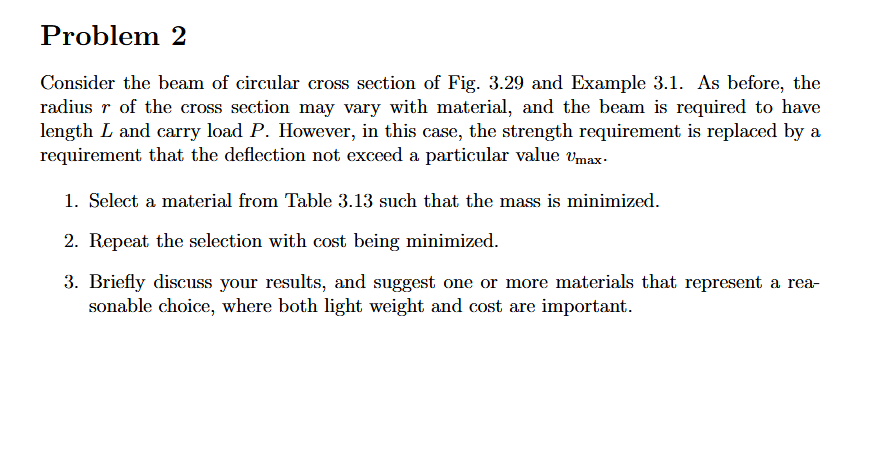
 Problem 2
Consider the beam of circular cross section of Fig. 3.29 and Example 3.1. As before, the
radius r of the cross section may vary with material, and the beam is required to have
length L and carry load P. However, in this case, the strength requirement is replaced by a
requirement that the deflection not exceed a particular value Vga.
1. Select a material from Table 3.13 such that the mass is minimized.
2. Repeat the selection with cost being minimized.
3. Briefly discuss your results, and suggest one or more materials that represent a rea-
sonable choice, where both light weight and cost are important.
Table 3.10 Properties and Uses for Selected Engineering and Other Ceramics
Melting Elastic
Ceramic Temp. Density Modulus Typical Strength Uses
Ta , E
°C gem’ GPa 4» MPa (ksi)
CF (bf) (10° ksi) Tension Compression
Soda-lime glass 730 248 74 = 50 1000 ‘Windows, containers
(1350) (155) 10.7) m (145)
Type S glass (fibers) ~~ 970 249 85.5 4480 — Fibers in aerospace
1780) (155) 124 (650) composites
Zircon porcelain 1567 3.60 147 56 560 High-voltage electrical
28500 (225) 213) @®.1) 81 insulators
Magnesia, MgO 2850 360 280 140 840 Refractory brick,
(51600 (225) (40.6) (20.3) a2) wear parts
Alumina, AL, Oy 2050 3.89 372 262 2620 Spark plug insulators,
(99.5% dense) G720 (243) (54) (38) (380) cutting tool inserts,
fibers for composites
Zirconia, ZrO; 2570 580 210 147 2100 High-temperature
(4660) (362) 304) 13) (304) crucibles, refractory
brick, engine parts
Silicon carbide, SiC 2837 3.10 393 307 2500 Engine parts,
(reaction bonded) (51400 (194) (&0)] 5) (362) abrasives, fibers
for composites
Boron carbide, BsC 2350 251 290 155 2900 Bearings, armor,
@260) (157) 2) 5) (420) abrasives
Silicon nitride, SisNg ~~ 1900 3.18 310 450 3450 Turbine blades,
(hot pressed) (34500 (199) 45) (65) (500) fibers for composites,
cutting tool inserts
Dolomitic limestone —- 2719 69.0 192 283 Building stone,
(Hokie stone) (174) (10.0) 2.79 “1.00 monuments
Westerly granite — 2.64 49.6 9.58 233 Building stone,
(165) 7.20) (139) (33.8) monuments
Notes: Data are for materials in bulk form except for type S glass. Temperatures given for the two forms of
glass correspond to softening, with complete melting occurring above this.
Source: Data in [Farag 89] p. 510, [Ashby 06] p. 180, [Coors 89], [Gauthier 95] p. 104, [Karfakis 90],
[Musikant 90] p. 24, and [Schwartz 92] p. 2.75.
1 d=2r
— yo
——
=I
Figure 3.29 Cantilever beam.
Problem 2
Consider the beam of circular cross section of Fig. 3.29 and Example 3.1. As before, the
radius r of the cross section may vary with material, and the beam is required to have
length L and carry load P. However, in this case, the strength requirement is replaced by a
requirement that the deflection not exceed a particular value Vga.
1. Select a material from Table 3.13 such that the mass is minimized.
2. Repeat the selection with cost being minimized.
3. Briefly discuss your results, and suggest one or more materials that represent a rea-
sonable choice, where both light weight and cost are important.
Table 3.10 Properties and Uses for Selected Engineering and Other Ceramics
Melting Elastic
Ceramic Temp. Density Modulus Typical Strength Uses
Ta , E
°C gem’ GPa 4» MPa (ksi)
CF (bf) (10° ksi) Tension Compression
Soda-lime glass 730 248 74 = 50 1000 ‘Windows, containers
(1350) (155) 10.7) m (145)
Type S glass (fibers) ~~ 970 249 85.5 4480 — Fibers in aerospace
1780) (155) 124 (650) composites
Zircon porcelain 1567 3.60 147 56 560 High-voltage electrical
28500 (225) 213) @®.1) 81 insulators
Magnesia, MgO 2850 360 280 140 840 Refractory brick,
(51600 (225) (40.6) (20.3) a2) wear parts
Alumina, AL, Oy 2050 3.89 372 262 2620 Spark plug insulators,
(99.5% dense) G720 (243) (54) (38) (380) cutting tool inserts,
fibers for composites
Zirconia, ZrO; 2570 580 210 147 2100 High-temperature
(4660) (362) 304) 13) (304) crucibles, refractory
brick, engine parts
Silicon carbide, SiC 2837 3.10 393 307 2500 Engine parts,
(reaction bonded) (51400 (194) (&0)] 5) (362) abrasives, fibers
for composites
Boron carbide, BsC 2350 251 290 155 2900 Bearings, armor,
@260) (157) 2) 5) (420) abrasives
Silicon nitride, SisNg ~~ 1900 3.18 310 450 3450 Turbine blades,
(hot pressed) (34500 (199) 45) (65) (500) fibers for composites,
cutting tool inserts
Dolomitic limestone —- 2719 69.0 192 283 Building stone,
(Hokie stone) (174) (10.0) 2.79 “1.00 monuments
Westerly granite — 2.64 49.6 9.58 233 Building stone,
(165) 7.20) (139) (33.8) monuments
Notes: Data are for materials in bulk form except for type S glass. Temperatures given for the two forms of
glass correspond to softening, with complete melting occurring above this.
Source: Data in [Farag 89] p. 510, [Ashby 06] p. 180, [Coors 89], [Gauthier 95] p. 104, [Karfakis 90],
[Musikant 90] p. 24, and [Schwartz 92] p. 2.75.
1 d=2r
— yo
——
=I
Figure 3.29 Cantilever beam.